
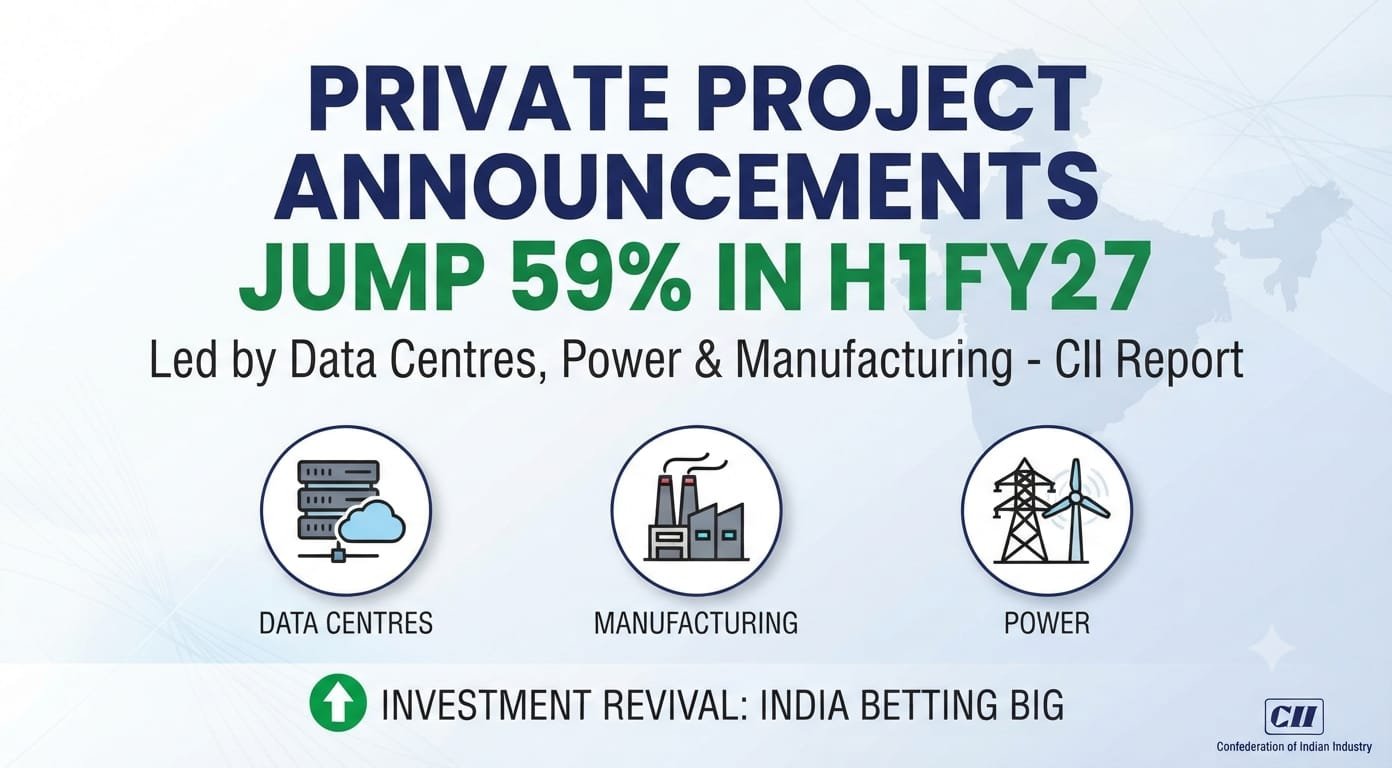
India’s private companies are spending with fresh confidence. According to the second edition of the CII Private Investment Barometer, private sector project announcements rose 58.5% year-on-year to Rs 26.6 lakh crore in the first half of FY27, which covers April to September 2026. That is 4.4 times the average for the first halves of FY17 to FY25. In simple terms, businesses are announcing far more factories, power plants and digital facilities than they did in most of the past decade.
Private firms are also taking a larger share of the total. Their share of all project announcements climbed to 86.2%, up from 74.2% a year earlier. The private sector, and not only the government, is now driving the new investment cycle. This matters because private money usually brings jobs, supplier orders and new technology, and it can keep growth going for years.
Announcements are only plans, so actual spending is the real test. Here, too, the numbers look encouraging. Around 1,800 listed private companies spent Rs 12.4 lakh crore on gross capital formation in FY26, equal to 3.6% of nominal GDP. From FY17 to FY21, the average was only 2.2%. On a like-for-like basis, investment by the same set of firms grew 8.7% in FY26. Some 54% of companies raised their fixed investment rates, and nearly three-fourths added net productive capacity, which means more machines, plants and output.
Plans are also turning into finished work. Private project completions between April and September 2026 reached Rs 1.8 lakh crore, the highest for that period since FY17. Ideas are therefore moving from paper to production, and that is what ultimately creates employment and income.
The sector-wise picture shows where the money is heading. Information technology projects, mostly data centres and AI-related infrastructure, were the biggest at around Rs 9.5 lakh crore. In the same period a year earlier, they stood at just Rs 70,000 crore. Manufacturing came next with Rs 8.1 lakh crore, which is 3.2 times its historical average. Electricity followed with Rs 7.7 lakh crore, a striking 5.1 times its historical average. Together these show a country preparing for a digital future while also building the factories and power supply to support it.
CII President R Mukundan said these trends show that Indian industry is responding to the opportunities created by government reforms. He noted that private enterprises are investing in manufacturing, infrastructure, energy, digital technologies and emerging sectors, backed by stronger balance sheets and growing confidence in India’s economic prospects. He added that reaching Viksit Bharat will need industry to work together as “Team Bharat”.
When companies build more, they hire more, buy more from small suppliers and create demand for transport, housing and services nearby. Data centres need power, power plants need equipment, and factories need workers, so one investment often sets off many others. That chain can lift local economies far beyond the big cities.
A few cautions remain. Announcements do not always become completed projects, as delays in land, approvals or funding can slow them. Even so, rising spending, record completions and stronger company balance sheets suggest that this wave rests on more than hope. If the momentum holds, the second half of FY27 could show whether India’s private investment revival is truly lasting.

