
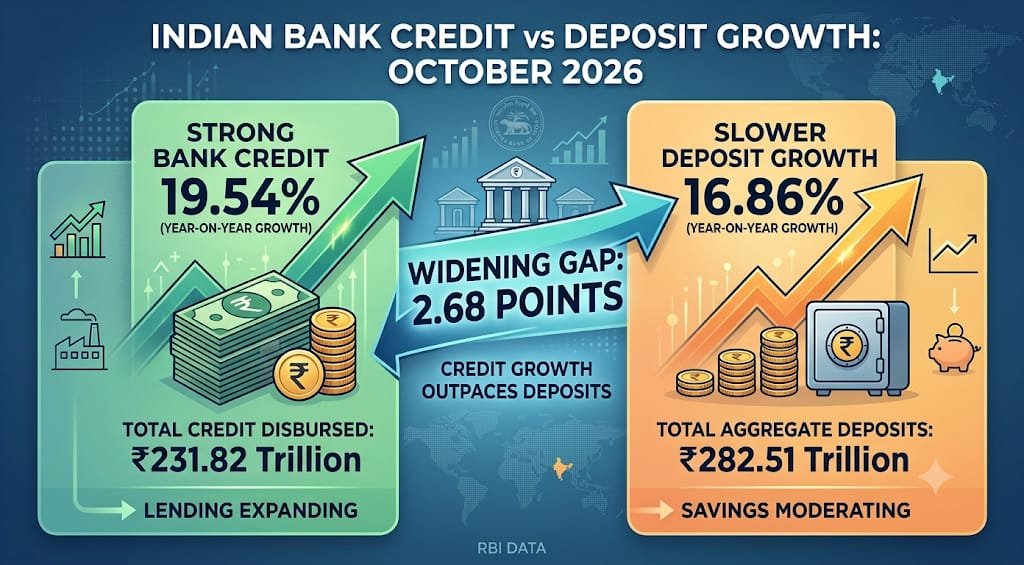
Bank lending maintained its strong pace in October, with credit growth staying above 19% for the fourth consecutive month. Outstanding bank credit increased 19.54% from a year earlier as of October 31, 2026, according to Reserve Bank of India data reported on November 13. Deposit growth, however, slowed to 16.86%, showing that money held in bank accounts was increasing more slowly than lending.
The figures show two different trends within the banking system. Loans continued to expand at a steady rate, while deposit growth became less consistent. Credit growth remained between 19.08% and 19.54% at successive month-ends from July through October. This means the annual increase in outstanding lending stayed within a narrow range rather than moving sharply from one month to another.
Deposits followed a different path. Their annual growth eased from 17.83% at the end of September to 16.86% in October. Deposits still increased compared with the previous year, but the pace of that increase weakened. Slower growth should therefore not be confused with a fall in the total amount deposited with banks. The distinction matters when understanding the latest numbers.
As lending grew faster than deposits, the difference between their growth rates widened. The gap reached 2.68 percentage points at the end of October, compared with 1.55 percentage points at the end of July. These figures compare annual growth rates, not the actual rupee amounts of loans and deposits.
Total deposits remained higher than outstanding bank credit despite their slower growth. Outstanding bank credit stood at ₹231.82 trillion at the end of the fortnight ending October 31. That represented an increase of ₹37.89 trillion over the year.
Aggregate deposits reached ₹282.51 trillion, rising by ₹40.75 trillion during the same period. In simple terms, banks added a larger rupee amount in deposits than in credit, even though deposits recorded the lower percentage growth rate. The fortnightly movement also showed lending advancing more quickly. Bank credit increased by ₹4.4 trillion, or 1.9%, while aggregate deposits rose by ₹3.75 trillion, or 1.3%.
Over this shorter period, credit therefore recorded both a bigger rupee increase and a faster percentage rise. The annual and fortnightly figures together underline the difference between lending momentum and deposit expansion.
However, the strong lending pace may not continue unchanged. CareEdge expects credit growth to moderate during the second half of financial year 2026–27.
It pointed to a less favourable comparison base and higher borrowing costs following the RBI’s latest interest rate increase. This is an outlook rather than a confirmed slowdown; October’s figures still showed credit growth holding above the 19% mark.
The RBI raised the repo rate by 25 basis points to 5.50% at its October 7 policy review. Economists expected another 50–75 basis points of increases.
The picture is therefore one of strong lending alongside slower deposit growth, with borrowing costs becoming an important factor in the months ahead. Whether lending maintains its pace will be closely watched as these conditions develop. For now, October marks another month of sustained credit expansion, rather than evidence that the expected moderation has already arrived.

