
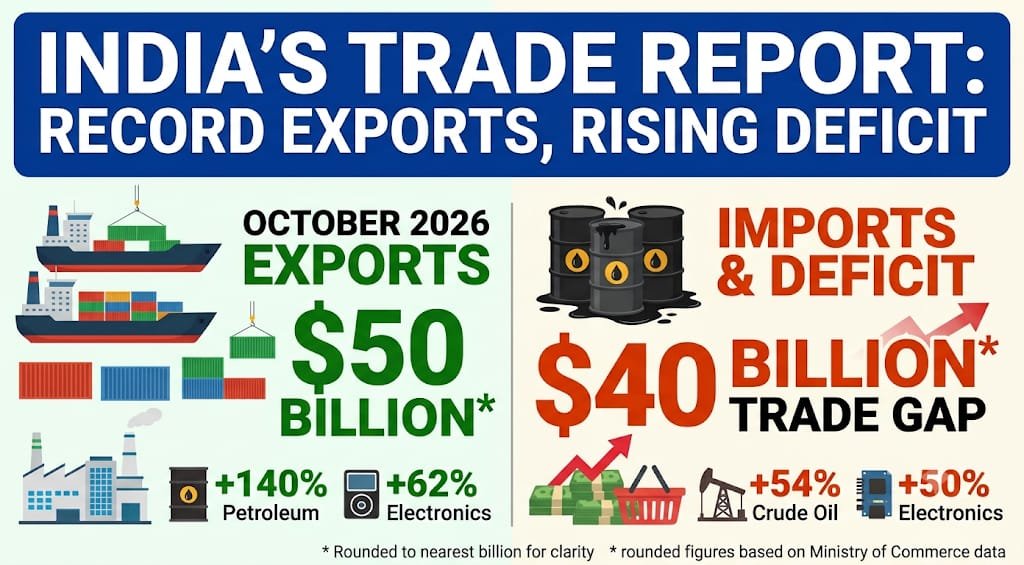
India’s merchandise exports touched a historic high of $49.47 billion in October 2026, registering a 45.06 per cent increase from $34.11 billion in October 2025. According to data released by the Ministry of Commerce and Industry, this was the highest-ever monthly merchandise export value and the strongest monthly export growth recorded in the past five years. The performance highlights the growing strength of Indian industries and their ability to expand shipments across international markets.
Petroleum products and electronic goods emerged as the biggest contributors to export growth. Petroleum product exports surged 140 per cent to $8.89 billion, while electronic goods exports increased 62 per cent to $6.64 billion.
Engineering goods also performed strongly, recording 36 per cent growth during the month. Commerce Secretary Rajesh Agrawal noted that export expansion was spread across multiple sectors and destinations, indicating broad-based improvement rather than growth driven by a single industry.
India’s export performance remained strong even after excluding petroleum, gems and jewellery. Non-oil and non-gems-and-jewellery exports increased nearly 32 per cent to $37.38 billion, compared with $28.11 billion a year earlier.
This indicates that the growth extended beyond petroleum shipments and reflected improving competitiveness across manufacturing sectors. Industry representatives also highlighted the role of free trade agreements and improved access to international markets in helping Indian exporters reach new customers.
The United States continued to be a major destination for Indian goods. Exports to the US rose 39.3 per cent to $8.72 billion in October, compared with $6.26 billion in the corresponding month last year.
Shipments to China increased 48 per cent, while exports to Japan grew 45 per cent. India also recorded export growth of more than 50 per cent to the United Kingdom, Taiwan and Kenya. This expansion across developed and emerging markets reflects India’s growing presence in global trade.
However, the record export performance came alongside rising imports. Merchandise imports increased 16 per cent to $89.35 billion in October from $76.69 billion a year earlier. Consequently, India’s merchandise trade deficit stood at $39.88 billion, close to $40 billion.
Although this was slightly lower than the $42.58 billion deficit recorded in October 2025, it was the highest monthly trade deficit of calendar year 2026.
Crude oil remained the biggest contributor to the rising import bill. Petroleum imports jumped 54 per cent to $22.81 billion. India imports nearly 85 per cent of its crude oil requirements, making its economy particularly sensitive to international oil prices.
The conflict in West Asia and disruptions associated with the Iran war pushed Brent crude prices to around $115 per barrel during October before easing to approximately $92.
Electronic goods imports also increased nearly 50 per cent to $14.31 billion. The rise reflects growing demand for components, machinery and technology products required by domestic manufacturing and consumption.
While these imports support industrial production and can strengthen future exports, they also increase the country’s import expenditure in the short term. Imports from Russia rose 74 per cent, while those from China increased 46 per cent.
Meanwhile, gold and silver imports declined despite the festive season. Gold imports fell 62 per cent to $5.51 billion, while silver imports dropped 28.26 per cent to $1.91 billion. The decline provided some relief to the overall import bill but could not offset higher spending on crude oil and electronics.
Including services, India’s total exports reached an estimated $89.99 billion in October 2026, marking another all-time monthly record. Overall export growth stood at 29.90 per cent, the third-highest monthly growth rate in the past five years.
October’s trade figures present a mixed but significant picture of India’s economic performance. Record exports demonstrate the expanding capabilities of Indian manufacturers and exporters, while the widening import pressure highlights the country’s continued dependence on imported energy and technology products.
The priority ahead will be to sustain export momentum through stronger domestic manufacturing, diversified energy sources, improved supply chains and greater value addition. India’s record export performance signals growing global competitiveness, but reducing import dependence will remain essential for achieving a more balanced and resilient trade position.

