
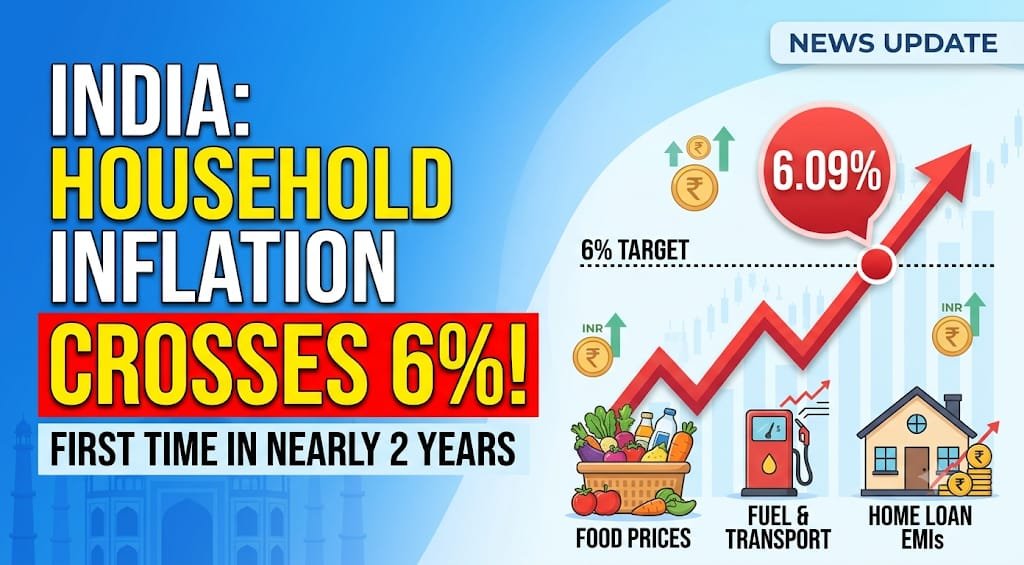
India’s household inflation has moved above 6 percent for the first time in nearly two years, making everyday spending more difficult for families across the country. In October, the Consumer Price Index-based inflation rate rose to 6.09 percent, up from 5.54 percent in September. This was the twelfth consecutive month in which inflation increased, and it crossed the upper limit of the Reserve Bank of India’s inflation target.
The rise has been driven largely by higher food prices and an unfavourable base effect. A base effect simply means that prices are being compared with a relatively low level from the same month last year, which can make the current inflation number appear higher. However, the main concern is not only the statistical effect; food prices have been rising in a way that directly affects household budgets, especially for essentials such as vegetables, pulses, edible oils and other daily-use items.
The Reserve Bank of India is legally required to keep inflation around 4 percent, with a flexible range of 2 to 6 percent. Inflation has remained above 4 percent for five months in a row. The latest reading of 6.09 percent has now crossed the 6 percent upper boundary for the first time since October 2024. This makes price control a major priority for the central bank, because persistent inflation reduces the purchasing power of money and makes it harder for ordinary families to manage monthly expenses.
For households, the impact is very practical. When inflation rises, the same amount of money buys fewer goods and services than before. A family that spends a fixed amount on groceries, transport, school-related costs and household needs may find that its monthly budget no longer covers the same basket of items. Food inflation is especially important because food takes a large share of spending for many Indian households. Even a small increase in the price of essential food items can quickly change the overall household budget.
The pressure is now clearly on the RBI to act further. Last month, the central bank’s Monetary Policy Committee increased the policy repo rate by 25 basis points to 5.5 percent. Economists widely expect another rate hike at the committee’s next meeting, scheduled for December 2 to 4. A higher repo rate generally makes borrowing more expensive for banks, which can then pass on higher interest costs to borrowers.
This has a direct connection with common financial decisions. Home loan EMIs, vehicle loans, personal loans and credit-card interest can become costlier when lending rates rise. At the same time, higher interest rates may offer better returns on fixed deposits and savings instruments. However, for families already dealing with higher daily expenses, the benefit from higher deposit rates may not immediately offset the pressure created by costlier loans and rising prices.
The RBI’s latest forecast suggests that the inflation challenge may continue for some time. It expects CPI inflation to average 6 percent during October to December, 5.7 percent during January to March 2027, and 5.6 percent during April to June 2027. These projections indicate that inflation is likely to remain above the RBI’s 4 percent target in the coming quarters, even if it may ease gradually from the current high level.
What makes the situation more complicated is that the Indian economy continues to grow strongly. GDP growth in April to June was unexpectedly high at 7.8 percent, and economists expect a similar pace in July to September.
BofA Securities economists Rahul Bajoria and Smriti Mehra have projected 7.7 percent growth for the second quarter of 2026-27, higher than the RBI’s forecast of 7.2 percent and the Finance Ministry’s estimate of 7.35 percent. Strong growth usually supports jobs and incomes, but it can also keep demand high, which may make it harder to bring inflation down quickly.
There are also external risks. Global geopolitics can affect crude oil prices, and changes in oil prices often influence transport costs, production costs and ultimately consumer prices in India.
Weather-related risks, including the possible impact of El Nino, can also affect agricultural output and food supply. Since food inflation is a major driver of the current rise, any disruption in crop production, supply chains or rainfall patterns could keep prices elevated.
Economists at BofA Securities expect the RBI to increase interest rates by another 75 basis points over the next six to nine months. They believe this tightening cycle could raise credit costs and soften consumer demand at the margin.
In simple terms, costlier loans may reduce some spending on big-ticket purchases, while higher interest rates can help cool demand and control inflation. But this policy trade-off is delicate because excessive tightening could also slow economic growth.
The bigger message is that inflation is no longer only a number discussed by economists and policymakers. It is now visible in kitchen budgets, fuel expenses, loan repayments and monthly household planning.
With inflation above the RBI’s upper tolerance limit and food prices under pressure, the coming months will be important for both consumers and policymakers. The RBI faces the challenge of controlling prices without weakening the strong growth momentum in the economy.

