
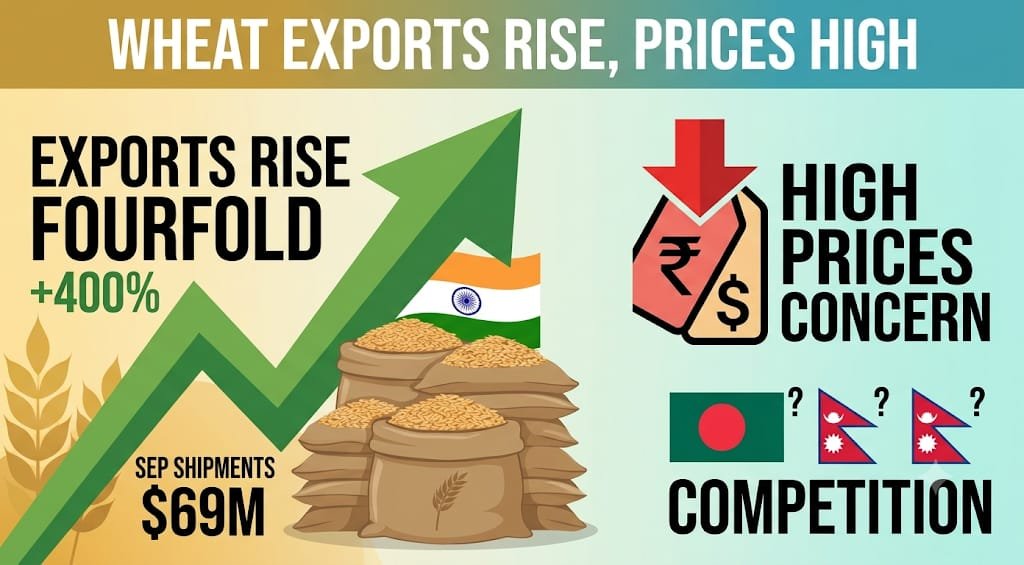
India’s wheat exports rose sharply in September, a month after the government lifted the export ban. Shipments reached $69 million, compared with $16.1 million in August, according to commerce department data. The increase brought fresh activity for traders after years of restrictions.
However, the recovery faces a challenge: Indian wheat remains expensive compared with supplies available from competing countries.
The rise was visible in both earnings and quantities. Wheat exports increased from 55,521 tonnes in August to 222,420 tonnes in September. Earlier shipments stood at 45,163 tonnes in April, 75,012 tonnes in May, 26,052 tonnes in June and 40,759 tonnes in July. September therefore marked a clear improvement over the previous months, although one strong month does not establish a lasting recovery.
Several factors supported the September jump. Demand increased in neighbouring countries, movements in currencies made purchases more favourable, and some competing suppliers faced disruptions. These conditions created an opening for Indian exporters. Bangladesh accounted for most shipments, followed by Nepal, while Sri Lanka also purchased Indian wheat during the month.
Across April–September of FY27, Bangladesh remained the largest destination, buying wheat worth $48.68 million. Nepal followed with $44.56 million, while Sri Lanka purchased $10.17 million. The United Arab Emirates and Somalia were also among the leading destinations, with purchases worth $9.94 million and $2 million, respectively. These figures show the importance of nearby markets to India’s wheat trade.
The earlier export restrictions were introduced in 2022, when global wheat prices rose following the Russia–Ukraine war. At that time, the government’s priority was to protect domestic availability, contain prices and meet food-security requirements. Restricting overseas sales helped keep more wheat available within the country instead of allowing international demand to pull supplies away from the domestic market.
The supply position has since improved. Wheat stocks in the central pool stood at 46.31 million tonnes on October 1, 2026, against a prescribed buffer requirement of 20.52 million tonnes. That larger cushion provided room for exports while maintaining reserves.
The agriculture ministry’s first estimate placed wheat production at a record 120.7 million tonnes for the 2026–27 crop year, compared with the previous year’s 117.9 million tonnes.
Still, plentiful stocks do not automatically make Indian wheat attractive abroad. Exporters said domestic prices remained high, partly because the minimum support price influences market prices.
Indian wheat was quoted at around ₹2,900–₹2,980 per quintal, while prices at Bangladesh ports were around ₹3,100–₹3,200. A quintal equals 100 kilograms, making even a modest price difference important when buyers order large quantities.
Bangladesh’s demand was also being supported by lower stocks. However, buyers could turn to other suppliers if their wheat became cheaper. Exporters therefore remained cautious about a substantial increase in business, even after September’s strong performance.
The government also signalled that permission to export was not a permanent guarantee. Foreign trade officials said international prices, domestic supply and food-security needs would continue to guide decisions.
Wheat exports would remain under review, with restrictions possible if circumstances changed. The immediate picture is encouraging for traders, but sustained growth will depend on competitive prices alongside adequate supplies at home.

