
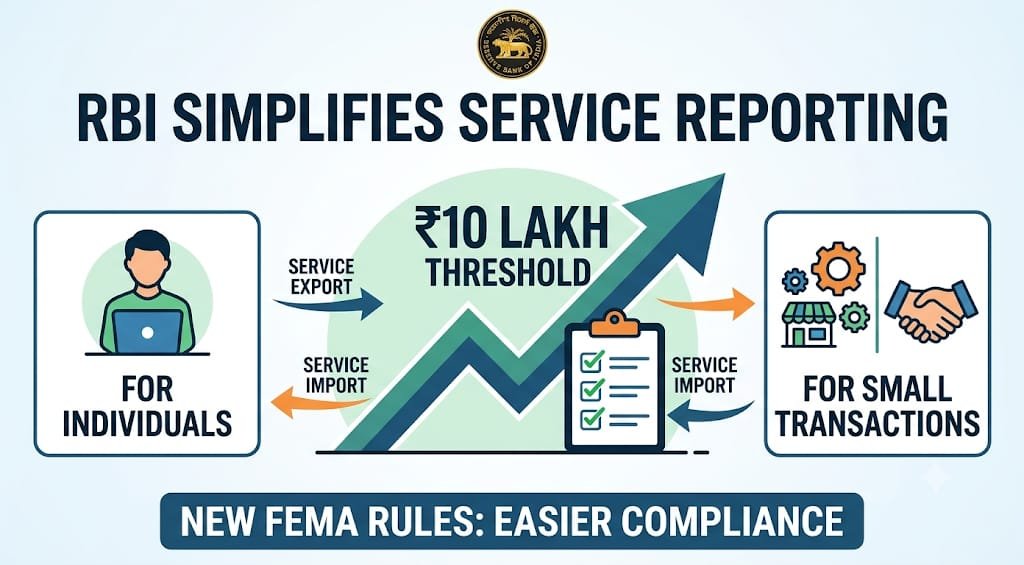
The Reserve Bank of India has made an important change in the rules related to foreign exchange transactions for services. Through the Foreign Exchange Management (Export and Import of Goods and Services) (Second Amendment) Regulations, 2026, notified on November 2, the central bank has simplified the reporting process for people and businesses that receive or make payments for services from abroad. These changes have come into effect retrospectively from October 1, 2026, and they amend the main FEMA regulations issued in January 2026.
The biggest relief is for resident individuals who export services. A resident individual means a natural person living in India. Earlier, such a person had to separately complete the Export Declaration Form, commonly called EDF, for reporting service exports.
Now, once the individual gives the required information to an Authorised Dealer, usually a bank, for crediting the foreign payment into the account, the person will be considered to have submitted the EDF. In simple words, the bank will handle the reporting process when the payment is received, so the individual will not need to file a separate declaration.
This change is likely to help freelancers, consultants, professionals, small service providers, and others who earn income from clients outside India. Many such people receive payments through banks for services such as software work, design, writing, teaching, consulting, or other professional support. With the new arrangement, the process of receiving foreign money and meeting FEMA requirements becomes less confusing and less time-consuming.
The RBI has also extended a similar benefit to service exporters who are not resident individuals, such as companies, firms, or other entities. However, for them, the simplified EDF treatment applies only when the value of the inward remittance does not exceed Rs 10 lakh or its equivalent in foreign currency.
This means smaller service-export payments can be treated as reported once the necessary details are given to the Authorised Dealer for crediting the amount. For resident individuals, no separate monetary limit has been specified under this provision.
The amendment also changes the reporting requirement for the import of services. Import of services means payment made to a foreign service provider, for example, paying a foreign company for software, consultancy, legal advice, marketing support, or technical services.
Earlier, Authorised Dealers had to enter the details of all service imports in the Import Data Processing and Monitoring System, known as IDPMS, within five working days of receiving documents from the importer.
Under the revised rule, this IDPMS reporting will be required only in two situations. First, the importer should not be a resident individual. Second, the invoice or contract value should be more than Rs 10 lakh or its equivalent in foreign currency.
When both conditions apply, the Authorised Dealer must enter the service-import details in IDPMS within five working days of receiving the relevant information from the importer. This means smaller service imports by resident individuals will no longer fall under the same detailed reporting requirement.
The practical effect of these changes is that the RBI has tried to reduce paperwork without weakening the overall monitoring system. Larger transactions and non-individual entities will still be reported properly, while smaller and individual-level service transactions will get a simpler route.
The Authorised Dealer remains central to the process because it receives the information, credits the payment, and completes the required reporting where applicable.
For ordinary readers, the message is straightforward. If a person in India provides services to a foreign client and receives payment through a bank, the process of declaring that export has become easier.
Similarly, if a resident individual pays a relatively small amount for a foreign service, the reporting burden has been reduced. For businesses and larger transactions above Rs 10 lakh, the compliance framework continues, but with clearer conditions and timelines.
Overall, the amendment reflects an attempt to make India’s foreign-exchange rules more practical for the growing services economy. As more Indians work with global clients and more businesses buy services from abroad, simpler and clearer reporting rules can reduce compliance costs, encourage formal banking channels, and support smoother cross-border service transactions.

