
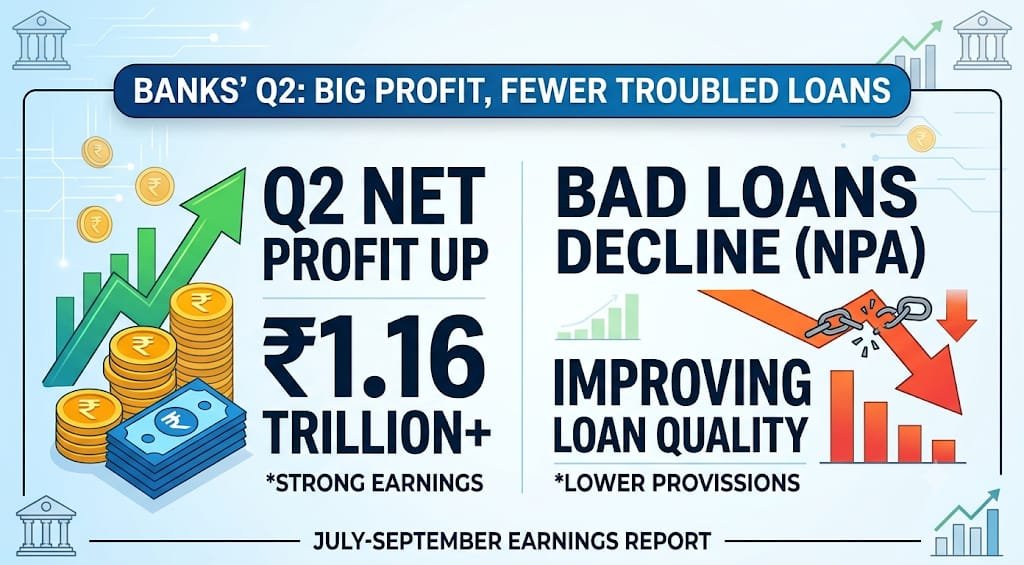
India’s banking sector reported a stronger September quarter, with the combined net profit of 32 banks rising 20.1% from a year earlier to ₹1.16 trillion, or about ₹1.16 lakh crore. Earnings improved as banks collected more income from lending, set aside less money for possible loan losses and reduced their stock of troubled loans. Together, these changes strengthened profitability during the second quarter of financial year 2026–27.
The combined net profit reached ₹1,16,462 crore, an increase of 10.3% over the preceding quarter. The results showed that earnings improved both from the previous year and from the April–June period. However, the overall increase did not mean every bank followed the same path. Differences in lending growth, deposit costs and provisioning continued to influence individual performances.
A major contributor was net interest income, which means the difference between interest earned on loans and investments and interest paid on deposits and other borrowings. Across the banks covered, this income rose 15.5% from a year earlier to ₹2,44,109 crore. It also increased 4.9% from the previous quarter, helping support the rise in overall earnings.
Another important reason was lower provisioning. Banks keep aside part of their income to cover potential losses, including loans that may not be repaid. These provisions and contingencies fell 9.1% from a year earlier to ₹27,271 crore. Although they increased 7.2% compared with the previous quarter, the annual reduction helped banks retain a larger share of their income as profit.
Loan quality also improved. Gross non-performing assets, commonly called bad loans, declined 10.8% from a year earlier to ₹3,59,423 crore. These are loans where repayments have remained overdue beyond the prescribed period. Net bad loans, measured after adjusting for provisions and related items, fell 10.9% to ₹78,698 crore. Both measures also declined compared with the preceding quarter.
The improvement was visible in the bad-loan ratios as well. The aggregate gross bad-loan ratio fell to 1.81%, compared with 2.27% a year earlier and 1.91% in June. The net bad-loan ratio eased to 0.33%, against 0.46% a year earlier and 0.39% in the previous quarter. Simply put, troubled loans formed a smaller share of banks’ loan books.
Business growth provided further support. Aggregate net interest income increased even as banks continued managing pressure on lending margins. Deposits grew 11.9% from a year earlier, while advances increased 15.5%. Since lending expanded faster than deposits, the figures also highlighted the continuing importance of attracting enough deposits to support credit growth.
Individual results nevertheless presented a mixed picture. HDFC Bank reported a sequential decline of nearly 10% in standalone profit, while Axis Bank recorded a marginal decline. Punjab National Bank, in contrast, posted a 31.6% sequential increase. ICICI Bank’s net interest margin improved by four basis points from the previous quarter to 4.18%, supported partly by an income-tax refund benefit.
Overall, the quarter’s stronger earnings reflected a combination of expanding interest income and healthier loan books, rather than a single factor. Falling bad loans reduced pressure on bank finances, while lower annual provisions supported profits. The differences between individual banks, however, showed why the sector’s headline growth needs to be read alongside each lender’s costs, margins and loan quality.

