
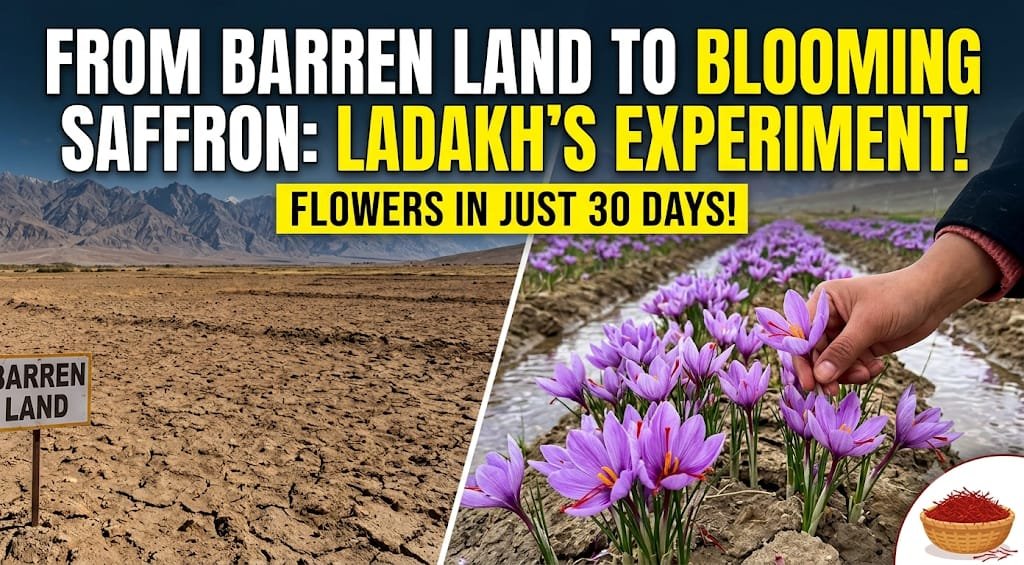
Saffron, often called the world’s most precious spice, has shown an encouraging early result in Leh, Ladakh. In an experimental cultivation project, saffron flowers appeared within only 30 days of planting, much earlier than the usual two months needed for the first bloom. This development has created hope that saffron farming can grow beyond Jammu and Kashmir and become a new source of income in Ladakh’s difficult cold-desert landscape. The experiment is being seen as an important step towards making barren land productive and creating fresh opportunities for local farmers and young people.
The pilot project has been set up at Spituk Pharka in Leh. Around 90,000 premium Iranian saffron corms, weighing nearly 800 kg, were planted on about 4,000 square metres of land that was once barren. The land has been restored under Project Him Sarovar, an initiative focused on bringing degraded land back into productive use. Water from the restored Igoo-Phey irrigation canal is being supplied to the field, helping improve soil moisture and support plant growth. This shows how careful land restoration and irrigation can together make farming possible even in a region known for harsh weather and limited agricultural conditions.
Lieutenant Governor of Ladakh, Vinai Kumar Saxena, inspected the experimental field and shared the early results. According to him, an average of 20 to 25 saffron flowers were blooming every day, while 72 flowers were recorded on a Sunday morning. In the first four days of flowering, nearly 22 grams of saffron were collected. Although these quantities are still small because the project is in its early stage, the speed of flowering and the healthy response of the plants have made the experiment promising.
Saffron is not an ordinary crop. It is obtained from the delicate stigma of the crocus flower and needs very careful handling. Because of its high market value, it is often called “red gold.” India’s saffron production is mainly concentrated in Jammu and Kashmir, which accounts for nearly 90 per cent of the country’s total output. For this reason, the successful early flowering in Leh is important, as it suggests that Ladakh’s unique climate may also be suitable for this high-value crop.
The main purpose of the project is not only to grow saffron but also to test whether the crop can be economically viable in Ladakh. The administration wants to understand whether saffron can survive and give good returns under the region’s agro-climatic conditions. If the experiment continues to succeed, it could encourage commercial cultivation in the future. This may help local farmers earn better income and may also inspire agro-based businesses among the youth of Ladakh.
The development is also significant because Ladakh has traditionally faced limits in agriculture due to its cold desert climate, short growing season, and water scarcity. However, the use of restored land and canal water in this project shows that scientific planning can help overcome some of these challenges. Instead of leaving degraded land unused, the project has turned it into a field for a premium crop. This approach can be useful for other dry and high-altitude areas as well.
If saffron farming becomes successful in Leh, it could bring several benefits. Farmers may get a new high-value crop option, rural households may find additional employment, and young people may see agriculture as a more attractive career. It could also reduce dependence on a few traditional crops and help diversify Ladakh’s local economy. At the same time, the results will need to be watched over a longer period, because saffron cultivation requires stable flowering, good yield, proper storage, and strong market links.
For now, the early bloom in Leh is a hopeful signal. Within just one month, a barren patch of land has produced saffron flowers, proving that innovation, restoration, and irrigation can create new agricultural possibilities. If the project maintains this momentum, Ladakh may soon add its name to India’s saffron map, turning a difficult landscape into a source of pride, income, and opportunity.

