
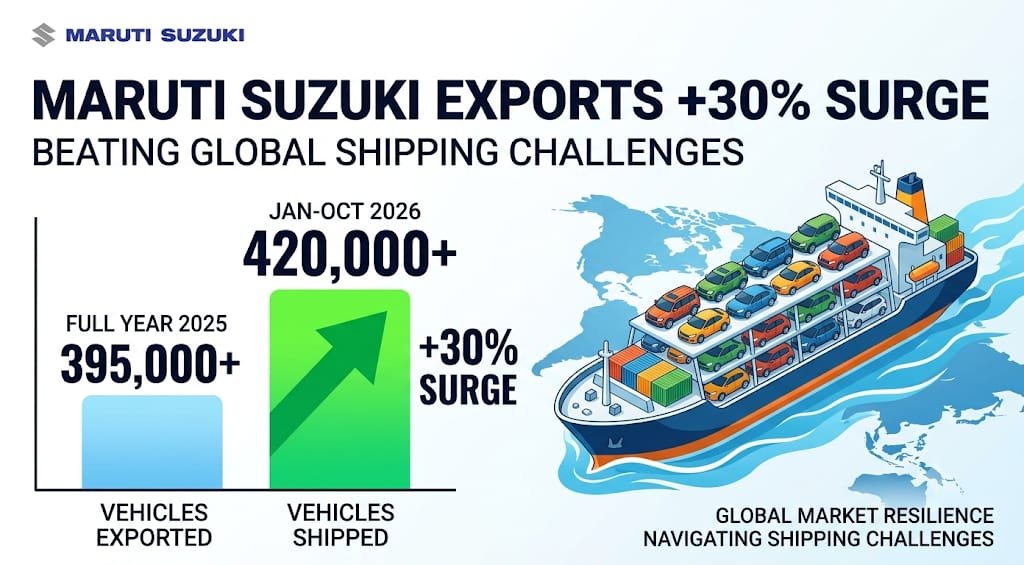
Maruti Suzuki has delivered a remarkable export performance in 2026, with overseas shipments rising by more than 30% year-on-year during January–October. The company shipped around 420,000 vehicles in these ten months, which is higher than the 395,000 units it exported during the entire calendar year 2025.
This is an important achievement because global trade routes have faced serious disruption due to the conflict in West Asia, especially in the Gulf region, which has traditionally been one of Maruti Suzuki’s major export destinations.
The growth becomes even more significant when seen against the background of shipping difficulties. Before the Iran conflict, the Gulf accounted for more than 11% of Maruti Suzuki’s annual exports. The company’s senior executive officer, Rahul Bharti, said the situation in the Middle East had slightly worsened in recent weeks and that even the alternate shipping route being used had faced problems.
However, customers in those countries continued to buy cars, and the company kept finding alternative ways to reach them. In simple terms, the demand did not disappear; the challenge was mainly in moving vehicles safely and efficiently to foreign markets.
One major reason behind the strong export numbers is Maruti Suzuki’s wide global presence. The company currently exports vehicles to nearly 120 countries, with Japan, Latin America, and Africa among its leading destinations. This wide spread has reduced its dependence on any single region.
Even when shipments to the Gulf became difficult, demand and sales in other markets helped maintain overall export growth. Bharti explained that this diversification helps the company reduce risk, because problems in one part of the world do not completely affect the entire export business.
The company also expanded its international footprint during the first quarter of calendar year 2026 by entering 20 new markets, mostly in Europe. A key driver of this expansion has been the e-Vitara, Maruti Suzuki’s first electric SUV.
The model has opened fresh opportunities in overseas markets, especially at a time when many countries are moving towards cleaner mobility. The e-Vitara has already been exported to 50 countries, including the United Kingdom, Norway, Germany, Japan, and Switzerland.
Electric vehicles are becoming an increasingly important part of Maruti Suzuki’s export story. The company began shipping the e-Vitara last year and has already exported more than 51,000 units of the SUV. This shows that Indian-made electric vehicles are finding acceptance not only in developing markets but also in developed and environmentally conscious markets such as Europe and Japan.
The strong response to the e-Vitara indicates that Maruti Suzuki is not relying only on petrol and diesel cars for overseas growth; it is also building a future-ready electric export business.
Among conventional vehicles, SUVs and popular mass-market models continue to lead exports. The Fronx and Jimny SUVs, along with the Dzire sedan and Swift hatchback, are among the company’s top five exported models.
These vehicles have strong demand because they combine affordability, fuel efficiency, and practical features, making them suitable for many international markets. The popularity of these models shows that Indian manufacturing has become competitive not just in price but also in quality and design.
Maruti Suzuki’s performance has also strengthened India’s position in the global automobile market. The company accounted for 51% of India’s passenger vehicle exports in the first half of FY27 and nearly 93% of the country’s electric vehicle exports.
This means that a large share of India’s car exports is being driven by Maruti Suzuki, making the company a major contributor to India’s manufacturing and foreign-exchange earnings. For the wider economy, higher vehicle exports support factories, suppliers, transporters, ports, and employment across the automobile value chain.
The broader message is that Indian carmakers are becoming more resilient in a difficult global environment. Maruti Suzuki’s export growth was achieved despite conflict-related shipping disruptions, higher logistical challenges, and uncertainty in an important regional market. The company managed this through market diversification, alternative routes, strong product demand, and a growing electric-vehicle portfolio.
If global shipping conditions improve, the export momentum could become even stronger. At the same time, the performance highlights the importance of reducing dependence on a few markets and building capabilities across regions, products, and technologies.
For ordinary readers, this story is not only about a car company selling more vehicles abroad. It reflects India’s growing role as a global manufacturing hub. Cars made in Indian factories are now reaching customers in Europe, Africa, Latin America, Japan, and many other regions.
Maruti Suzuki’s 30% export rise shows that Indian industry can grow even during global uncertainty when it has strong products, flexible supply chains, and access to a wide network of markets.

