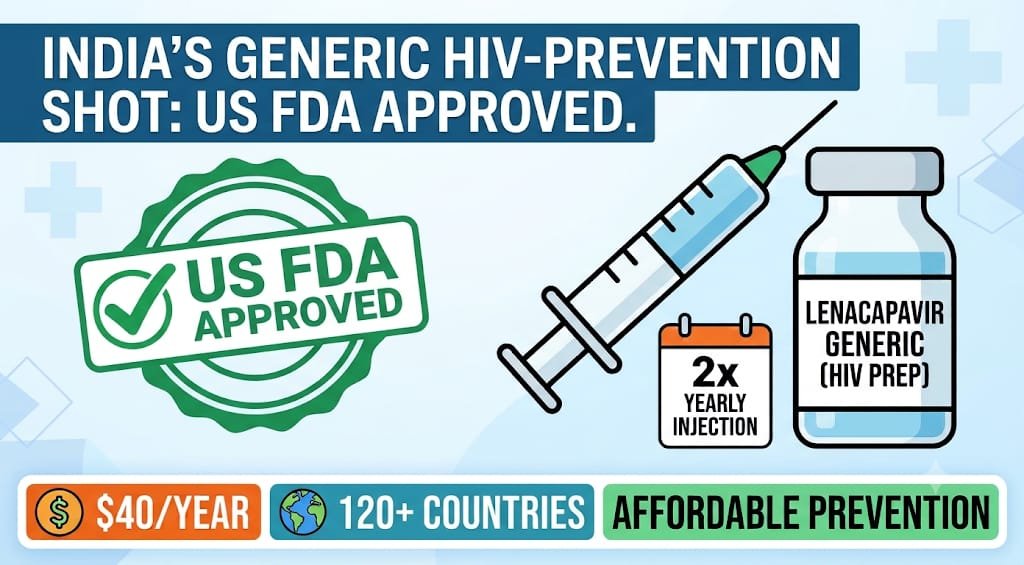
India-made lenacapavir could make twice-a-year HIV prevention available at about $40 a year in 120 low- and middle-income countries.The United States has approved a generic version of lenacapavir, a long-acting medicine used to prevent HIV, for sale in poorer countries. This decision is important because the medicine is given as an injection only twice a year, making HIV prevention easier for people who find it difficult to take a daily pill. The approval could help bring an affordable and effective prevention option to millions of people in low- and middle-income countries.
The generic version has been developed by India-based Dr Reddy’s Laboratories. The work was supported through an agreement involving Unitaid, the Clinton Health Access Initiative and Wits RHI, an African health research institute.
These organisations came together to speed up the development of the drug and make it available at a price that poorer countries can afford. The medicine is expected to cost about $40 per person for a year, which is close to the yearly cost of daily HIV-prevention pills.
Lenacapavir works as PrEP, which stands for pre-exposure prophylaxis. It is meant for people who are at risk of getting HIV but do not already have the infection. Instead of taking medicine every day, a person receives an injection twice a year.
This can be especially helpful for people who may miss daily doses because of busy lives, stigma, travel, or difficulty accessing medicines regularly. Health experts believe that better adherence can lead to stronger protection against HIV.
The new approval is seen as a major step because earlier studies found that lenacapavir nearly eliminated new HIV infections among people at high risk.
According to the World Health Organization, around 41 million people were living with HIV last year, and about 570,000 people died from HIV-related causes. If the injection reaches a large number of people who need prevention, it could reduce new infections and eventually help lower AIDS-related deaths.
The approval by the US Food and Drug Administration is described as tentative because the original branded version of lenacapavir remains protected by a patent in the United States. The branded version, called Yeztugo, is made by Gilead Sciences and cannot be replaced by the generic in the US market. Its listed price before insurance is $28,218 a year.
However, the generic version is approved specifically for supply to eligible low- and middle-income countries, where it can be sold at a much lower price.
Until now, Gilead was the only supplier of lenacapavir, and demand in poorer countries had been higher than the available supply. Last year, the company signed royalty-free licensing agreements with six generic manufacturers.
These agreements allow production for selected countries in sub-Saharan Africa, Asia and Latin America. The approval of Dr Reddy’s version is expected to increase supply and reduce the pressure caused by limited availability.
The FDA approval may also help speed up regulatory clearance in other countries. Many nations depend on trusted international approvals before allowing new medicines into their public health systems.
Still, the timeline may differ from country to country. Some places may receive the generic within weeks, while others may need to complete their own approval process first. Generic versions made by the other licensed manufacturers have not yet received FDA approval.
There are some important safety points linked to the medicine. Common side effects include pain or reaction at the injection site, headache and nausea. Before starting lenacapavir, and before every injection, a person must be tested for HIV.
This is necessary because if someone already has undiagnosed HIV and takes the drug alone, drug-resistant HIV can develop. Health workers say rapid HIV testing is available in many low- and middle-income countries, which can make this process practical.
The bigger challenge now is not only making the drug but also funding its purchase and delivering it to the people who need it. Health advocates say the world now has a powerful tool, but governments, global health agencies and donors must ensure that money, clinics, testing services and supply chains are ready. If this happens at scale, the twice-a-year injection could become one of the most important advances in the global effort to control HIV.

