
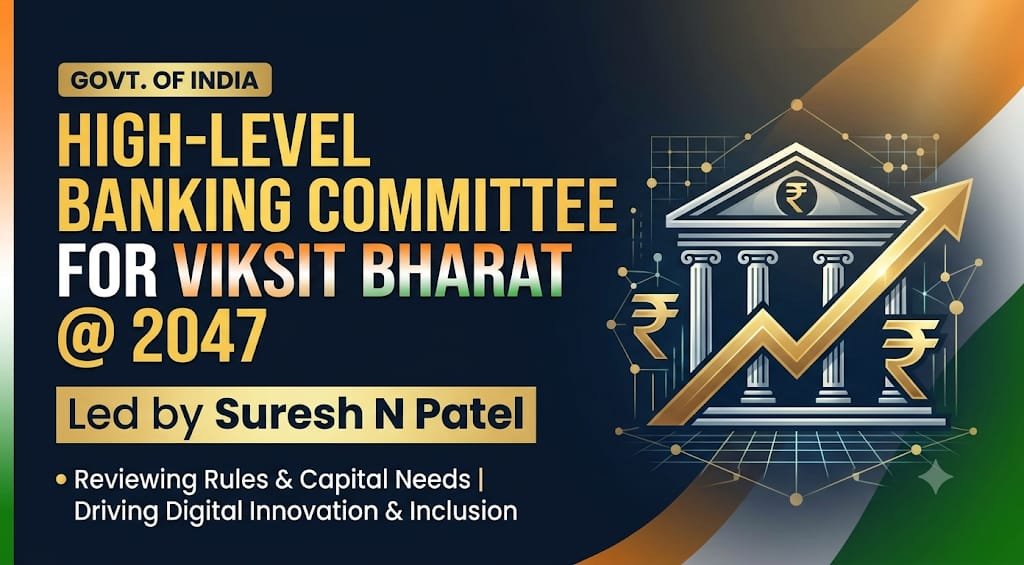
The Central Government has formed a High Level Committee on Banking for Viksit Bharat to examine the country’s banking system and suggest major reforms. Former Central Vigilance Commissioner Suresh N Patel has been appointed as the chairman of this committee.
The main purpose is to prepare Indian banking for the long-term goal of Viksit Bharat by 2047, when the country aims to become a developed economy. The committee will recommend structural, institutional, regulatory and legislative changes so that banks can become globally competitive, financially inclusive and resilient.
The panel has been given a six-month tenure to complete its work and submit recommendations to the government. It will not only look at large commercial banks but also study Regional Rural Banks and Cooperative Banks, which play an important role in rural credit and local financial services.
The idea is to find out where the present system is working well and where reforms are needed to make banking simpler, faster and more useful for ordinary people, small businesses and large industries alike.
Suresh N Patel brings long experience in banking and public administration to this role. He has earlier served as Central Vigilance Commissioner and has more than three decades of experience in the banking sector.
The committee also includes Reserve Bank of India Deputy Governor Shirish Chandra Murmu, former RBI Deputy Governor N S Vishwanathan and former Managing Director and CEO of Indian Bank Padmaja Chunduru. This combination of regulatory experience, banking leadership and policy knowledge is expected to help the committee understand both ground-level challenges and larger systemic issues.
One of the committee’s first responsibilities will be to review present banking practices and prudential norms. Prudential norms are rules that help banks manage risk, maintain financial strength and protect depositors. The committee will compare Indian practices with global best practices and suggest what can be adopted in India.
It will also prepare a roadmap for creating globally competitive Indian banks, which means banks capable of supporting large investments, international trade and the country’s growing economic ambitions.
The committee will also study the legal and regulatory framework for banks. This includes commercial banks, Regional Rural Banks and Cooperative Banks. Its aim will be to reduce unnecessary complexity, improve efficiency and make it easier to do banking.
For a small trader, farmer, startup or household, easier banking can mean quicker loans, fewer procedural hurdles and better access to formal financial services.
Another important area is long-term capital. Banks, Development Financial Institutions and Non-Banking Financial Companies need adequate capital to lend safely and support economic growth. The committee will assess future capital requirements and recommend funding sources and mechanisms that can help expand credit.
This matters because businesses need loans to build factories, buy equipment, expand operations and create jobs. If banks have stronger capital support, they can lend more confidently without weakening their own financial health.
The panel will also examine why the cost of capital differs for businesses and suggest policy options to encourage private investment. In simple terms, when borrowing becomes costly or difficult, companies may delay expansion. Lower and more predictable financing costs can encourage entrepreneurs and industries to invest, which can support employment and long-term growth.
Technology will be a major part of the committee’s work. It has been asked to prepare a roadmap for artificial intelligence and digital innovation in banking. At the same time, it must suggest safeguards against cyber risks.
Digital banking has made payments, transfers and account services faster, but it has also increased the need for strong cybersecurity, customer protection and reliable systems. The committee’s recommendations may therefore shape how banks use technology in the coming years.
The committee will also focus on people. It will suggest strategies for talent acquisition and capacity building so that the banking workforce is ready for future challenges.
As banking becomes more digital and data-driven, employees will need new skills in technology, risk management, customer service and financial analysis. A future-ready workforce will be essential for implementing any major reform successfully.
Financial inclusion remains another central theme. The committee will review the Priority Sector Lending framework and the Lead Bank Scheme. These systems are meant to ensure that credit reaches agriculture, small enterprises, weaker sections and underserved regions.
The review will check whether these frameworks are still relevant, effective and well coordinated with today’s economic priorities. The goal is to promote balanced and data-driven credit delivery while strengthening financial inclusion.
Overall, this committee represents an important step in India’s banking reform agenda. Its recommendations could influence how banks lend, adopt technology, manage risks, raise capital and serve people across urban and rural India. If implemented well, the reforms could help build a banking system that supports businesses, protects depositors, expands access to credit and contributes meaningfully to the vision of Viksit Bharat 2047.

