
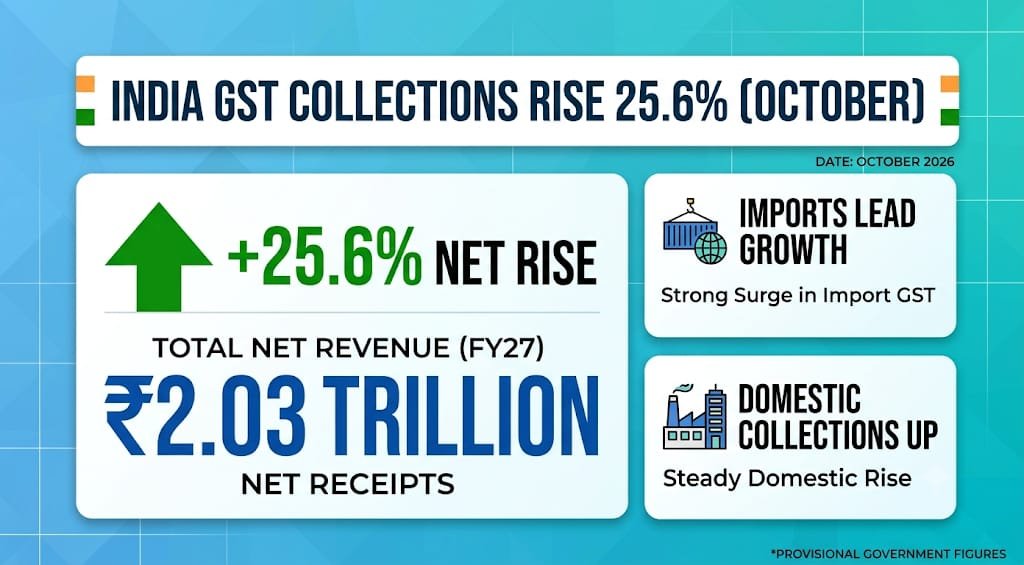
India’s net Goods and Services Tax collections increased by 25.6% in October from a year earlier, reaching ₹2.03 trillion, or about ₹2.03 lakh crore. This was the fastest growth recorded in the current financial year, 2026–27. Higher tax receipts from imports played a major role, while collections from domestic transactions also improved, according to provisional government figures.
The numbers offer an important update on tax revenue following the recent GST rate changes. Lower rates had raised concerns that government collections could weaken. October’s results suggest that revenue remained strong during the month, although one month’s performance alone cannot establish how collections will behave over the rest of the financial year.
Gross GST collections, measured before refunds are deducted, rose 22.9% to ₹2.31 trillion, or ₹2.31 lakh crore. Net collections represent the amount remaining after refunds. The distinction matters because a rise in gross receipts does not always produce the same increase in the money retained by the government. Refund payments also influence the final figure.
Domestic GST collections increased 15.8% to approximately ₹1.59 lakh crore. These receipts relate to transactions within India. Their growth indicates that the improvement was not limited to imports, although import-related tax revenue increased much faster. The figures therefore show two different contributions to October’s performance: steady domestic growth and a sharper rise in collections linked to goods entering the country.
Gross GST revenue from imports rose 42.2%. After accounting for refunds, import-related collections increased 65.1%. This stronger contribution helped lift overall net revenue growth above the growth in gross collections. It also makes the composition of the increase important: the headline figure reflects both domestic transactions and cross-border trade, rather than domestic demand alone.
October’s figures also stood out against the earlier part of the financial year. Between April and September, net GST collections had recorded single-digit growth, with August showing the weakest increase at 3.3%. October consequently marked a clear acceleration after several months of relatively modest growth in net receipts.
For the April–October period, gross GST collections reached ₹14.78 lakh crore, compared with ₹13.05 lakh crore in the corresponding period a year earlier, an increase of 13.2%. Net collections rose 12.6% to ₹12.69 lakh crore from ₹11.27 lakh crore. These cumulative figures provide a broader view than the October increase alone.
Import-linked tax collections can move for several reasons. Changes in the quantity of goods imported, international prices and exchange rates can all affect the taxable value. The report also linked stronger collections to imports of gold and services. This means the increase should not automatically be read as an equally large expansion in the volume of goods bought or sold.
The wider policy question is whether stronger business activity can continue supporting revenue after tax-rate reductions. Measures encouraging local production may gradually reduce dependence on imports, potentially changing the balance between domestic and import-linked receipts. For now, October brought a substantial improvement in GST revenue. The months ahead will show whether this pace can continue and how much of the growth comes from domestic economic activity.

