
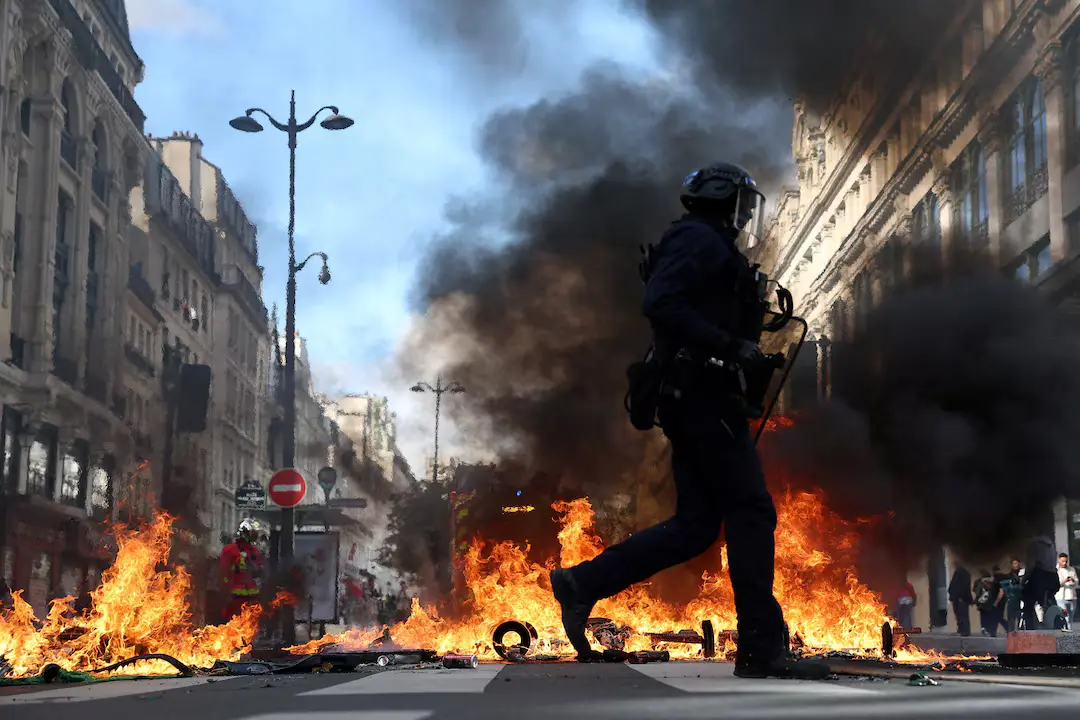
Welcome to the wonderful world of international human rights, where geography apparently matters as much as the human rights themselves. When protesters clash with police in France, governments talk about public order, rioting and protecting public property. When mass detentions happen in India, international institutions suddenly take an urgent interest in democracy’s health.
France witnessed widespread protests on October 17, 2026, with more than 1,200 arrests reported amid clashes, looting, arson and attacks on public buildings. Police officers were injured, shops were damaged, and fires broke out across several cities.
Even iconic buildings like the 143-year-old bell tower of Limoges Town Hall collapsed in flames during the protests.
A piece of France’s history, gone in seconds—The 143-year-old bell tower of Limoges Town Hall collapses in flames amid protest violence. Built in 1883. Survived nearly a century and a half. Gone. https://t.co/G0ueYZIyGV— Shiv Aroor (@ShivAroor) October 17, 2026
Naturally, the French authorities had a responsibility to deal with violence. No serious democracy can expect police to watch helplessly while buildings burn and officers are attacked. Arresting people suspected of committing offences is not automatically a human rights violation. The circumstances, legality and proportionality of each action matter. However, when India does the same, it becomes a global human rights crisis.
When Indian authorities detained people during CJP protests against the Election Commission, the UN human rights office expressed concern over mass detentions and urged the government to respect peaceful assembly. Human Rights Watch also criticised the police response, alleging excessive force and arbitrary detention.
Now, if the standard is that peaceful protesters must be protected while violence can be lawfully addressed, then surely the same principle should apply everywhere, from Paris to Delhi, but apparently it doesn’t.
When India cracked down after violence during Cockroach Janata Party protest few months ago, it became a human rights issue. When India acted to prevent any such violence during their current protest, it became a human rights issue. Do these human rights that allow violence apply only to India?
The question is worth asking that do international watchdogs apply consistent standards, distinguish peaceful demonstrators from violent offenders, and scrutinise police conduct regardless of the country involved?
Human rights should not come with a European exemption or an India-specific penalty.
If an arrest is lawful and proportionate, examine the evidence. If police use excessive force, investigate it. And if peaceful protesters are detained arbitrarily, speak up.
The real test of human rights institutions is not how loudly they condemn a government. It is whether they apply the same principles to every government, whether they are in Europe or Asia.

