
Despite global uncertainties, geopolitical tensions and tariff concerns, India’s merchandise exports continued their strong growth for the second consecutive month.
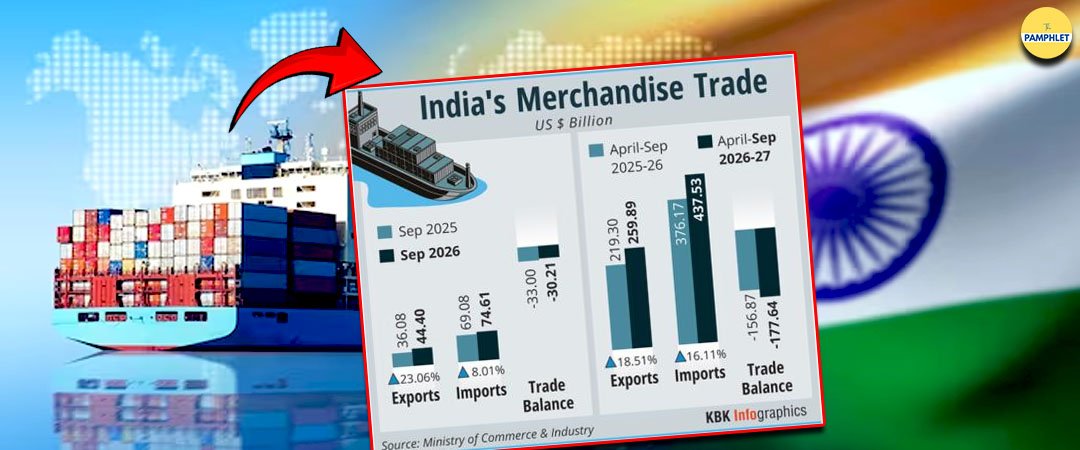
India’s external trade performance delivered an encouraging signal in September 2026, with merchandise exports rising 23% year-on-year to $44.40 billion, compared with $36.08 billion a year earlier. The robust expansion came amid uncertainty over potential fresh US tariffs linked to India’s imports of Russian oil and continuing geopolitical tensions in West Asia.
According to data released by the Ministry of Commerce and Industry, merchandise exports have now grown by more than 20% for the second consecutive month, underlining the resilience of Indian businesses and their ability to tap international demand despite challenging global conditions.
Imports grew at a comparatively slower pace of 8% to $74.61 billion, against $69.08 billion in September last year. This helped narrow the merchandise trade deficit to $30.2 billion from $33 billion a year earlier.
The figures offer an encouraging assessment of India’s trade performance and reflect the importance of the government’s continuing efforts to improve export competitiveness, facilitate trade and strengthen the country’s position in global supply chains.
US market emerges as a major growth driver
The United States remained a key contributor to India’s export expansion, with merchandise exports to the country surging 48% in September and crossing $8 billion.
The growth is significant given the uncertainty surrounding the proposed India-US bilateral trade agreement and the possibility of additional tariff measures. Strong shipments despite these concerns underline the continuing demand for Indian products in one of the country’s most important overseas markets.
Commerce and Industry Minister Piyush Goyal said the first tranche of the India-US trade agreement had been finalised and was undergoing legal drafting. The government hopes to complete the process soon and operationalise the agreement in a manner that gives Indian exporters a competitive advantage over their peers.
The proposed agreement could provide greater predictability to businesses, improve market access and strengthen commercial ties between the two economies. Its implementation would be an important step towards expanding India’s export opportunities and reducing uncertainty for exporters.
Electronics exports ride the AI wave
Electronics emerged as a major contributor to merchandise export growth. Exports in the category jumped 70.4% to $5.3 billion in September, compared with $3.1 billion in the corresponding month last year.
The expansion reflects growing opportunities arising from worldwide demand for technology-related products, including those associated with the artificial intelligence ecosystem. Electronics exports have also benefited from exemptions from the US tariffs discussed in the report.
The strong performance reinforces the importance of India’s growing role in global manufacturing and technology supply chains. Continued investment in domestic production, infrastructure and logistics can help Indian manufacturers capture a larger share of international demand.
It also highlights the benefits of diversifying the export basket, allowing India to capitalise on emerging sectors while reducing its vulnerability to fluctuations in traditional industries.
Slower imports help contain the trade deficit
India’s import bill continued to rise in September, but at a slower pace than exports. The resulting improvement helped moderate the merchandise trade deficit to $30.2 billion.
A sharp decline in gold imports played a major role. Gold imports fell 81.3% to $1.8 billion in September , compared with $9.6 billion a year earlier.
The fall was notable because gold imports typically rise during India’s festive season. Commerce Secretary Rajesh Agarwal indicated that high import duties could have contributed to the decline.
While the narrower trade deficit offers some relief to India’s external balances, the improvement was driven substantially by lower gold imports and should not be attributed entirely to stronger export competitiveness.
Nevertheless, robust exports combined with slower import growth have helped limit pressure on the trade balance amid persistent global uncertainties.
Government’s trade strategy shows encouraging results
The September figures underline the importance of the government’s sustained focus on export promotion, trade facilitation and improving the business environment.
India is seeking to expand its participation in global markets through bilateral trade negotiations, stronger manufacturing capabilities and measures aimed at reducing procedural and tax-related obstacles for exporters. Progress on the India-US trade agreement is an important example of this approach.
The government has also been working to address issues affecting services exporters. The GST Council has recommended amendments to the Central Goods and Services Tax Act to allow refunds of accumulated input tax credit on input services and capital goods under the inverted duty structure.
These measures can help reduce accumulated tax credits, ease working-capital pressures and improve the competitiveness of eligible businesses. Their ultimate impact will depend on effective implementation and exporters’ ability to access the benefits.
Taken together, the initiatives reflect a policy approach that recognises the importance of supporting both merchandise and services exports. Sustaining the momentum will require continued attention to logistics costs, access to finance and predictable trade rules.
Rising Chinese imports remain a concern
Despite the strong export performance, the sharp rise in imports from China remains an area of concern.
Indian imports from China increased 31.5% to $14.86 billion in September, compared with $11.30 billion a year earlier. During April–September, imports reached $80.35 billion, up 27% from $62.86 billion in the corresponding period last year.
The trend has prompted greater use of anti-dumping duty investigations by the Union Commerce and Industry Ministry. Such measures can address unfairly priced imports where the relevant legal requirements are met.
However, a sustainable response will also require investment in technology, improved product quality and stronger domestic manufacturing capabilities so that Indian companies can compete effectively on cost and scale.
Services exports register a rare decline
While merchandise exports performed strongly, services exports recorded a rare year-on-year decline in September. Government projections put services exports at $36.35 billion, marginally below the $36.67 billion recorded a year earlier.
Commerce Secretary Rajesh Agaarwal attributed some of the pressure to the West Asia crisis, rising energy prices and their impact on travel and tourism.
The government noted that projected global services trade growth had been revised down from 4.8% to 3.3%. Higher travel costs and geopolitical disruptions have weighed on parts of the sector.
Despite the monthly decline, Agarwal said India’s services exports continued to grow at more than 9% year-on-year, although growth would have been stronger under more favourable global conditions.
Current account deficit likely to widen
The broader external account outlook remains subject to uncertainty. Aditi Nayar, Chief Economist at ICRA, said the merchandise trade deficit remained broadly in line with levels seen during the first five months of FY2027, even as import growth slowed.
Nayar expects India’s current account deficit to widen to $13–15 billion in the second quarter of FY2027, from $4.2 billion in the first quarter. However, the projected deficit would be marginally lower than in the corresponding period a year earlier.
The outlook reflects developments in merchandise trade, services earnings and other sources of foreign exchange, including remittances. Any moderation in these receipts could offset some of the gains from merchandise exports.
Sustaining export momentum while strengthening services earnings will therefore remain important for managing external pressures.
The road ahead
India’s September trade performance offers grounds for cautious optimism at a time when international commerce is being reshaped by tariff uncertainty, geopolitical tensions and changing supply chains.
Merchandise exports of $44.40 billion, a 48% increase in shipments to the US and 70.4% growth in electronics exports underline the opportunities available to Indian businesses. Slower import growth also helped contain the trade deficit.
The government’s engagement with major trading partners, efforts to improve the tax and regulatory environment, and focus on manufacturing competitiveness provide an important foundation for sustaining this progress.
The broader takeaway is encouraging: India’s trade sector has demonstrated considerable resilience, with merchandise exports expanding strongly despite external uncertainty. If the government can translate trade negotiations and policy reforms into durable market access, lower business costs and stronger domestic production, India will be better positioned to sustain export growth and strengthen its role in the global economy.

