
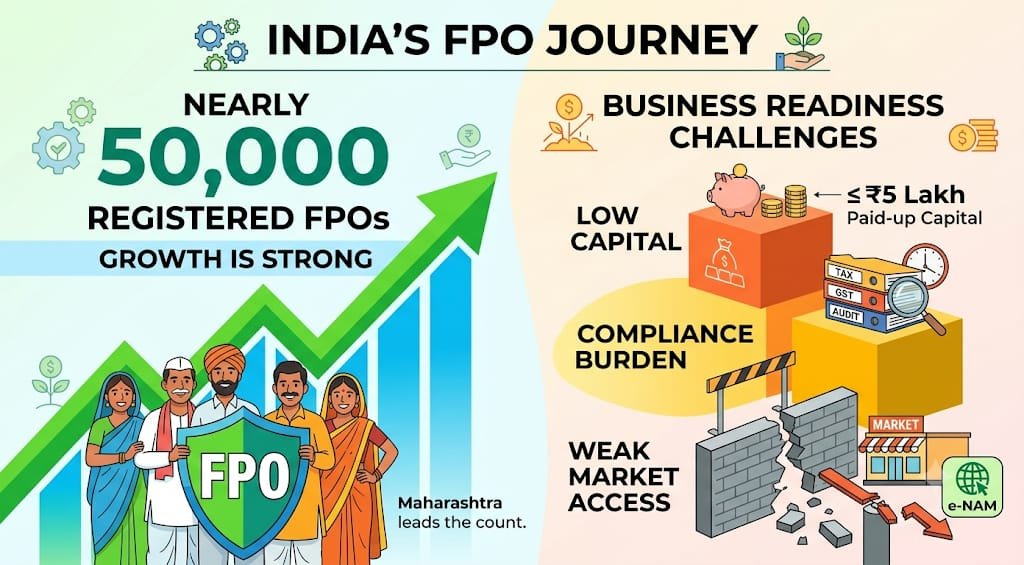
India’s farmer producer organisations, commonly known as FPOs, are close to crossing the important milestone of 50,000 registered bodies. According to the State of the FPO Sector in a report prepared by the National Association for Farmer Producer Organisations in collaboration with NABARD, more than 49,800 such organisations have been registered under company and cooperative laws.
This shows that farmer collectives have become a major part of India’s agricultural economy, especially after 2016, when 97 percent of the present FPOs were incorporated. The growth has also been supported by the agriculture ministry’s scheme to form 10,000 FPOs across the country.
An FPO is essentially a group of farmers who come together to improve their income and bargaining power. Instead of selling produce separately at low prices, members can collectively arrange better seeds, machinery, storage, transport, processing and market linkages.
The idea is simple: when small farmers act together, they can negotiate like a larger business and receive better value for their crops. The rapid increase in registered FPOs therefore reflects a growing belief that collective farming enterprises can reduce the difficulties faced by individual cultivators.
Maharashtra clearly leads the country in this sector, with more than 18,000 FPOs. Uttar Pradesh follows with over 7,900 organisations, while Madhya Pradesh has around 2,500. These numbers show that the movement is not limited to one region, although the gap between leading and other states remains wide.
The organisations are registered under different legal systems, including the Companies Act, 2013, state cooperative society laws and the Multi-State Cooperative Societies Act. This legal variety gives farmers flexibility, but it also means that different FPOs may face different rules and support systems.
Despite the impressive registration numbers, the report points out that many FPOs are still not fully prepared to run as strong businesses. Nearly 91 percent of farmer producer companies have paid-up capital below Rs 5 lakh. This is a small amount for activities such as storage, food processing, packaging, branding and direct retail sales.
Many organisations may need five to eight years before they can begin processing work. In simple terms, while farmers have formed groups in large numbers, turning those groups into profitable enterprises is taking much longer.
The challenge is not only money. Regulatory compliance is another major burden for farmer producer companies. These bodies must handle statutory filings, audits, GST and tax deduction requirements, even though many operate with limited funds and little professional help.
Market access is equally important. The electronic National Agriculture Market, or e-NAM, connects 1,656 mandis across 23 states and has onboarded more than 4,700 FPOs. This is a positive step because digital platforms can help farmers reach more buyers and receive clearer price information.
However, the report cautions that the spread of digital markets has not automatically led to strong FPO-led trade. Registration on a platform does not always mean that an FPO can sell regularly, transport goods easily, maintain quality standards or negotiate profitable contracts.
Women-led FPOs add another important dimension to the story. The report surveyed 170 women-led enterprises and found that 80 percent of women-led farmer producer companies have more than 600 members. This large membership gives them better scale and potentially stronger bargaining power in the market. Yet their business activities remain limited.
Around 90 percent of women-led FPOs depend mainly on cereal-based value chains and mandi sales. This suggests a major opportunity to move towards processing, differentiated products and alternative market channels, which can bring higher returns to women farmers.
The overall picture is encouraging but incomplete. India has built a large base of farmer-owned organisations, and this is a significant achievement for rural economic development.
The next stage is more difficult: helping these organisations become financially stable, professionally managed and market-ready. Easier compliance, better access to credit, training in business planning, storage and processing facilities, and stronger links with buyers can make FPOs more useful for farmers.
If these gaps are addressed, the near-50,000 registered FPOs could move beyond being formal entities and become genuine engines of higher farm incomes, rural employment and stronger local economies.

