
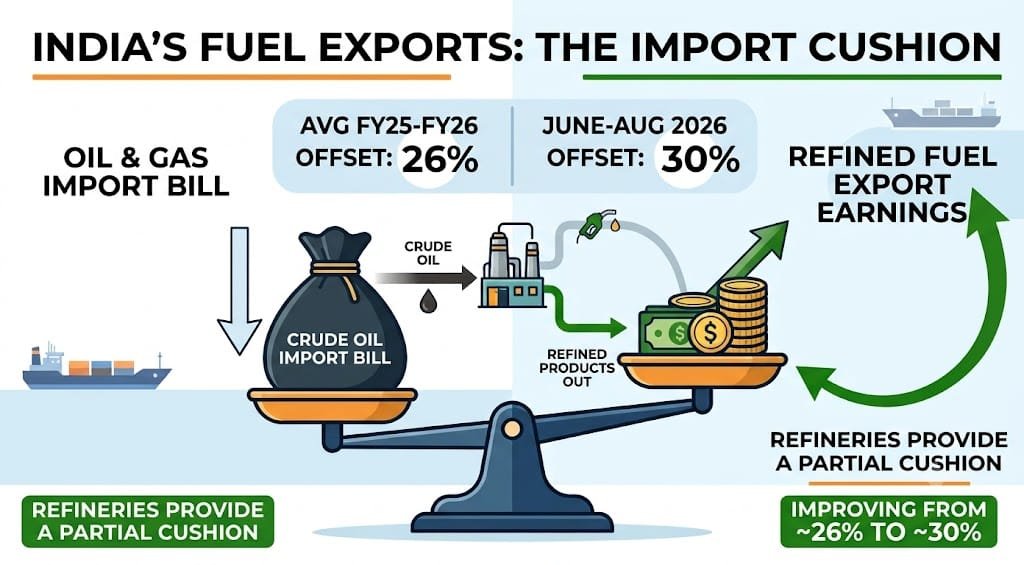
India depends heavily on other countries for crude oil, but its refineries provide an important cushion. They process crude into fuels such as petrol, diesel and jet fuel, which can be sold overseas. This brings foreign currency back into the country and partly balances the dollars spent on energy imports. India imports more than 88% of its crude oil requirement, making these export earnings particularly valuable.
The relationship is straightforward. Crude oil is the raw material, while refineries turn it into usable products. India therefore does not need to produce all its own oil to earn money from selling refined fuels. Its strength lies in processing imported crude and supplying finished products to overseas markets. Official petroleum data identify diesel, petrol and aviation turbine fuel among the country’s leading petroleum exports.
Across FY25 and FY26, India’s annual oil and gas import bill averaged $166.65 billion, while annual export earnings averaged $42.75 billion. Those earnings covered roughly 26% of the import bill. These are averages across the two financial years, rather than proof that exports earned exactly the same amount in each year. In simple terms, exports brought back around $26 for every $100 spent on oil and gas imports.
The cushion became somewhat larger during June–August 2026, a period within FY27. Monthly oil and gas imports averaged $15.93 billion, while exports averaged $4.77 billion. Export earnings therefore offset about 30% of the import bill. That is an improvement over the earlier two-year average, although three months of stronger performance cannot establish the outcome for the entire financial year.
The figures also show the limits of this relief. Even after allowing for export earnings, most of the import bill remained uncovered. Recovering approximately $30 against every $100 spent still leaves a substantial gap. Fuel exports reduce the financial burden; they do not remove India’s dependence on imported energy. The export value is also revenue, not profit, because purchasing crude, processing it and transporting finished fuels all involve costs.
This matters when several pressures arrive together. Higher crude prices make purchases more expensive, while higher freight charges and marine insurance premiums add to the cost of bringing oil into India. A weaker rupee increases the rupee amount needed to purchase dollars. The reported rise in these costs explains why the foreign currency earned through fuel exports offers useful, but only partial, relief.
The wider economic risk remains significant. According to ICRA’s estimate cited in the report, a $10-per-barrel increase in average crude prices over a financial year can raise India’s net oil import bill by around $12 billion to $13 billion. That can widen the current account deficit, which measures the gap in the country’s international earnings and payments. Stronger fuel exports help, but an expensive crude market can still outweigh those gains.
India’s position is therefore more balanced than either extreme suggests. The country is neither self-sufficient in crude oil nor simply an importer with nothing to sell in return. Its refining industry converts imported raw material into exportable fuels and recovers part of the money spent abroad. The improvement from roughly 26% coverage to around 30% shows why that capability matters, while the remaining gap explains why oil prices, shipping costs and import dependence continue to shape the economic picture.

