
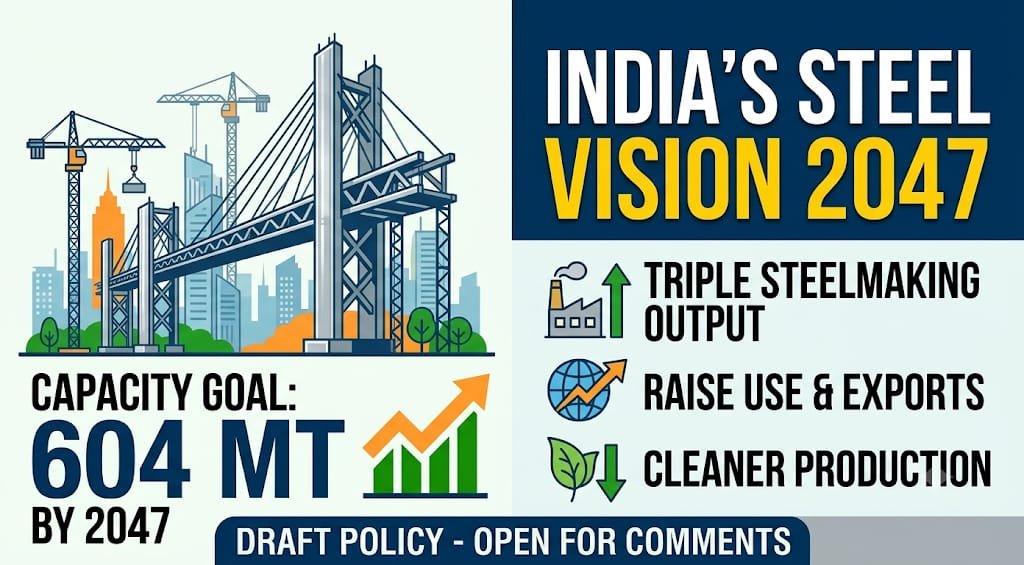
India has released a draft National Steel Policy Vision 2047 that presents a long-term roadmap for one of the country’s most important industries. Steel may not always be visible in daily life, but it is present almost everywhere. It is used in homes, bridges, railway tracks, factories, cars, household goods, power projects and large infrastructure works.
As India plans more cities, roads, manufacturing units and public infrastructure, the need for steel is expected to grow sharply. The new draft policy says India could raise its crude steelmaking capacity to 604 million tonnes by 2047, from about 220 million tonnes at present. This means the country is aiming for almost three times more steelmaking capacity over the next two decades.
The policy estimates that crude steel production could reach 531 million tonnes by 2047. Finished steel consumption is projected to rise to 505 million tonnes, compared with about 164 million tonnes in 2025-26. Per-person steel consumption is expected to rise from around 116 kilograms at present to 302 kilograms by 2047.
In simple terms, this reflects the expectation that more steel will be needed as income levels rise and more people buy homes, vehicles, appliances and other manufactured products. Higher investment in railways, highways, clean-energy projects, ports and urban housing could also increase steel demand.
The policy is still in draft form and has been placed in the public domain for comments and suggestions until October 30, 2026. This is important because the final policy may change after industry groups, producers, consumers and other stakeholders share their views.
The document is expected to replace the National Steel Policy, 2017, whose main horizon was 2030. The new plan looks much further ahead, linking the growth of the steel sector with the wider goal of building a developed India by 2047.
A major concern behind this large expansion is the availability of raw materials. Steel production depends heavily on iron ore and coking coal. The draft estimates that iron ore demand could rise to 772 million tonnes by 2047 from about 299 million tonnes in 2025. Coking coal demand may climb to 236 million tonnes from around 72 million tonnes.
Since India depends significantly on imports for coking coal, the policy gives importance to reducing supply risks. It proposes measures such as expanding coal-washing facilities, securing long-term overseas supply arrangements, improving domestic mining and using technology to improve the quality and use of coal blends.
Transport and logistics form another key part of the plan. Moving heavy raw materials from mines to steel plants is expensive and can delay production. The policy proposes a major expansion of iron ore slurry pipelines, with capacity expected to rise from around 18 million tonnes per year to more than 299 million tonnes by 2047.
Such pipelines can carry processed iron ore in liquid form and may reduce pressure on roads and rail networks. The proposal also mentions government support through viability gap funding, which can help projects that are useful for the economy but may not be financially attractive in the early years.
The draft policy also recognises that higher steel output should not lead to unchecked pollution. It aims to reduce the steel industry’s carbon-emission intensity by 39 percent, bringing it down to 1.54 tonnes of carbon dioxide per tonne of crude steel by 2047 from 2.54 tonnes currently.
Greater use of scrap steel, energy-efficient technology, cleaner fuels, automation and research could support this shift. The plan also targets steel exports of 45 million tonnes by 2047, helping India become a stronger supplier to global markets.
The roadmap is ambitious, but its success will depend on investment, stable raw-material supplies, timely infrastructure, cleaner technologies and competitive production costs. If these pieces move together, the policy could help India meet rising domestic demand while creating jobs, supporting manufacturing and strengthening the country’s position in the global steel industry.

