
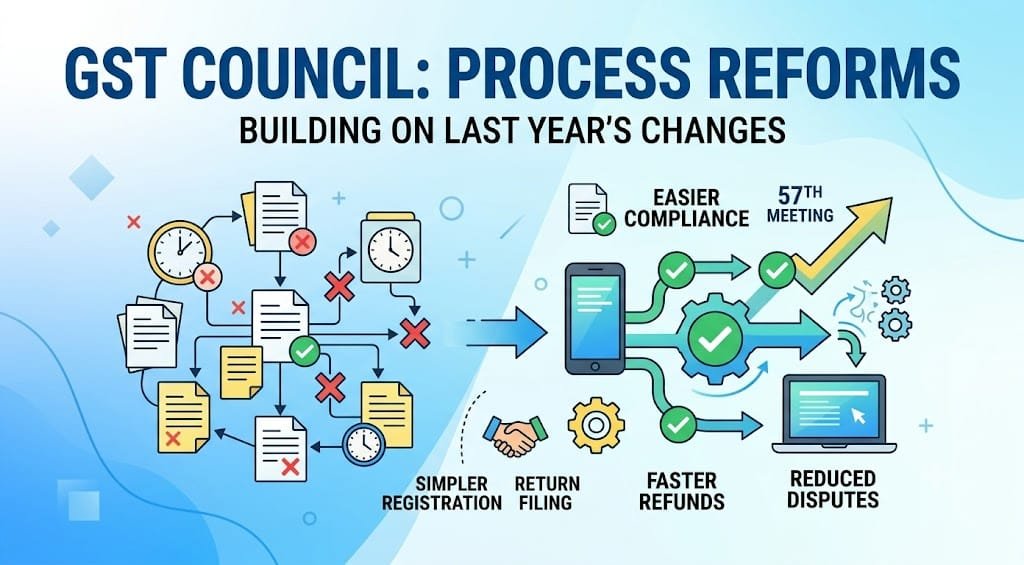
The 57th GST Council meeting, held in New Delhi on October 8, recommended several changes aimed at reducing delays and confusion for businesses. The government has described these as process reforms, but their impact could be felt in the everyday work of manufacturers, traders, exporters, service providers and small online sellers. The recommendations will become legally effective only after the required amendments, notifications and circulars are issued.
The latest recommendations of the GST Council are best understood as the next step in the reform process that began last year. The previous round of reforms mainly focused on reducing and rationalising GST rates. The new recommendations focus on the practical side of the tax system: registration, return filing, refunds, input tax credit, appeals, enforcement and the movement of goods. In simple terms, the direction has shifted from deciding how much tax should be paid to making the entire process easier to follow.
One important area is GST registration. The Council has recommended clearer guidelines, frequently asked questions, simpler forms and a more user-friendly GST portal. Drop-down menus, tool-tips and better instructions are expected to reduce errors in applications. This could lower the number of unnecessary queries and rejections faced by businesses while applying for registration.
The process of changing registration details is also expected to become easier. Most amendments may be accepted automatically through the portal, except changes related to the principal place of business in certain cases. Cancellation of registration could also become more system-based once pending returns are filed and outstanding dues are paid. For small sellers using e-commerce platforms, a simplified registration route has been recommended. Such sellers may be able to supply goods in other states without maintaining a physical business location in every state.
The next major focus is return filing and input tax credit. Many GST disputes arise because the figures reported in sales returns, tax returns and purchase-related records do not match. The Council has proposed electronic statements for reverse-charge payments, input tax credit reversals and credit reclaims. These changes are intended to help businesses correct genuine mistakes before they turn into notices or demands. The proposed system is expected to apply from the return period of April 2027, subject to final approval.
Refunds are another important part of the reform package. The Council has recommended greater automation in refund processing. In eligible cases, a large part of the refund may be sanctioned provisionally through a risk-based system without waiting for prolonged officer-level processing. The time limit for issuing an acknowledgement or deficiency memo has also been proposed to come down from 15 days to 10 days. For exporters and businesses facing inverted duty structures, faster refunds could improve working capital and reduce the money blocked in the tax system.
The recommendations also seek to reduce small-value litigation. A minimum threshold of ₹10,000 has been proposed for issuing GST show-cause notices. This means cases involving a lower tax amount may not lead to a formal notice. The maximum general penalty has also been proposed to fall from ₹25,000 to ₹10,000. In eligible non-fraud cases, a lower penalty may apply when tax and interest are paid within the prescribed period.
A significant change concerns enforcement. The Council has recommended removing arrest provisions under GST and raising the prosecution threshold from ₹1 crore to ₹5 crore. The intention is to reserve criminal action for more serious cases while dealing with genuine errors through a less intimidating process. At the same time, fraud and deliberate tax evasion will continue to face action under the law. Goods in transit may also be intercepted only on specific intelligence and with proper authorisation, reducing random checks in transit states.
The reforms offer wider support to exports and services. Indian companies providing services through overseas branches may receive export-related benefits, while certain services performed in India for foreign clients may qualify as exports even when the goods do not leave the country. The Council has also recommended wider input tax credit and refund eligibility for selected input services and capital goods.
Taken together, these measures show a clear continuation of last year’s GST reforms. The earlier changes attempted to make the tax structure more rational. The latest changes aim to make the system more predictable, less paper-heavy and more trust-based. For businesses, the real test will now be the speed and clarity with which these recommendations are converted into rules. If implemented properly, the reforms could make GST less about navigating procedures and more about running a business.

