
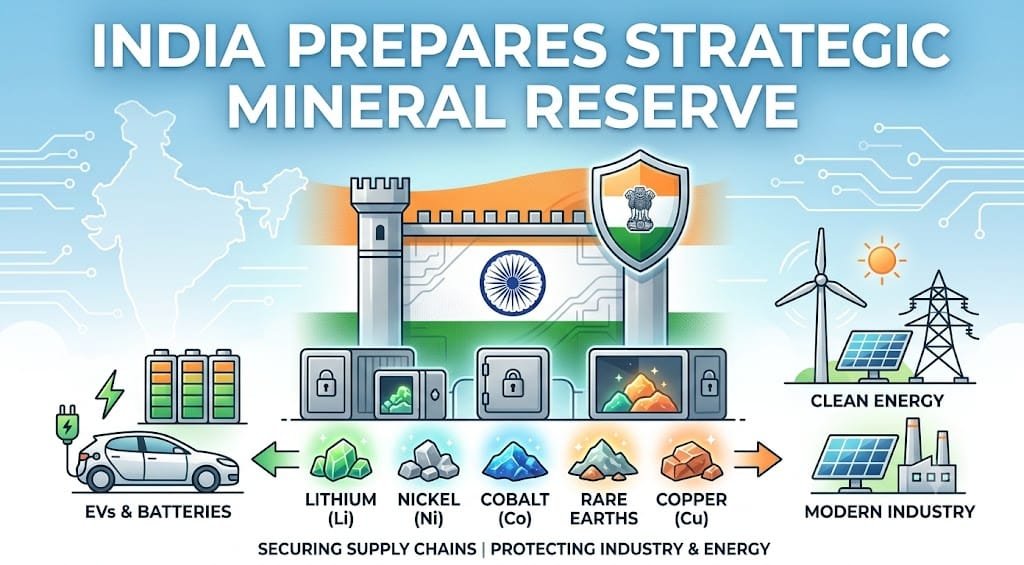
India is preparing to finalise a new policy for stockpiling critical minerals within about a month. The move comes at a time when global supply chains have become uncertain and the country remains heavily dependent on imports for materials that are essential for electric vehicles, batteries, wind turbines, power networks and several modern industries.
According to Mines Secretary Keshav Chandra, elaborate plans are being prepared to create strategic reserves of these minerals.
A stockpile is simply a carefully maintained reserve of important materials. Its purpose is to ensure that, even if global supplies are suddenly interrupted, Indian factories and clean-energy projects do not come to a halt. Critical minerals such as copper, lithium, nickel, cobalt and rare earth elements are needed for battery manufacturing, electric mobility, renewable energy equipment and electricity infrastructure.
These materials may not be visible in daily life, but they sit at the centre of the country’s transition towards cleaner energy and advanced manufacturing.
The urgency arises because India has limited capacity to process these minerals and is fully import-dependent for most of them. This creates a major strategic risk. China controls around 90 per cent of global critical mineral processing and has often used this advantage during periods of trade tension. In such a situation, any restriction on exports, a shipping disruption or a geopolitical conflict can raise prices and delay projects in India. A domestic reserve can therefore act as insurance against such shocks.
The proposed National Critical Mineral Stockpile Programme is part of the National Critical Minerals Mission. The government has committed Rs 500 crore for the mission period from 2024-25 to 2030-31 to develop this reserve. The stockpile is expected to include at least five critical minerals and will be designed to meet domestic needs during emergencies. It may be developed through a joint initiative involving central public-sector undertakings and private companies.
The policy also highlights a larger challenge: owning mineral assets abroad does not automatically guarantee secure supplies. India’s overseas acquisition vehicle, Khanij Bidesh India Ltd, has faced difficulties in expanding its presence in mineral-rich countries such as Australia, Vietnam, Mali and Chile, where several proposed projects have stalled or failed.
Its main progress so far has been in Argentina, where it has acquired five lithium brine blocks in Catamarca province. This shows why building domestic processing capacity and maintaining reserves have become equally important.
To reduce dependence on imported processed materials, the government has identified Andhra Pradesh, Odisha, Gujarat and Maharashtra for critical mineral processing plants. Gujarat and Andhra Pradesh are expected to focus on rare earth processing, while Odisha and Maharashtra are set to work on nickel and lithium respectively.
The idea is to develop each park as a complete ecosystem for a particular mineral, bringing together processing, technology and industry in one place.
Technology is another major part of the plan. The Mines Secretary has underlined that countries which have developed advanced critical-mineral processing technology are generally unwilling to share it with newer players. India therefore needs to build indigenous technology while also using opportunities where technology is available. Nine Centres of Excellence have been identified for this purpose, and some are reported to be making substantial progress.
The government is also considering a separate scheme for lithium and nickel, two minerals considered crucial for the battery-manufacturing ecosystem. Such support could encourage companies to invest in processing facilities within India rather than depending entirely on foreign supply chains.
For ordinary people, this policy may sound technical, but its impact could be very real. Secure mineral supplies can help keep electric vehicles affordable, support battery production, strengthen renewable energy projects and reduce the risk of sudden price increases. If implemented effectively, the stockpiling policy could become an important step towards making India’s clean-energy and manufacturing ambitions less vulnerable to global disruptions.

