
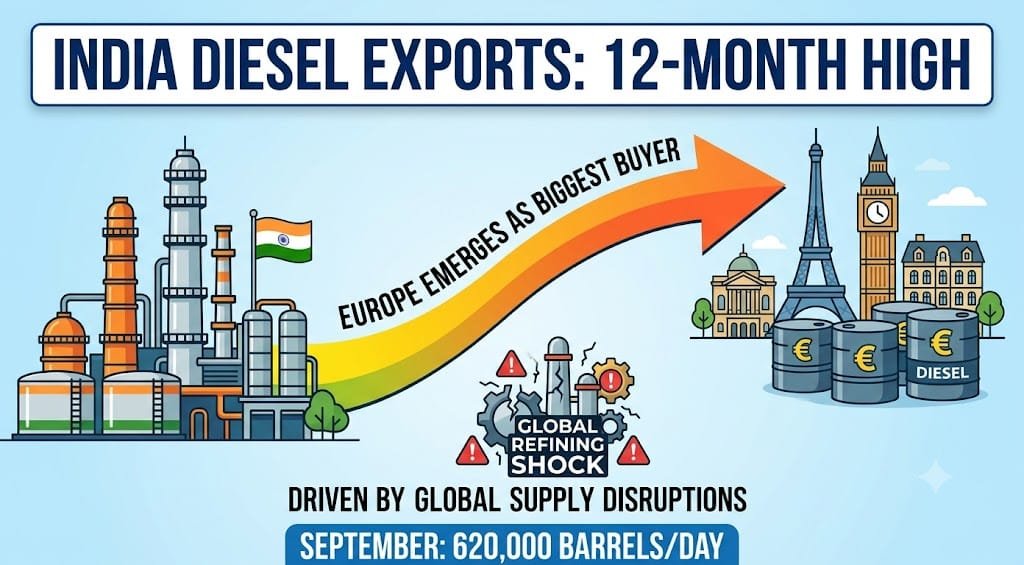
India’s diesel exports rose to their highest level in twelve months during September, showing how a sudden disruption in global refining has created a major opportunity for Indian fuel producers.
According to market data cited in reports, Indian refiners exported around 620,000 barrels of diesel per day last month, or roughly 2.50 million tonnes in total. This was the strongest monthly performance in a year and came at a time when several major fuel-producing regions were struggling to maintain normal supplies.
The main reason behind this rise was a global refining shock. Attacks on refineries in Russia, disruptions in West Asia, shipping constraints and reduced Chinese exports together affected a large part of the world’s refining capacity.
Traders and analysts estimated that around 8 million barrels per day of global refining capacity was impacted, which is close to 10 per cent of total capacity. When refineries cannot operate smoothly, they produce less petrol, diesel and jet fuel. This creates shortages in countries that depend on imports, pushing prices and profit margins higher.
For Indian refiners, especially private-sector companies such as Reliance Industries, this became a valuable opening. Diesel refining margins, often called “cracks,” rose sharply because diesel became scarce in international markets. In September, Singapore diesel margins against Dubai crude were reported to be above $60 per barrel.
Such high margins encouraged refiners to produce more diesel and send larger quantities abroad, since selling in overseas markets became more profitable.
Europe was the biggest destination for Indian diesel. Nearly half of India’s September shipments, about 280,000 barrels per day, went to Europe. This was around 80 per cent higher than August, reflecting the region’s urgent need for alternative supplies. Europe depends heavily on imported diesel, and disruptions in Saudi refining along with limited availability of Russian fuel made the shortage more serious.
As a result, India emerged as an important “swing supplier,” meaning a country that can quickly increase shipments when global supply falls. India also supplied diesel to other regions. Around 200,000 barrels per day went to Africa, 50,000 barrels per day to Asia and 40,000 barrels per day to the Americas.
The remaining shipments went to destinations that were not clearly identified. Interestingly, there were no diesel shipments to Russia in September, although some flows had been seen in the previous three months. This wide geographic reach shows that Indian refineries were able to serve markets across Europe, Africa, Asia and even distant parts of the Americas.
The rise in exports does not mean that every part of India’s fuel sector benefited equally. Export-oriented refineries gained strongly from high international margins, but companies selling fuel mainly in the domestic market may not have enjoyed the same advantage.
Domestic selling prices are often regulated or constrained, which can limit the benefit of higher global prices. In addition, India imposes a windfall tax on diesel exports, which was about $37 per barrel in September. This tax reduces a significant part of the profit earned by exporters, although export-focused refineries in special economic zones may have different tax treatment.
Overall, September’s export surge highlights India’s growing importance in the global fuel market. A combination of geopolitical tension, refinery outages and shipping problems reduced supply elsewhere, while Indian refiners maintained domestic availability and expanded overseas sales.
If global disruptions continue, India could remain a key supplier of diesel, but the same global tightness could also keep energy costs elevated for consumers and businesses.

