
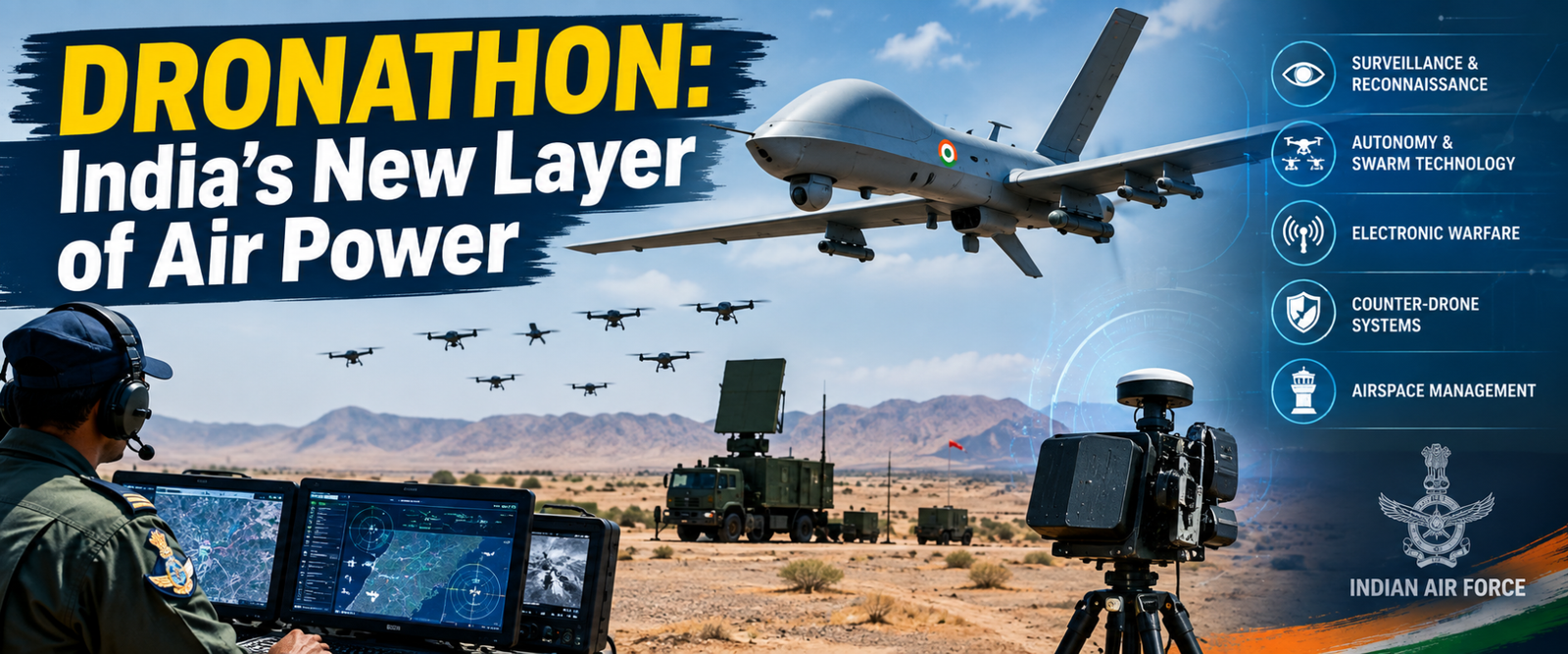
Post Operation Sindoor, the importance of drones and unmanned systems has been widely acknowledged. The significance of India’s first Dronathon is not simply that the Indian Air Force is testing more drones. It is that the IAF is beginning to treat unmanned warfare as a wider operational system, linking drones with autonomy, electronic warfare, counter-drone technology and airspace management.
Held at the Pokhran Field Firing Range in Rajasthan from September 14 to 16, Dronathon brought together defence companies, start-ups, MSMEs, DPSUs and innovators. The exercise covered surveillance, autonomous operations, swarm technology, electronic warfare and counter-Unmanned Aircraft Systems. The focus was on assessing operational effects under demanding conditions rather than simply displaying new technology.
That distinction matters. The future of drone warfare will not be determined only by the number of unmanned aircraft a country possesses. It will increasingly depend on how effectively those platforms connect with sensors, communications, data and command systems.
Beyond the drone
Military discussions around drones have often focused on individual platforms: range, payload, endurance and autonomy. But an unmanned aircraft is only one part of a larger system. Its battlefield value depends on its ability to gather information, communicate with other platforms and operate in contested environments.
Dronathon reflected this shift. Surveillance, reconnaissance, swarm operations, autonomy, electronic warfare and counter-drone technologies were brought into the same operational framework. This points to a broader change in military thinking. Unmanned warfare is becoming less about individual aircraft and more about networks of connected capabilities.
The counter-drone challenge
The spread of drones has created an equally important requirement: defeating them.
Small unmanned systems can provide surveillance, identify targets and threaten military infrastructure. Their relatively low cost also creates an economic challenge for conventional air defence. Using expensive weapons against large numbers of inexpensive drones may not always be sustainable. Counter-UAS capabilities are therefore becoming a necessary part of modern air power.
Dronathon placed offensive and defensive unmanned technologies alongside each other. The IAF needs systems that can exploit drones while protecting its bases, forces and infrastructure from hostile ones. This could make control of lower-altitude airspace increasingly important. Future air operations may involve not only fighter aircraft and missiles, but also large numbers of unmanned systems operating below them.
From prototypes to capability
Dronathon also saw the release of the IAF’s UAS Roadmap, providing industry and research organisations with greater clarity about future requirements. That matters because developing a prototype is very different from developing a military capability.
India has a growing defence start-up ecosystem, but the transition from innovation to induction requires testing, refinement and sustained engagement with military users. A clearer roadmap can help companies develop systems around actual operational requirements rather than purely technical possibilities. The real measure of Dronathon will therefore come later. If systems demonstrated at Pokhran move through further trials and eventually enter service, the exercise will have helped create a pathway from innovation to capability.
Managing a crowded sky
The drone challenge also extends beyond combat. The IAF demonstrated Vayu UTtaM, an indigenous multi-mode unmanned traffic management system designed to detect and track military and civil unmanned aircraft. It is intended to support coordinated UAS operations and help identify unauthorised drones. This will become increasingly relevant as civilian drone use expands. Military drones, commercial operators and conventional aviation will increasingly share the same airspace.
Knowing what is flying, where it is flying and whether it is authorised will therefore become an operational capability in its own right. India’s unmanned strategy is consequently not limited to manufacturing aircraft. It also requires systems that can manage and monitor an increasingly crowded aerial environment.
India’s Drones: A New Layer of Air Power
Dronathon also fits into India’s wider effort to build domestic defence technology. The focus extends beyond airframes to propulsion, sensors, payloads, communications, autonomy, electronic warfare and countermeasures. Developing these capabilities within India can reduce dependence on imported components and give the armed forces greater flexibility.
The participation of start-ups and smaller manufacturers is particularly relevant. Direct interaction with military users can help emerging companies understand operational requirements and improve their systems. But the success of this ecosystem will ultimately depend on what happens after demonstrations. Indigenous innovation will matter most when it produces reliable systems that can be deployed and sustained by the armed forces.
A new layer of air power
The traditional architecture of air power is built around fighters, missiles, surveillance aircraft and air-defence systems. Those capabilities will remain central. But unmanned systems are adding another layer. They can provide persistent surveillance, extend operational reach and perform missions without exposing personnel or expensive platforms unnecessarily. Autonomous systems and swarms could further change reconnaissance and combat operations, while counter-UAS systems will be required to defend against them.
Dronathon therefore represents more than an exercise focused on drones. It reflects an emerging shift in how India views the future battlefield. The challenge is no longer simply to build or acquire unmanned aircraft. It is to connect them with the sensors, networks, electronic warfare systems and command structures that allow them to function as part of a wider force.
The next phase of air power will increasingly be shaped by integration. For India, the question is not whether drones will become important, but how quickly their different capabilities can be brought together into a reliable operational system.

