
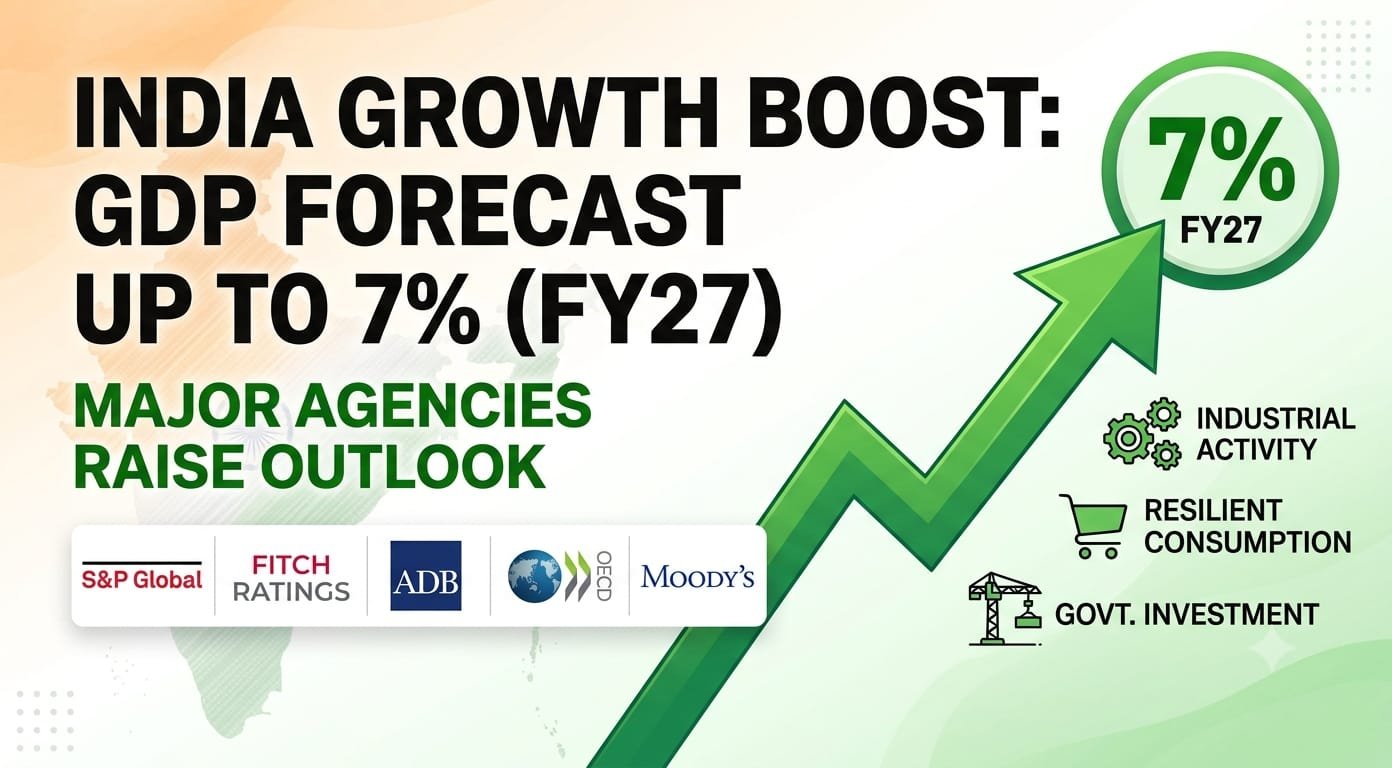
A fresh wave of optimism has entered India’s economic narrative as leading global agencies S&P Global, Fitch, the Asian Development Bank (ADB), and the OECD have lifted their GDP growth forecast for the current fiscal year (ending March 2027) to around 7 percent . This move comes on the back of a strong April–June quarter, where the economy expanded faster than expected, and a notable resilience in domestic activity even as geopolitical tensions in West Asia created global headwinds.
The upgraded numbers sit above the Reserve Bank of India’s 6.7 percent projection and align with Moody’s recent revision to 7 percent , signaling a broad-based confidence in India’s near-term momentum.
The drivers behind this upgrade are straightforward and relatable. Factories have been humming with robust industrial activity, households have continued to spend steadily, exports of goods have held up well, and government capital spending has picked up pace. S&P Global highlighted these very factors in its latest Asia-Pacific outlook, noting that the combination of strong investment demand, healthy consumption, and manufacturing and services growth supported a 7.8 percent year-on-year expansion in the first quarter of FY27.
The agency raised its full-year forecast to 7 percent from 6.6 percent , while also flagging that growth could ease slightly in the second half as certain one-off boosts such as tax rationalization and income tax relief fade.
At the same time, agencies are keeping a close watch on two familiar variables that touch everyday life: the monsoon and inflation. Cumulative rainfall remained about 15 percent below normal until early September, which keeps agricultural output and food prices in focus. Fitch pointed out that below-normal rains could weigh on farm growth and rural demand, while rising inflation may squeeze real incomes and temper consumer dynamics.
Even so, private investment prospects appear brighter, with investment expected to rise by more than 10 percent and non-food credit growth touching 19 percent in July, suggesting that businesses are willing to expand capacity.
The ADB’s revision to 7 percent for FY27 reflects India’s stronger-than-expected start to the fiscal year, supported by resilient consumption, solid manufacturing and services performance, and sustained capital inflows. For the next fiscal (2027–28), the bank projects growth at 7.1 percent , a touch lower than its earlier 7.3 percent estimate, largely because the base level of GDP is now higher.
The OECD, meanwhile, lifted its FY27 projection by 80 basis points to 7.1 percent , crediting resilient domestic demand and policy measures that cushioned households and firms from higher energy prices. Across these assessments, a common thread emerges: India’s growth engine is being powered by domestic demand and policy support, even as external shocks and weather risks require careful monitoring.
Taken together, these upgrades paint a picture of an economy that is absorbing global stress better than many peers, while continuing to create jobs, invest in infrastructure, and sustain consumption. The message is not of unchecked acceleration but of steady, policy-backed momentum with clear watchpoints monsoon performance, food inflation, and the pace of private investment determining how smoothly the 7 percent trajectory plays out through the rest of the fiscal year.

