
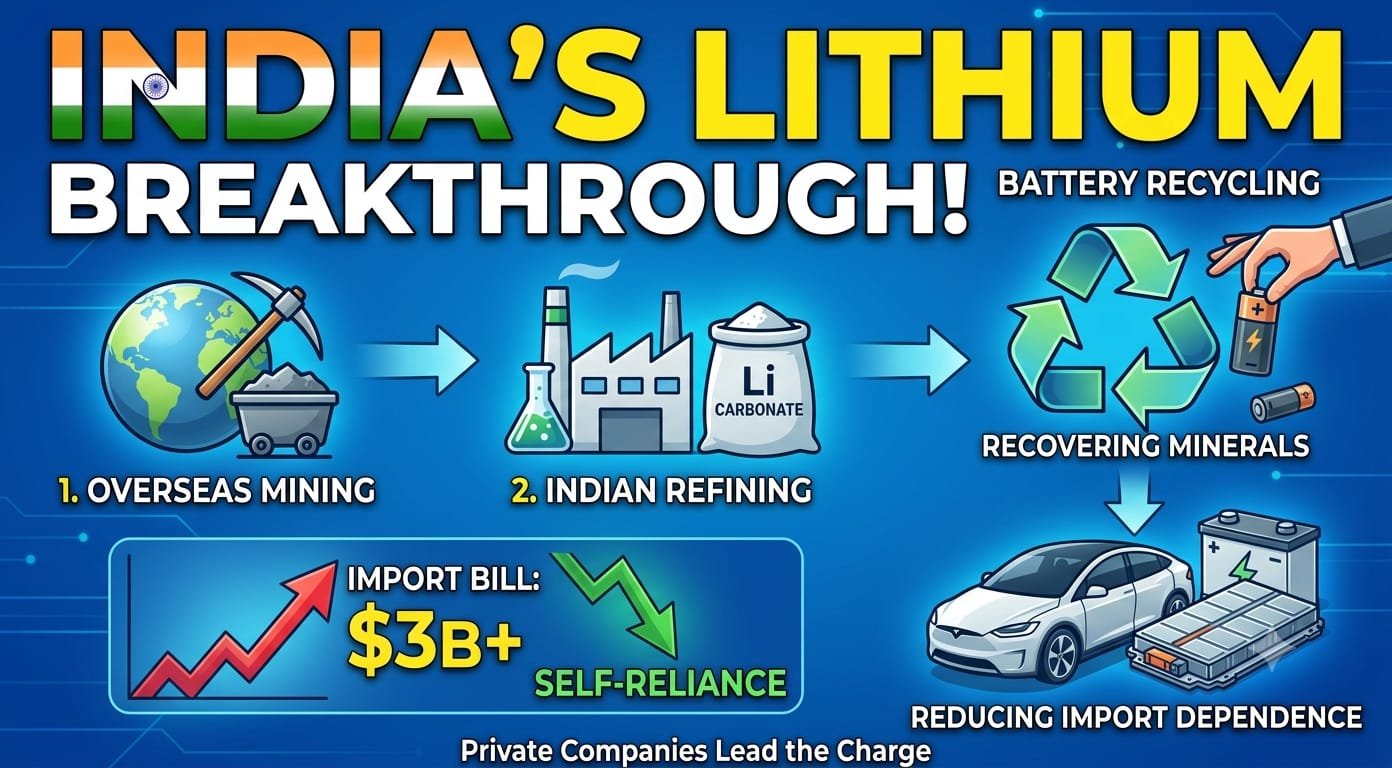
India’s electric vehicle and battery industry is entering an important phase. For several years, the country has depended almost entirely on imported lithium-ion batteries. Now, private companies are trying to build a complete supply chain inside and outside India. The plan includes mining lithium overseas, refining it in India, producing battery materials and recovering valuable minerals from used batteries.
Lithium is an important mineral for electric vehicles, mobile phones and energy-storage systems. It is used in lithium-ion batteries, which store and supply power. As electric vehicles become more common and renewable energy expands, the demand for lithium batteries is also rising. This has made lithium a strategic resource for India.
At present, India’s dependence on imported lithium-ion batteries is close to 100 per cent. Around three-fourths of these imports mainly come from China. The cost of importing such batteries has also increased sharply. India’s lithium-ion battery import bill crossed $3 billion in the financial year 2024-25, almost eight times higher than it was six years earlier. This heavy dependence creates risks for the electric vehicle industry, especially if global prices rise or supplies are affected.
Private companies are now trying to close this gap. Hyderabad-based Altmin is planning to invest $200 million in a lithium refinery at Kakinada in Andhra Pradesh. The facility is expected to process 30,000 tonnes of spodumene every year and produce lithium carbonate, a battery-grade material. Engineering work has already started, and the refinery is expected to begin operations within two years.
Spodumene is a lithium-bearing ore. It is processed to separate lithium-bearing material, which is then refined into lithium carbonate. This refined material is used to make cathode active materials. Cathodes are among the most important parts of a battery cell. Battery cells are later used in electric vehicles, electronic devices and stationary energy-storage systems.
Altmin has purchased lithium-refining technology from Brazil for an estimated $15-20 million. The company expects demand from its own operations and from other battery-material manufacturers. It is also setting up a lithium iron phosphate cathode plant in Mahabubnagar, Telangana. The project will have a capacity of 25,000 tonnes per year and is planned in two phases, with an investment of about Rs 800 crore.
Greater Noida-based Lohum is following a different route. The company has started mining lithium from 10 blocks in Zimbabwe. These mines are expected to produce around 30,000 tonnes of lithium carbonate annually. Lohum already operates a lithium-refining facility in Greater Noida with a capacity of 1,000 tonnes per year. It is now searching for a location for a much larger refinery in India, where the material from Zimbabwe can be processed.
This approach could connect foreign mining resources with Indian manufacturing. Instead of importing finished batteries, India could import raw material, refine it domestically and use it to produce battery components. Such a system could create new industrial opportunities and reduce dependence on finished products from other countries.
Recycling is another important part of this developing supply chain. Batteries do not become useless after an electric vehicle or electronic device reaches the end of its life. Used batteries still contain lithium, cobalt, nickel, graphite and other valuable minerals. Recycling can recover these materials and put them back into production.
Attero currently operates 16,000 tonnes of lithium-ion battery recycling capacity. It is adding another 10,000 tonnes and plans to reach 60,000 tonnes annually within three years. The company is also expanding its total processing capacity from around 200,000 tonnes to 500,000 tonnes a year. New facilities are planned in Bengaluru and Andhra Pradesh, along with existing operations in Roorkee, Pune and Reengus.
Kolkata-based Navprakriti is also focusing on battery recycling. The company has received approval from the Directorate General of Foreign Trade to import battery scrap. It is exploring supplies from Bangladesh and Nepal, while discussions are also taking place with suppliers in Indonesia, Singapore and Africa. The company is targeting its first imports in October 2026.
The wider message is clear. India will need both fresh lithium from mines and recovered lithium from used batteries. Overseas mining can provide raw material, Indian refineries can process it, and recycling companies can recover minerals from old batteries. Together, these efforts can support electric vehicles, reduce import pressure and make India’s energy transition more secure.

