
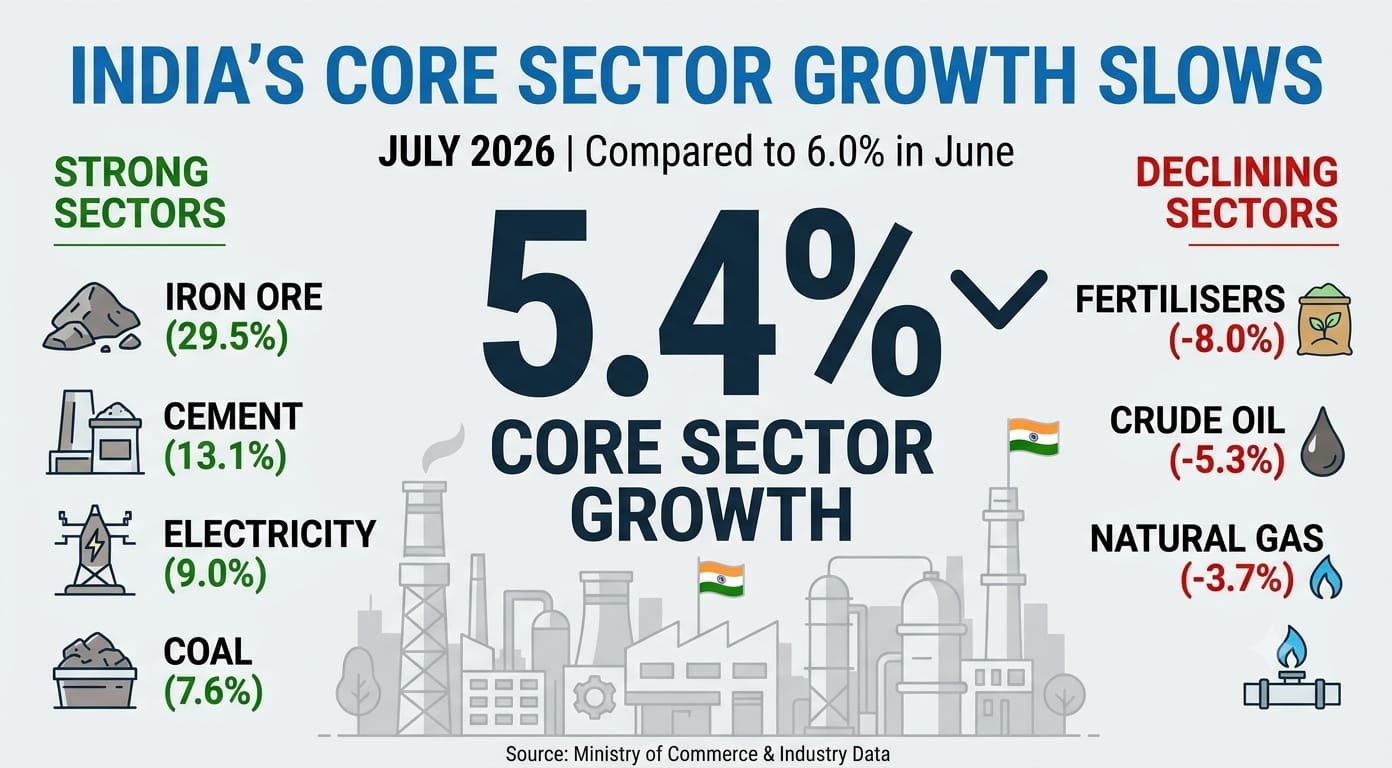
India’s core sector growth slowed to 5.4% in July 2026, compared with a revised growth rate of 6% in June. The data, released by the Ministry of Commerce and Industry, shows that the country’s major infrastructure-linked industries continued to expand, but the pace was not the same across all sectors. The July performance was still stronger than the 3.2% growth recorded in July 2025 last year, showing that industrial activity remained firm despite some weaknesses.
Core industries are important because they supply the basic materials and energy needed by factories, construction companies, transport services and households. The index covers nine major sectors, including coal, crude oil, natural gas, refinery products, fertilisers, steel, cement, electricity and iron ore. When these sectors grow, the wider economy often receives support through higher construction activity, improved production and stronger demand for transport and services.
The overall index of core industries rose to 121.2 in July from 120.7 in June. This means that production increased during the month even though the annual growth rate became slower. Six of the nine sectors recorded positive growth, while three sectors reported a decline. The result presents a mixed picture: construction-related industries performed well, but energy and fertiliser production faced difficulties.
Iron ore remained the strongest-performing sector in July, with production rising 29.5% compared with the same month last year. However, the pace was much lower than the 44.5% growth recorded in June. Iron ore is a key raw material for steel production and is closely connected with mining, transport and infrastructure activity. The sharp rise still indicates strong demand, although the slowdown suggests that the sector’s rapid expansion may be losing some momentum.
Cement production increased by 13.1% in July, marking a seven-month high. The sector had recorded 9.9% growth in June and 11.1% growth in July 2025. Strong cement output usually reflects demand from housing, roads, bridges, factories and other construction projects. For ordinary households, this growth can be linked to visible activity such as new buildings, expanding highways and public infrastructure work.
Electricity generation grew by 9% in July, although this was slower than the 11.4% growth seen in June. Coal production increased by 7.6%, supporting power generation and industrial operations. Steel output also grew, but only by 2.9%, compared with 5.6% in June. This was the lowest steel growth recorded in the 14 months available under the new data series. Since steel is widely used in automobiles, construction, machinery and infrastructure, weaker growth in this sector deserves close attention.
Refinery products returned to growth after contracting for three consecutive months. Production rose by 2.7% in July, compared with a 4% decline in June. This improvement may provide some support to the petroleum and manufacturing sectors. However, the recovery remains modest and will need to continue in the coming months to make a stronger contribution to overall industrial growth.
The weakest performance came from fertilisers, crude oil and natural gas. Fertiliser production declined by 8% in July, worsening from a 3.3% contraction in June. This is important for agriculture because fertilisers are directly linked to farm operations and crop production. Crude oil output fell by 5.3%, while natural gas production declined by 3.7%, continuing a period of weakness in domestic energy production.
Despite the slowdown in July, the cumulative performance during April-July 2026 remained encouraging. The nine core sectors grew by 4.3% during this period, compared with only 1.5% during the same period a year earlier. This suggests that industrial activity has improved over the financial year so far, even though some sectors are struggling in individual months.
The July data therefore tells a balanced story. Cement, iron ore, electricity, coal and refinery products indicate continuing strength in construction and selected industrial activities. At the same time, falling crude oil, natural gas and fertiliser output, along with slower steel growth, show that the recovery is uneven. Future industrial performance will depend on whether energy and fertiliser production improve while construction-led growth remains strong.

