
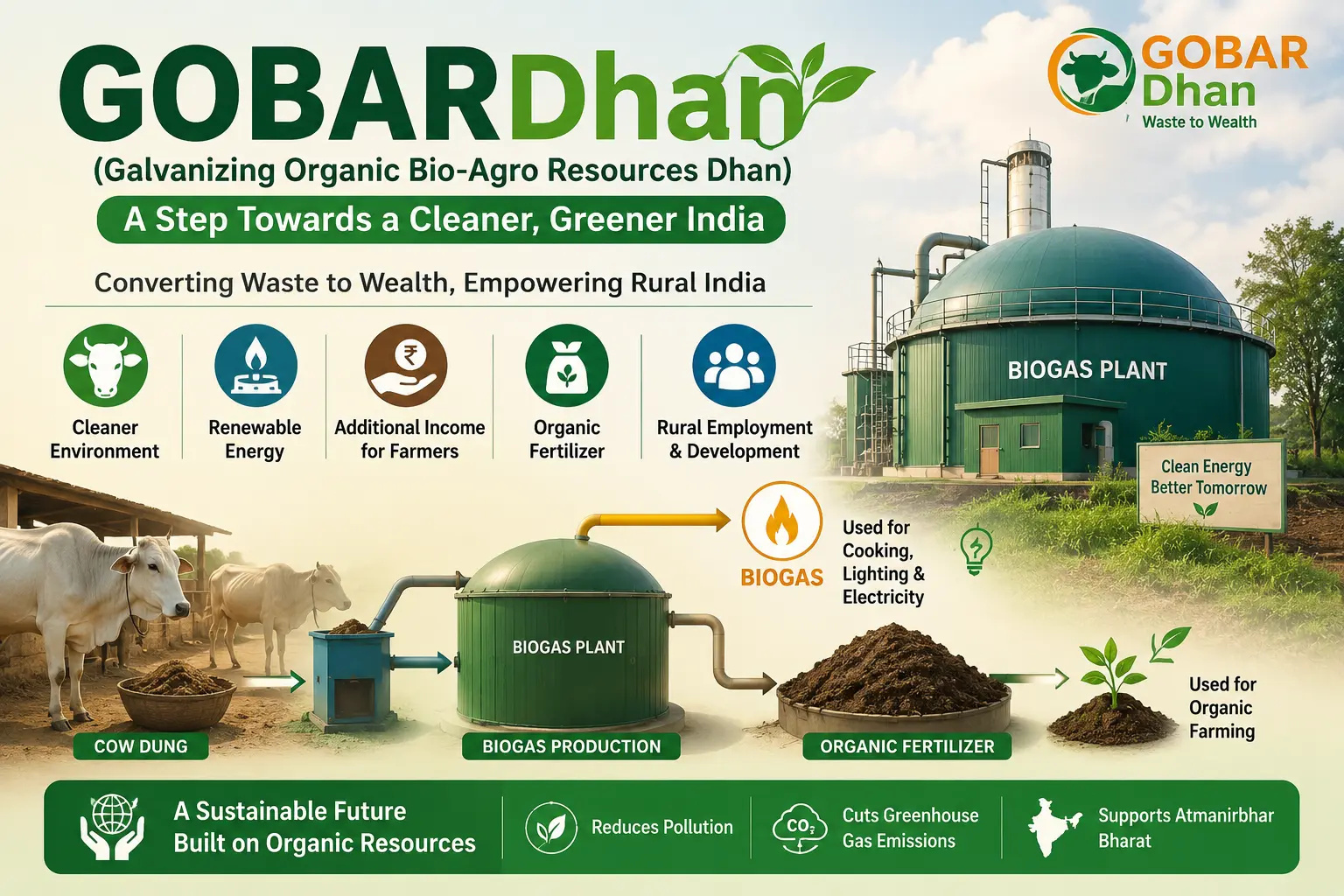
The GOBARdhan Scheme is set to transform India’s energy landscape by converting organic waste into Compressed Biogas (CBG). It is expected to reduce gas imports by $5 billion and fertiliser imports by $1 billion. This initiative offers economic, environmental, and social benefits while creating rural jobs and improving soil health.
Remember the villagers in India trying to collect cow dung to fuel their stoves? That is a thing of the past with the Ujjawala Scheme, so now that organic waste is being converted into fuel.
India’s push toward energy self-reliance has found a powerful new engine in the GOBARdhan Scheme, a national circular bioenergy initiative that promises to turn everyday waste into a strategic asset.
Approved by the Union Cabinet with a financial outlay of Rs 23,731 crore, the scheme is designed to convert organic waste such as agricultural residues, cattle dung, and municipal solid waste into clean energy in the form of Compressed Biogas (CBG).
According to the Indian Biogas Association (IBA), this move could trim India’s natural gas import bill by as much as $5 billion annually, while also delivering wide-ranging economic, environmental, and social dividends.
At the heart of the matter lies India’s heavy dependence on imported natural gas. About half of the country’s natural gas needs are met through imports, leaving the economy exposed to volatile global prices and geopolitical shocks. In FY 2024–25 alone, liquefied natural gas (LNG) imports cost India around $15.2 billion (roughly Rs 1.28 lakh crore).
With the ongoing West Asia crisis and a weakening rupee, that bill is expected to rise further. The GOBARdhan Scheme seeks to change this story by scaling up domestic CBG production. IBA estimates suggest that with around 1,500 fully functional CBG plants in the coming years, India could cut its gas import deficit by one-third, translating into savings of about $5 billion (nearly Rs 40,000 crore).
The scheme’s benefits, however, extend far beyond energy savings. CBG plants produce two valuable by-products: Fermented Organic Manure (FOM) and liquid bio-slurry. These are rich in nutrients and can partially replace chemical fertilisers, especially imported phosphatic and potassic varieties.
In FY 2024–25, India’s fertilizer import bill stood at $18 billion (around Rs 1.5 lakh crore). IBA projects that widespread adoption of CBG by-products, combined with good agricultural practices, could reduce fertiliser imports by at least 5 percent saving another $1 billion annually and easing the burden on the current account deficit.
From a rural perspective, the scheme opens up new income streams. Farmers and rural entrepreneurs can monetise agricultural residues and cattle waste that would otherwise be burned or left to rot. This not only curbs stubble burning, a major cause of air pollution in the National Capital Region, but also improves soil health over time.
Healthier soils mean lower dependence on chemical inputs, better crop quality, and more sustainable farming. The scheme is also expected to generate significant employment, particularly in rural areas, by creating skilled and semi-skilled jobs in CBG plant operations, feedstock collection, and supply chain management.
To make this vision work, the government has built in several support mechanisms. City gas distribution companies will be required to blend CBG into their supplies 3 percent in 2026–27, 4 percent in 2027–28, and 5 percent from 2028–29 onwards. A stable administered price of Rs 2,110 per MMBTU has been fixed for CBG to give producers revenue certainty.
Greenfield projects can receive capital assistance of up to Rs 2 crore per tonne per day of installed capacity, while brownfield expansions are also eligible for support. Additional help comes in the form of pipeline infrastructure funding, credit guarantees for MSMEs, and a challenge fund to spur innovation in feedstock aggregation and technology.
The timing of the scheme is especially significant. With global energy markets in flux and India aiming to raise the share of gas in its energy mix from 6 percent to 15 percent by 2030, boosting domestic CBG production aligns with both energy security and climate goals.
The scheme is set to run for ten years, from 2026–27 to 2035–36, and aims to increase domestic CBG output nearly tenfold. By turning waste into wealth, cutting import bills, creating jobs, and cleaning the air, GOBARdhan represents a rare win-win for the economy, the environment, and the farmer.

