
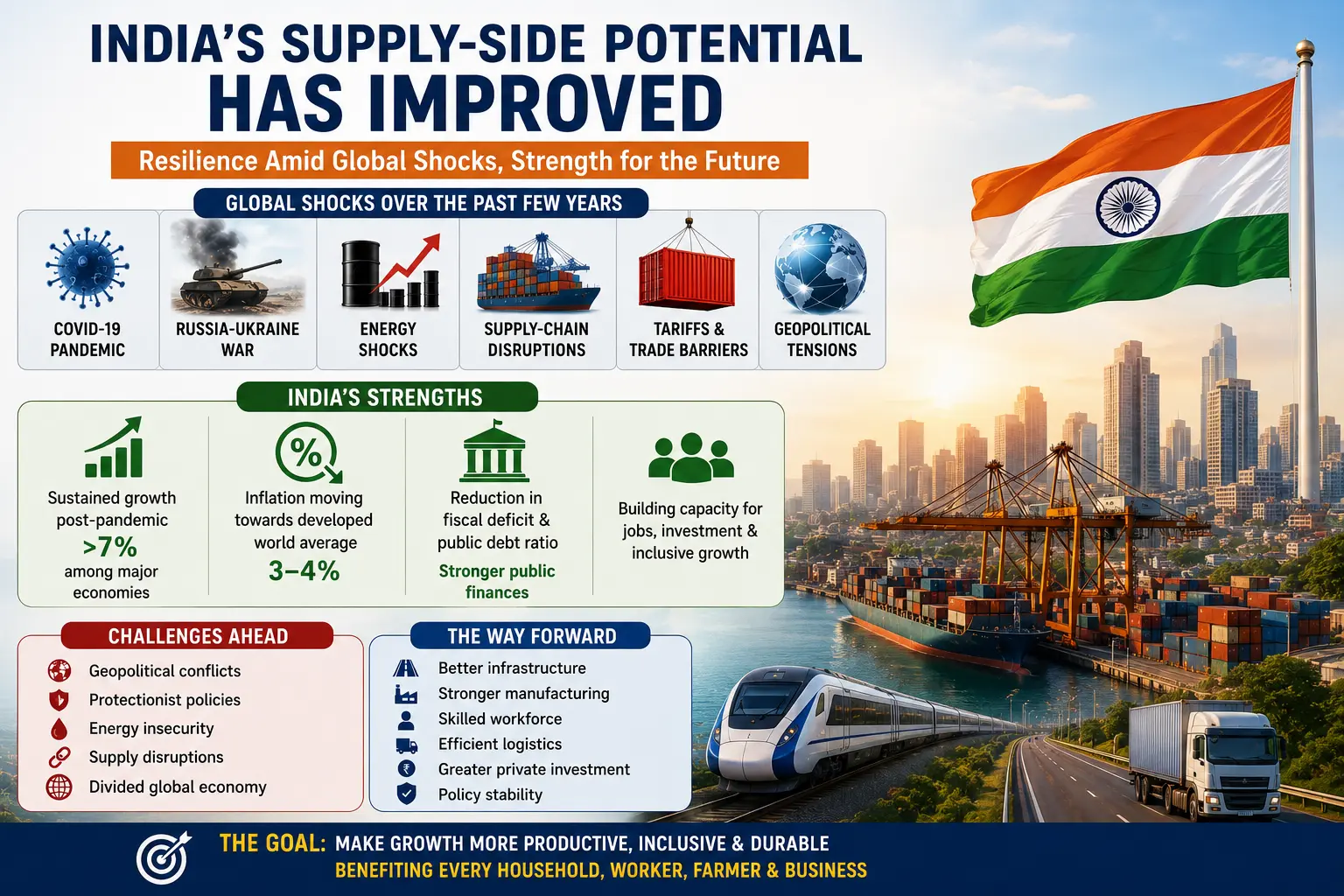
India’s supply-side potential has improved in the past few years despite the pandemic, wars, energy shocks, tariffs and supply-chain disruptions. Chief Economic Advisor (CEA) to the Government of India V. Anantha Nageswaran, explained about the Indian economy’s resilience and the challenges that still lie ahead in a recent address.
The economy has become stronger on the supply side despite facing several serious global shocks over the past decade. Chief Economic Adviser V. Anantha Nageswaran said the country has managed to maintain economic growth while also reducing the pressure of public debt and the fiscal deficit. This combination is being seen as an important sign of improvement in India’s economic strength.
The statement came during an address at an Assocham FinTech event. The discussion focused on how the Indian economy has dealt with repeated disruptions and what may lie ahead. Over the last few years, the world economy has faced the Covid-19 pandemic, the Russia-Ukraine war, rising energy prices, supply-chain problems, tariffs and continuing geopolitical tensions. Each of these events affected trade, investment, prices and business confidence across countries.
India, however, continued to show resilience during this difficult period. According to Nageswaran, sustained growth after the pandemic has indicated that the economy’s ability to produce goods and services has improved. In simple terms, supply-side potential means the capacity of an economy to create products, provide services, generate jobs and expand businesses without putting excessive pressure on prices. A stronger supply side can help an economy grow in a more stable and lasting manner.
India has also been among the few major economies to record growth of more than 7 per cent after the Covid period, according to comments attributed to the Chief Economic Adviser. This performance became significant because growth continued even when international conditions remained uncertain. The economy had to deal with higher input costs, disruptions in the movement of goods and changing global trade conditions, yet domestic activity remained relatively strong.
Another important development has been the movement of inflation closer to the levels seen in developed economies. Nageswaran said India’s average inflation has declined over time and is increasingly moving towards the developed-world average of around 3 to 4 per cent. Lower and more stable inflation matters because it protects household budgets, supports consumption and makes it easier for businesses to plan investments.
The improvement in public finances has added another layer of strength. Economic growth accompanied by a reduction in the fiscal deficit and public debt ratio suggests that expansion has not been based only on heavy government borrowing. A lower fiscal burden can give the government greater room to respond when another crisis appears. It can also support long-term spending on infrastructure, technology, manufacturing and human development.
Still, the message from the Chief Economic Adviser was not limited to optimism. The next 20 years may be more difficult than the previous period because the global environment is changing rapidly. Geopolitical conflicts, protectionist trade policies, energy insecurity and repeated supply disruptions may remain important risks. The international economic system is also becoming more divided, creating uncertainty for trade, capital flows and technology cooperation.
The situation creates both pressure and opportunity. A resilient domestic economy can help absorb external shocks, but continued progress will require better infrastructure, stronger manufacturing, skilled workers, efficient logistics and greater private investment. Policy stability will also remain important as businesses make decisions that involve large investments and long time periods.
The broader message is that the economic story is no longer based only on the hope of future growth. The country has already demonstrated an ability to grow through difficult global conditions. The bigger task now is to make that growth more productive, inclusive and durable so that its benefits reach households, workers, farmers and businesses across the country.

