
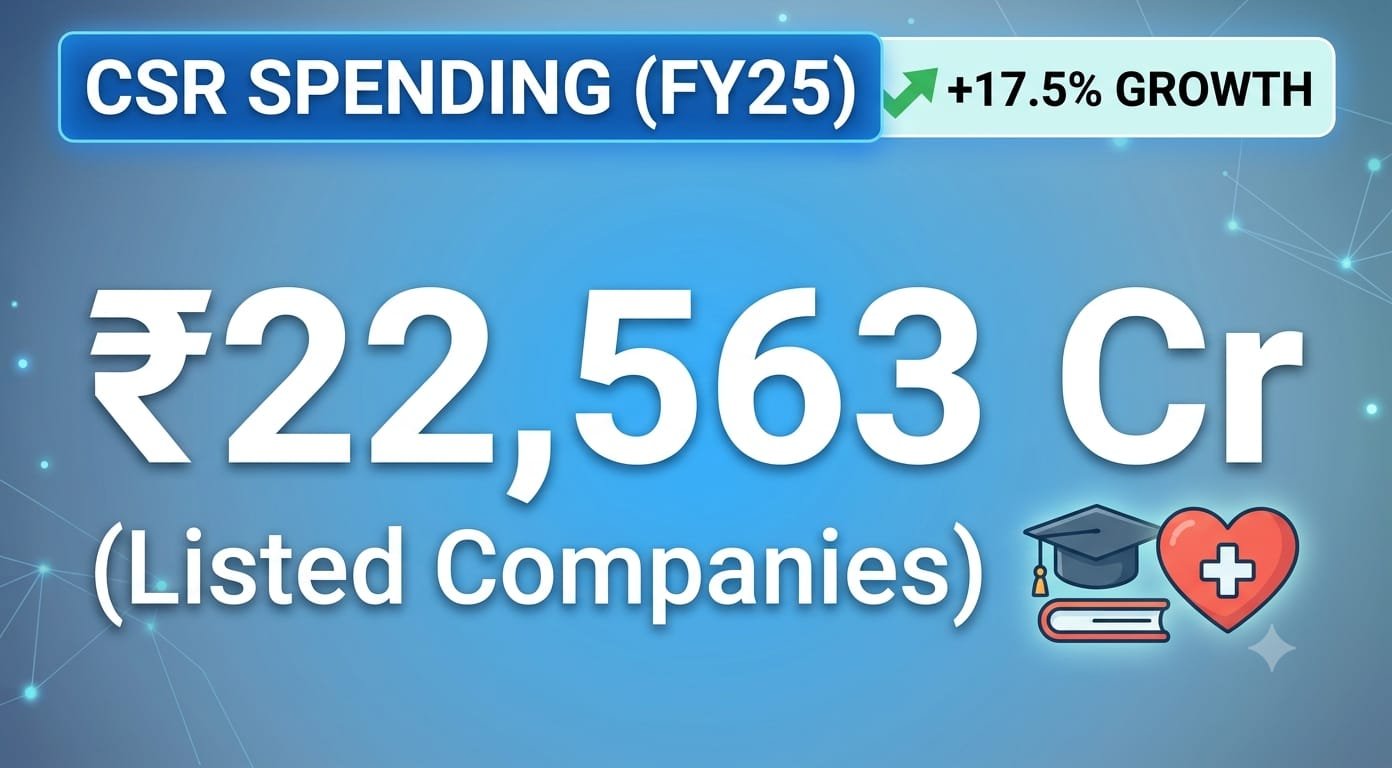
Corporate social responsibility spending by listed companies in India increased sharply in the financial year 2025. According to Crisil’s CSR Yearbook 2026, companies spent ₹22,563 crore on social and development-related activities during the year. This was 17.5 per cent higher than the ₹19,208 crore spent in the previous financial year. The rise shows that CSR is becoming a larger and more organised part of corporate activity in India.
The increase was not limited to the amount of money spent. The number of companies reporting CSR expenditure also grew significantly. In FY25, 2,013 companies reported CSR spending, compared with 1,678 companies in FY24. This represents a 20 per cent rise and is described as the fastest growth in the number of reporting companies in a decade.
The findings are based on an analysis of 2,323 listed companies. These companies met at least one of the CSR applicability conditions based on their financial performance in the preceding financial year. Under India’s corporate law, companies meeting specific profit, turnover or net-worth requirements are required to spend a portion of their profits on approved social development activities.
A major part of the additional spending came from companies that had already been contributing to CSR projects. At the same time, several new companies also entered the pool of CSR contributors. This combination helped increase the total expenditure and broaden the participation of businesses in social programmes.
Education and skill development remained the most important area of CSR spending. Companies spent ₹9,182 crore on this sector, which accounted for nearly 41 per cent of the total CSR expenditure.
The focus included access to education, scholarships, vocational training, employability programmes and skill development initiatives. These activities are closely connected with employment opportunities and the long-term improvement of household incomes.
Healthcare and sanitation received the second-largest share. Spending in this category stood at ₹5,386 crore, or almost 24 per cent of the total. The money supported healthcare services, medical facilities, sanitation programmes and other activities linked to public health. The continued high allocation to this area reflects the importance of basic services in improving everyday living conditions.
Some sectors recorded a smaller share but showed much faster growth. Environmental spending nearly quadrupled to ₹2,371 crore. Rural development expenditure rose to ₹1,632 crore, while spending on sports increased to ₹753 crore. The growth in these areas suggests that companies are gradually expanding their CSR priorities beyond education and healthcare.
Environmental projects can include conservation, pollution control, water management and climate-related efforts. Rural development programmes may support village infrastructure, livelihoods, drinking water and local economic activity. Sports-related projects can help promote health, discipline, talent development and community participation.
The sector-wise contribution also shows which parts of the economy are spending the most on CSR. Banking, financial services and insurance companies were the biggest contributors, with expenditure of ₹5,066 crore. Manufacturing companies followed with ₹4,530 crore, while energy companies spent ₹3,067 crore. Together, these three sectors accounted for 56 per cent of the total CSR spending by listed companies.
The wider trend indicates that CSR in India is moving gradually from a compliance-based activity towards a more planned and impact-focused approach. More companies are participating, and spending is rising across several important areas. However, the effectiveness of CSR cannot be measured only by the amount of money allocated.
The real impact depends on whether projects reach the communities that need support most, whether implementation is monitored properly and whether the benefits continue over time.
Crisil’s findings therefore present both progress and a continuing responsibility for India Inc. Higher spending means more resources are available for education, health, environmental protection and rural development.
The next challenge is to ensure that these resources are directed carefully, measured transparently and converted into meaningful improvements in people’s lives. The rise in CSR spending is significant, but its lasting value will depend on the quality, reach and results of the work carried out.

