
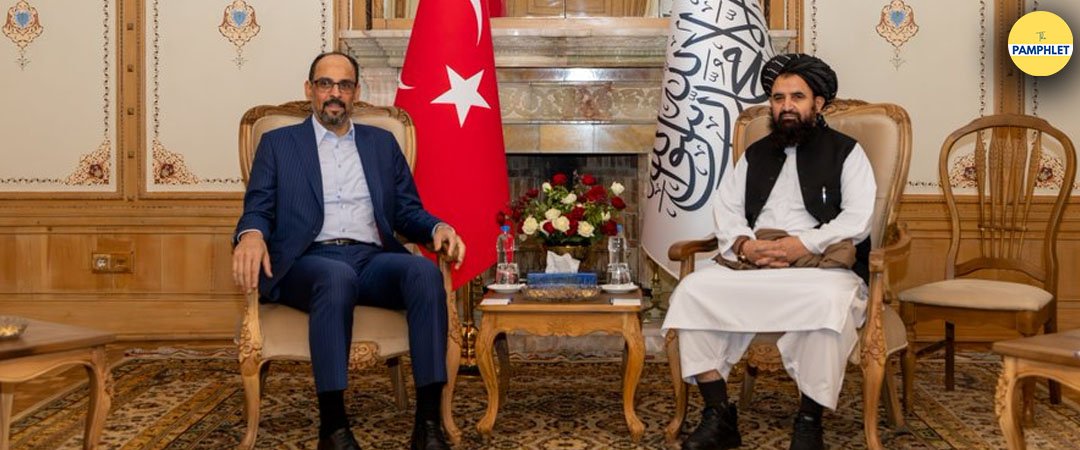
The head of Turkish intelligence had travelled to Kabul ‘to discuss the ongoing Afghanistan-Pakistan crisis.
Turkish intelligence chief Ibrahim Kalin travelled to Kabul on Tuesday and held talks with senior leaders of the Taliban government on “reducing tensions between Afghanistan and Pakistan”.
A senior security official in the Taliban government told, that “the Turkish intelligence chief arrived in Kabul on Tuesday and ended his trip on Wednesday, with talks held on security cooperation and Afghanistan-Pakistan issues.”
The official said that Mr Kalin and his accompanying delegation had meetings and talks with the Taliban government’s Deputy Prime Minister for Economic Affairs Mullah Abdul Ghani Baradar, Defence Minister Yaqoob Mujahid, Interior Minister Sirajuddin Haqqani and Intelligence Chief Abdul Haq Wasiq.
Although it is not yet clear what was discussed in Kandahar and whether there was a meeting with Mawlawi Hibatullah Akhundzada, but this trip is considered “important” from many aspects.
Turkish media, quoting security sources, have said that “both sides also discussed security and intelligence cooperation between Turkey and Afghanistan and that the effects of the war between the US, Iran and Israel were also discussed.”
Not many details of the talks have been revealed about what the Turkish intelligence chief achieved from this visit. The Taliban government says it is keen to hold talks to end the crisis with Pakistan, but firm guarantees are needed. This is the first time that a foreign official of this level has travelled to Kabul in efforts to resolve the crisis between Afghanistan and Pakistan.
At that time, Taliban government spokesman Zabihullah Mujahid had said that at the request and mediation of Saudi King Salman, they had released three Pakistani soldiers who were prisoners with them.
Since then, the crisis has deepened further. Turkey’s role was then at the level of hosting talks. On October 24, 2025, several days of consecutive talks were held in Istanbul, Turkey, between representatives of the Taliban government and the Pakistani army and security agencies, but ended without any result.
Mr. Kalin was also seen during the agreement that was signed in Doha between Pakistani Defense Minister Khawaja Asif and the Taliban government’s Defense Minister Mohammad Yaqoob Mujahid through the mediation of Qatari officials, prior to these talks.
Although Turkey has given refuge to some opponents of the Taliban government, it simultaneously maintains good relations with the Taliban government. The affairs of the Afghanistan embassy in Ankara are also handled by the ambassador of the Taliban government.
It is believed that Turkey wants to maintain relations with the Taliban government in Afghanistan for its influence in the region and to prevent the escalation of any crisis that weakens its allied countries.
Ankara also has deep military and political relations with Islamabad and is recently part of that alliance with Saudi Arabia and Pakistan which has brought them together in the framework of a defense agreement.
Turkish and Qatari delegations visit Afghanistan; will the Kabul-Islamabad talks resume? Although it is not yet clear what was discussed in Kandahar and whether there was a meeting with Mawlawi Hibatullah Akhundzada, this trip is considered “important” from many aspects.
According to Taliban government statements and Turkish government sources, the information released says that the talks were largely focused on bilateral cooperation. However, according to several important sources, there were also extensive discussions on the stalled talks between Afghanistan and Pakistan and the possible restoration of relations between the two countries.
But why are high-level security delegations from Qatar and Turkey making a surprise visit to Afghanistan?
Mr. Kalin went directly from Kabul to Islamabad where he met with army chief Asim Munir and a number of intelligence officials.
After negotiations between Kabul and Islamabad in Riyadh in December 2025 ended inconclusively following direct talks, lengthy talks were also held between the two sides in China.
But according to one source, in the past nearly ten months, in addition to China, Qatar, Saudi Arabia, Turkey and the United Arab Emirates have tried to restart talks but without any practical result.
This visit comes at a time when relations between Kabul and Islamabad are colder than ever, for nearly ten months all land routes between the two countries have been closed, trade has also fallen to its lowest level and diplomatic engagement is virtually non-existent.
At the same time, the crisis between Saudi Arabia and Yemen is also escalating, and there does not seem to be much progress in talks between Iran and the US. Under the Mecca agreement, Turkey and Pakistan are obliged to get involved in this crisis if the Yemeni Houthis increase attacks on Saudi Arabia.
Qatar and Turkey, which have previously mediated talks between Kabul and Islamabad, are now trying to restart this stalled process.
During talks in Kabul between Qatari and Turkish delegations and Taliban government officials, Taliban officials said they are “ready for talks and opening routes with Pakistan” but on the condition that “Pakistan will not close them again for political purposes.”
According to another source who participated in these discussions, it was also said that senior officials of the Taliban government told the Turkish and Qatari delegations that “we assure Pakistan that Afghanistan’s soil will not be used against them, but Pakistan will also assure us that its soil will not be used against us.”
Another source who participated in these talks said the Taliban government officials also proposed to the delegations the creation of a “formal framework” to address “concerns” between Kabul and Islamabad.
Even on Thursday, Pakistani Foreign Ministry spokesman Sajid Haider Khan said they are ready to open trade routes with Afghanistan on the condition that attacks against Pakistan “from Afghan soil” are completely stopped. The Taliban government has always rejected such accusations and has called the TTP Pakistan’s own internal issue. But it appears that the TTP remains a major reason for strained relations between the two countries.
Ahsan Tipu Mehsud, an analyst on Afghanistan and Pakistan affairs in Pakistan, says that considering Turkey’s participation in the Mecca Agreement, it is expected that Ankara can play an important role in improving relations between Kabul and Islamabad.
Mr. Mehsud told, that if the crisis between the Houthis and Saudi Arabia escalates, Turkey may consider it important that Pakistan does not face another headache in the region and therefore tries to bring Kabul and Islamabad back to the negotiating table.
According to him, “Despite the increase in militant attacks in Pakistan, Pakistan has not attacked Afghanistan again, Haqqani’s recent statement calling for the creation of a mechanism to prove claims by both countries, and thirdly the visit of the Turkish intelligence chief, show that both sides seem eager for talks.”
But despite all this, Kabul and Islamabad do not seem to trust each other, and according to analysts, until both sides reconsider their demands, there are not many signs of a permanent solution.

