
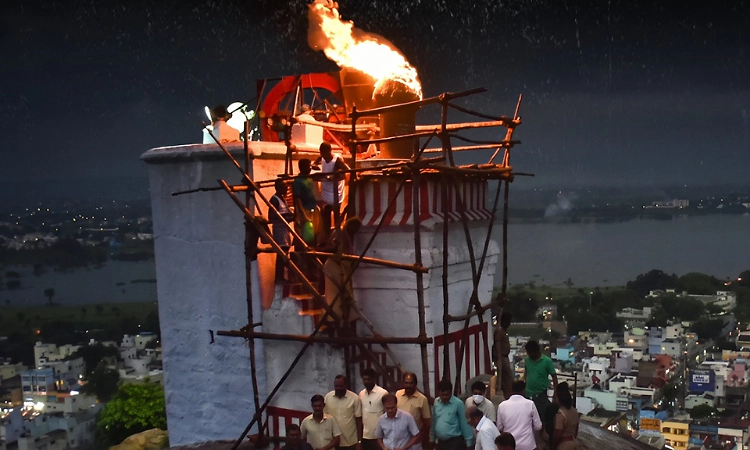
A ceremonial lamp has turned into a major legal and civilisational confrontation in Tamil Nadu, with the Supreme Court stepping in to ensure that a religious tradition is followed at the disputed Deepathoon on Thiruparankundram hill in Madurai.
On Friday, November 27, the Supreme Court directed that the traditional Karthigai Deepam be lit atop the stone pillar on Saturday, November 28. The court also issued contempt notices to Tamil Nadu Chief Secretary, DGP, Madurai District Collector, and other senior officials over alleged willful disobedience of its earlier order. It even suspended the temple’s Board of Trustees and appointed two retired Madras High Court judges as receivers to oversee the temple’s administration. the Madurai Collector had earlier apologised in front of the Court for not following their orders.
But how did a simple lamp-lighting ceremony become such a contentious issue?
The dispute revolves around the Deepathoon, a stone pillar located on Thiruparankundram hill, close to the Sikandar Badusha Dargah. Hindu devotees have repeatedly said that the pillar is the traditional location for lighting the Karthigai Deepam, an important festival celebrating the victory of light over darkness.
The controversy has much older roots. A property dispute involving the temple and the Dargah dates back to litigation initiated in 1920. A 1923 court settlement dealt with the respective rights over different portions of the hill. Subsequently, in 1996, the Madras High Court directed that the ceremonial lamp be lit at the Deepa Mandapam near the Uchipillayar temple, where the practice continued.
In 2025, Hindu petitioners approached the courts seeking permission to light the lamp at the Deepathoon. The Madras High Court subsequently ruled in their favour, triggering further legal proceedings and objections from the Tamil Nadu government, which cited law-and-order concerns and disputed customary practices.
The Supreme Court, on November 20, permitted the lighting of the lamp at the Deepathoon as a one-time interim measure on November 24, with safeguards for the nearby Dargah. However, the authorities lit it at the customary mandapam instead.
The Supreme Court has now taken a much stronger position, directing the CRPF to secure both religious sites and ensuring that devotees can participate in the ceremony while maintaining a 50-metre buffer around the Dargah.
The Supreme Court’s latest intervention makes one point clear, and something Tamil Nadu government should do well to remember- Judicial orders are binding on the executive, and their implementation cannot be treated as optional.

