
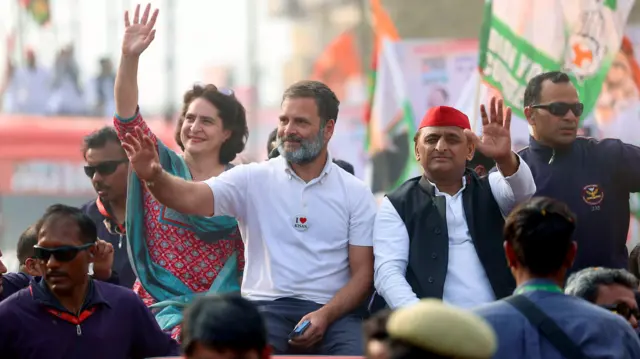
The Congress party has spent years projecting itself as the principal national opposition to the BJP. Rahul Gandhi has been busy delivering speeches about saving democracy, defending the Constitution and leading the opposition’s grand political alternative. But when it comes to negotiating seats in Uttar Pradesh, the state that is the gateway to the PM post, Rahul Gandhi appears non-existent.
The Samajwadi Party appears to have offered the Congress a rather uncomfortable reality check by offering them only 26 seats out of 403.
Yes, 26. Not 126, not 100, not even 50. Just 26! Akhilesh Yadav obviously knows that Congress is a spent force.
The negotiations for the 2027 Uttar Pradesh Assembly elections have exposed an interesting contradiction within the INDIA bloc. The Congress reportedly demanded 181 seats initially, while Akhilesh Yadav’s Samajwadi Party responded with an offer of 26. That is quite a difference between the party’s self-image and its bargaining position.
Perhaps Rahul Gandhi’s political advisors had calculated the Congress’s seat demand using its national ambitions rather than its actual electoral strength in Uttar Pradesh.
A quick look at the numbers explains why Akhilesh might not be particularly enthusiastic about handing over a large chunk of the state. In the 2022 Assembly elections, Congress contested 399 seats and managed to win just two. In 2017, when it allied with the Samajwadi Party, Congress received 107 seats but could win only seven.
Of course, Congress would point towards the 2024 Lok Sabha elections, when it won six of the 17 parliamentary constituencies it contested in Uttar Pradesh. The party believes that performance deserves a much bigger share of the Assembly pie.
But apparently, Akhilesh Yadav is not running a political charity where seats are distributed according to the number of press conferences Rahul Gandhi holds.
The SP’s proposed formula reportedly includes the two Assembly seats Congress won in 2022, four where it finished second, and 20 more constituencies where the Samajwadi Party believes it has a stronger electoral presence. SP leaders have also argued that giving away too many constituencies could demoralise their own workers.
And the drama does not end there. The Congress is reportedly unhappy with the offer, particularly because it gets only limited representation in the Amethi-Rae Bareli belt. Meanwhile, the SP has already announced five candidates, including names from constituencies that Congress reportedly wanted to contest. So much for the famous bonhomie between alliance partners.
It is almost amusing how the INDIA bloc functions. Every party wants to be the leader, every leader wants the maximum number of seats, and everyone wants Rahul Gandhi to be the national face. But when the actual political game begins, the grand political brotherhood suddenly starts looking like a neighbourhood property dispute.
Akhilesh Yadav’s message seems fairly straightforward: winning elections requires more than national television appearances and political slogans. It requires ground-level organisation, credible candidates and actual votes.
The Congress, meanwhile, must decide whether it wants to negotiate like a party with considerable electoral strength or accept that its Uttar Pradesh organisation has a long way to go.
There is also a lesson here for the INDIA bloc. An alliance built on the promise of defeating the BJP is one thing; an alliance where every constituent wants to dictate terms is quite another.

