
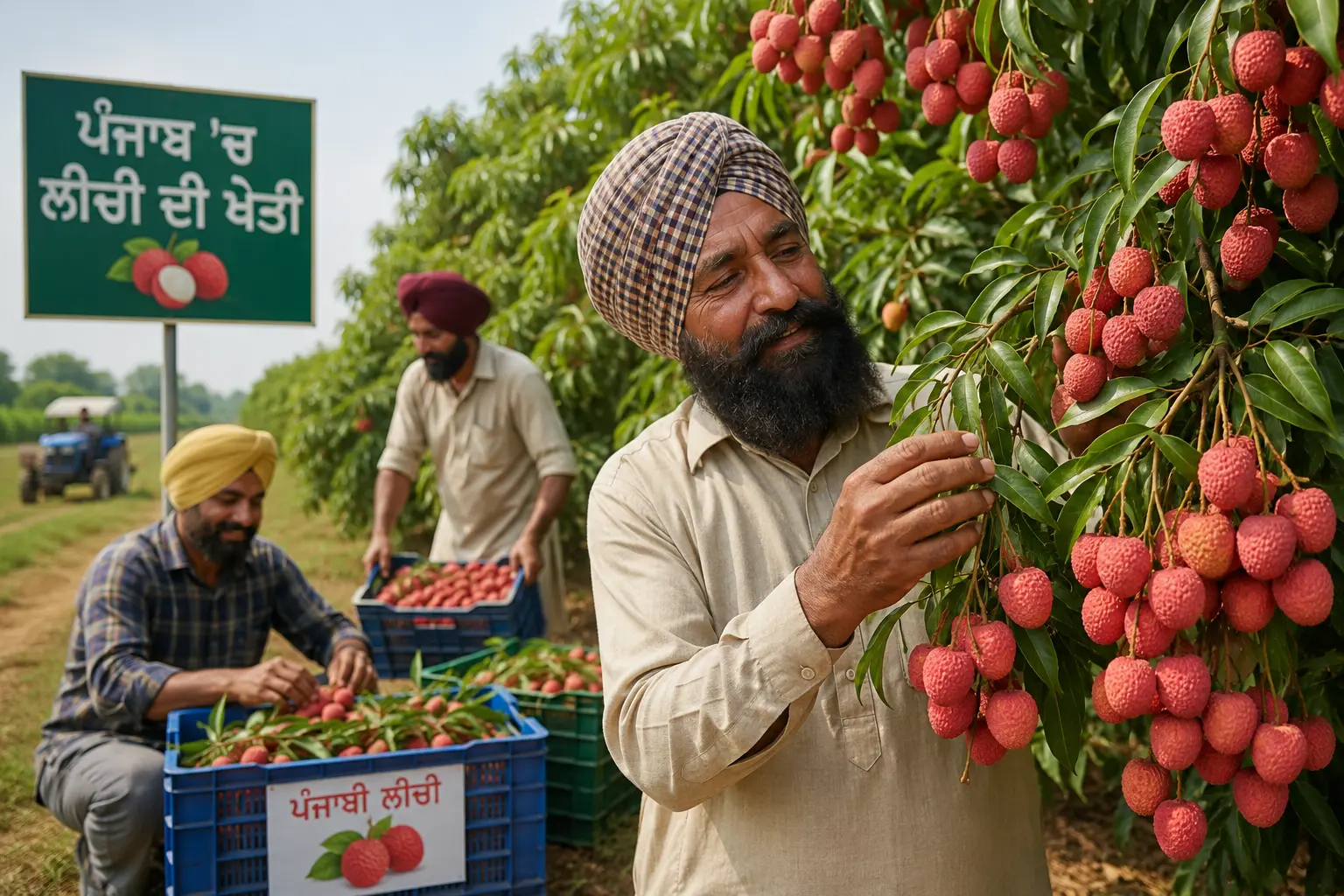
Punjab, long celebrated as India’s breadbasket for its wheat and paddy production, is witnessing a remarkable transformation. Farmers across the state are embracing diversification, leveraging government schemes, financial support, and agricultural technology to move beyond conventional monocropping. This shift is not only enhancing incomes and sustainability but also placing Punjab’s produce on the global map, bringing pride to the state and the nation. These success stories highlight innovation rooted in tradition and supported by forward-looking initiatives.
A shining example is the recent export of fresh lychees from Punjab to Oman- the first such consignment. In early July 2026, a 500-kilogram shipment of premium lychees grown by the Unati Agri Allied Cooperative Society in Hoshiarpur reached Omani markets, facilitated by the Agricultural and Processed Food Products Export Development Authority (APEDA). This milestone opens doors to Gulf markets and showcases the superior quality of Punjab’s horticultural produce. Farmers in the region, supported by better planting material, drip irrigation, and post-harvest management techniques, have turned lychee orchards into viable, high-value enterprises. What was once a niche crop in select pockets has now gained international recognition, with potential for scaled exports to Europe and other regions.
This success stems from a broader push towards horticulture and high-value crops. Union Government initiatives such as the Mission for Integrated Development of Horticulture (MIDH), the National Horticulture Board (NHB) schemes, and APEDA’s export promotion efforts have provided critical financial assistance, technical training, and market linkages. Subsidies for drip and sprinkler irrigation under schemes like Pradhan Mantri Krishi Sinchayee Yojana (PMKSY) have helped farmers conserve water while improving yields. In Punjab, where water scarcity and soil fatigue from intensive wheat-rice cycles pose challenges, these interventions have enabled a shift to fruit crops like lychee, kinnu, pear, and guava, which offer better returns and environmental benefits.
One inspiring individual story is that of Gurvinder Singh, a former soldier who transitioned into organic farming after retiring from service. On his farm in Punjab, Gurvinder now cultivates over 60 different crops using fully organic methods. From vegetables and fruits to herbs and millets, his diversified polyculture model has reduced dependency on chemical inputs and built resilience against market fluctuations and climate variability. By adopting vermicomposting, bio-pesticides and natural soil enrichment techniques, he has achieved healthy yields while commanding premium prices in domestic and niche markets. Gurvinder’s journey reflects the growing organic farming movement in the state, supported by the Paramparagat Krishi Vikas Yojana (PKVY) and other central schemes that offer training, certification assistance and market support for organic produce.
Farmers like Gurvinder are part of a larger trend. Across Punjab, thousands have moved from conventional practices- reliant on high chemical use and water-intensive staples: to integrated farming systems that combine horticulture, agroforestry, and livestock. Government-backed agri-tech initiatives, including soil health cards, mobile apps for advisory services and drone-based monitoring under the National Mission on Sustainable Agriculture, have empowered farmers with data-driven decisions. Financial support through Kisan Credit Cards, interest subvention schemes, and direct benefit transfers has eased access to capital for adopting modern practices such as protected cultivation (polyhouses and net houses), which allow year-round production of high-value vegetables and flowers.
The results are tangible. Diversified farms report 30-50% higher net incomes compared to traditional wheat-paddy rotations, according to recent agricultural assessments. Export volumes of fresh fruits and vegetables from Punjab have grown steadily, with horticultural exports contributing significantly to the state’s agri-trade basket. Cooperative models, like the one behind the Oman lychee shipment, have been instrumental. They enable small and marginal farmers to pool resources, meet international quality standards (such as GlobalGAP certification), and access better logistics and cold chain infrastructure funded through central and state partnerships.
Another dimension of this transformation is value addition. Many farmers now process their produce into juices, jams, pickles, or ready-to-eat products, supported by schemes like the Pradhan Mantri Formalization of Micro Food Processing Enterprises (PMFME). This reduces wastage and increases profitability. Women self-help groups in rural Punjab have particularly benefited, taking up food processing units that generate additional household income while preserving traditional recipes with modern hygiene standards.
The shift also addresses pressing environmental concerns. Conventional farming in Punjab has long been associated with declining groundwater levels, soil degradation and stubble management issues. By promoting crop diversification and organic practices, Union Government programs encourage sustainable alternatives. Initiatives like the Sub-Mission on Agroforestry and National Mission for Sustainable Agriculture promote tree integration and climate-resilient varieties, helping restore ecological balance. Farmers report improved soil organic carbon levels and reduced pest incidence on diversified plots, leading to long-term farm viability.
Gurvinder Singh’s success, for instance, extends beyond his fields. He has become a mentor, training neighboring farmers in organic techniques and helping them access certification. Similarly, lychee growers in Hoshiarpur collaborate through cooperatives to invest in grading, packing and refrigerated transport- infrastructure often supported by government grants. These stories underscore how targeted support: financial, technological and knowledge-based can unlock potential even in a region historically dominated by grain production.
As Punjab’s farmers embrace these changes, they contribute to India’s broader goals of doubling farmer incomes, boosting agro-exports and achieving nutritional security. The lychee’s journey to Oman and organic polycultures thriving on former soldier’s land symbolize a proud evolution: From feeding the nation to delighting global palates with premium, sustainable produce.
This progress is a testament to the collaborative spirit between farmers, scientists, and policymakers. Union Government initiatives in agriculture have played a pivotal role by providing the necessary scaffolding- be it subsidies for tech adoption, export facilitation, or capacity building. Farmers, with their ingenuity and hard work, are turning these opportunities into tangible achievements. As more stories like these emerge, Punjab continues to set benchmarks, reinforcing India’s position as a leader in agricultural innovation and resilience. The state’s farmers are not just adapting; they are redefining the future of Indian agriculture, one diversified field at a time.

