
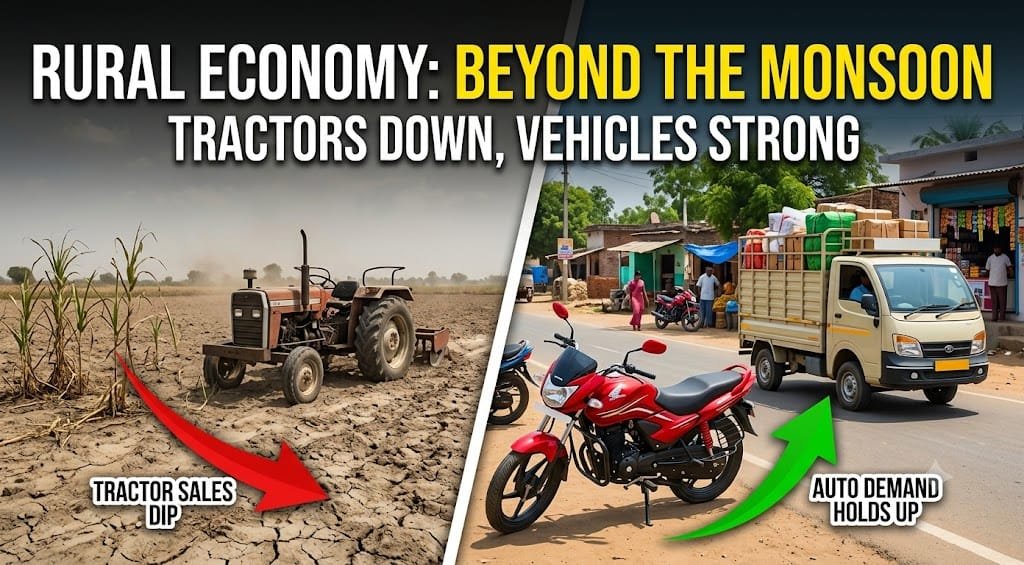
Rural India’s demand for vehicles has remained stronger than expected despite a weak and uneven monsoon. The development suggests that village economies are no longer dependent only on farming. Small businesses, transport work, construction activity and other non-farm sources of income are helping families continue with important purchases such as motorcycles, cars and commercial vehicles.
Data from the Federation of Automobile Dealers Associations shows that rural passenger vehicle sales increased by 32.09 percent in September compared with the same month last year. Urban passenger vehicle sales grew at almost the same pace, rising 32.11 percent. This close performance between rural and urban markets shows that vehicle demand is spreading beyond large cities and that many rural families are still confident about spending.
The wider automobile market also recorded a strong September. Total retail sales reached 25,36,920 vehicles, marking a year-on-year increase of 31.82 percent. Passenger vehicle sales rose 32.1 percent to 4,27,213 units, while two-wheeler sales climbed 33.08 percent to 17,90,188 units. Commercial vehicle sales also increased 37.62 percent to 1,03,557 units. However, these figures need to be viewed carefully because vehicle purchases were unusually weak in September last year when many buyers postponed purchases before the GST 2.0 change.
The strongest message is coming from the changing nature of rural income. Agriculture remains important, but it is no longer the only source of money for many households. Rural residents are earning through shops, delivery services, transport operations, small factories, construction work and local trade. These activities can continue even when farm income is affected by poor rainfall. As a result, the purchase of a motorcycle or small car is increasingly linked to work, family travel and business needs rather than only to the success of the crop season.
The situation is different in the tractor market. Tractor sales are more closely connected with farming conditions, land preparation and farmers’ expectations about future income. Retail tractor sales fell 12.6 percent from August to 76,906 units in September. Mahindra & Mahindra reported a 21 percent fall in tractor sales, while Escorts Kubota recorded a decline of 16.7 percent. The weak monsoon and lower crop sowing affected demand in this segment.
India received 12.6 percent less rainfall than normal during the June-September monsoon period, which usually provides nearly 70 percent of the country’s annual rainfall. Uneven rain and long dry periods created pressure on farm income and delayed some large purchases. Still, late-season rainfall may improve water availability for the winter crop and could support rural demand in the coming months.
The festive season is another important factor. Festivals began in October this year, later than last year, so some purchases may have shifted from September to October. Dealers are therefore expecting continued interest in cars, motorcycles and commercial vehicles during the festive period. The outlook remains positive, although higher costs, rural financial pressure and dealer inventory will need close attention.
The larger picture is clear. Weak rainfall has hurt tractor demand, but it has not damaged the entire rural automobile market. Rural India is becoming more economically diverse, and that diversity is creating a stronger base for vehicle purchases. This resilience could help automobile companies maintain growth even when farming conditions remain uncertain.

