
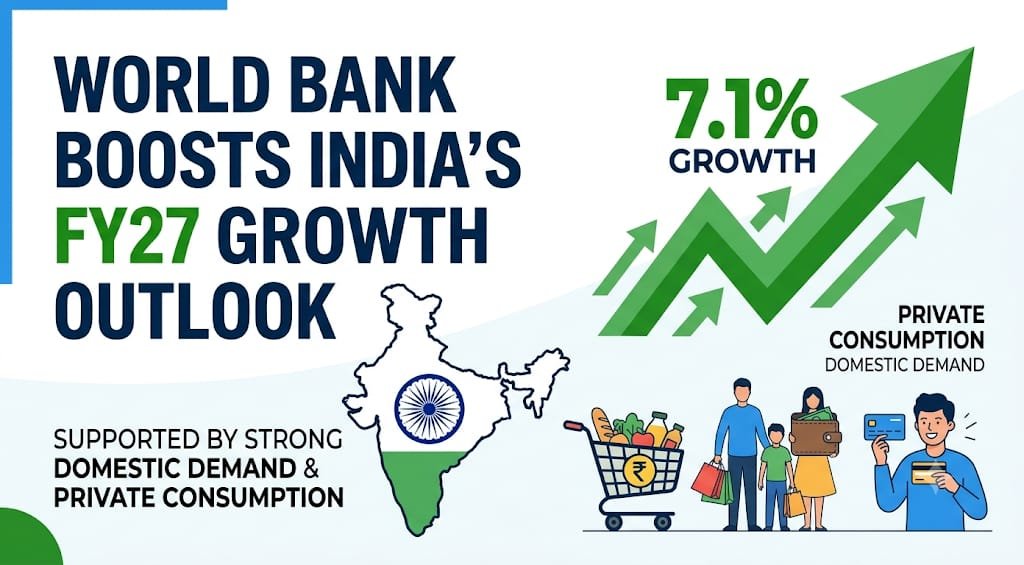
India’s economic outlook has become brighter, with the World Bank raising its growth forecast for the financial year 2026–27 to 7.1% from its earlier estimate of 6.6%. The increase of 50 basis points reflects stronger-than-expected economic activity, firm domestic demand and improving exports, even as the global economy continues to face trade tensions and geopolitical uncertainty. The World Bank shared the updated forecast in its latest India Development Update released on October 6, 2026.
The central message from the World Bank is clear: private consumption is expected to remain the main force behind India’s growth. In simple terms, household spending on food, housing, travel, transport, education, healthcare and other daily needs is likely to keep businesses active and support new economic activity.
When families spend more, shops sell more, companies produce more and employment opportunities can improve. This broad movement creates a strong connection between household confidence and national growth.
India’s economy grew by 7.8% in the first quarter of FY27, following growth of 7.8% in FY26 and 7.2% in FY25. Strong investment and solid private consumption supported this performance, while favourable policy conditions and better access to credit helped reduce the impact of trade-related pressures.
Rural consumption performed well earlier, supported by agricultural activity, rural income support, food subsidies and moderate inflation. Urban demand gained strength later, helped by income-tax relief and reductions in goods and services tax rates.
The World Bank, however, expects growth to moderate in the later quarters of FY27. A rainfall deficit recorded through August could affect rural demand by reducing agricultural output and rural income. Government consumption is also expected to remain subdued. This means that the growth story will depend heavily on whether household spending stays strong and whether rural conditions improve during the remaining months.
Exports are providing another important support. Stronger overseas demand can help Indian manufacturers and service providers earn more, expand operations and create jobs. The government’s policy measures, including reductions in customs duties on fuel, have also helped cushion the economy against higher costs linked to the West Asia conflict. India is expected to remain one of the fastest-growing major economies and a significant contributor to global growth.
At the same time, the World Bank has warned that the risks remain serious. A prolonged West Asia conflict could keep crude oil prices high, increasing inflation, widening pressure on the current account and raising public financial concerns. A stronger El Niño may bring a larger-than-expected rainfall shortage, weaken farm output and reduce rural consumption. Stock-market corrections could also lead to unstable capital flows.
The overall message is encouraging but balanced. India’s strong domestic market gives the economy a useful cushion during global uncertainty, yet growth will remain sensitive to weather, energy prices and financial conditions. If energy markets normalise and rainfall improves, economic momentum could become stronger. For now, the World Bank’s 7.1% forecast presents India as a resilient economy whose next phase of growth will largely depend on the spending strength of its households.

