
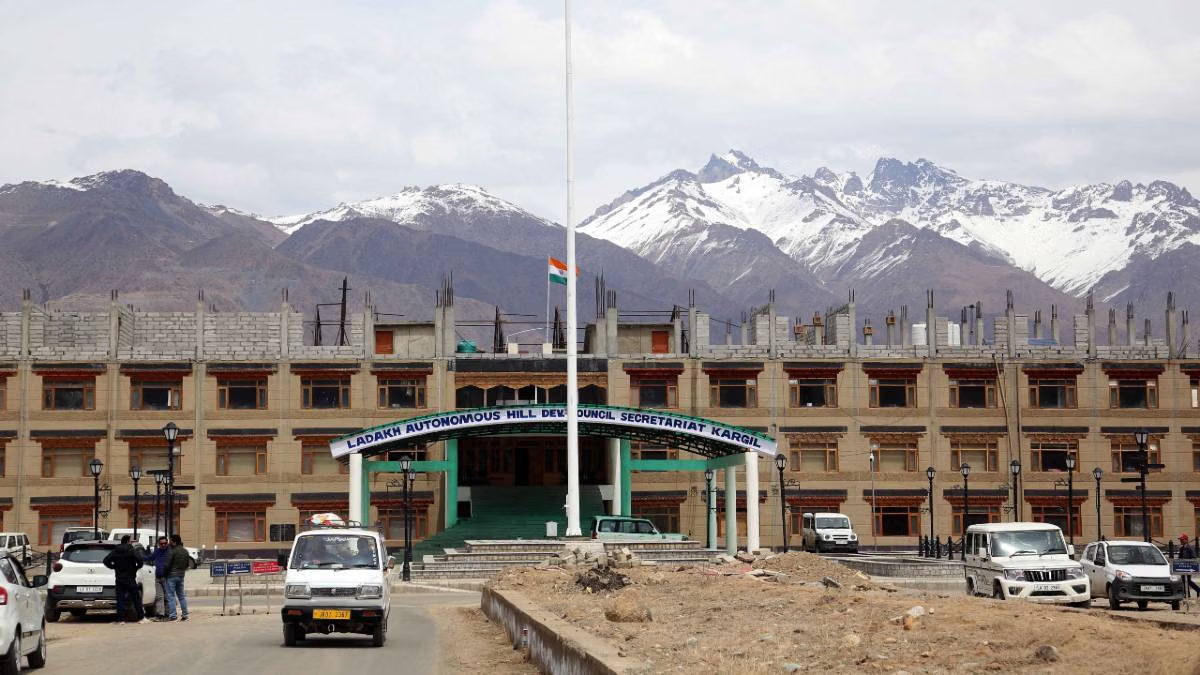
In a significant step towards expanding democratic representation in Ladakh, the Union Territory Administration has announced that each of its seven districts will have its own Autonomous Hill Development Council (AHDC). The announcement was made by Ladakh Chief Secretary Ashish Kundra during a press conference in Leh on July 13, describing the move as a landmark reform aimed at strengthening grassroots governance and democratic decentralisation.
The decision follows Ladakh’s administrative reorganisation in April 2026, when the Union Territory expanded from two districts to seven by creating the new districts of Sham, Nubra, Changthang, Zanskar and Drass. Despite the expansion, elected local governance had remained limited to the existing Hill Councils in Leh and Kargil. The latest announcement extends the same institutional framework to all newly created districts.
The move is already envisaged under Section 3(1) of the Ladakh Autonomous Hill Development Council (LAHDC) Act, which provides for the constitution of a Council for every district once notified by the government. According to the administration, only limited amendments to the Act, wherever necessary, along with the delimitation of constituencies, remain before the new Councils can be constituted.
Unlike a transitional or limited arrangement, the new Councils will enjoy the full range of powers available under the LAHDC Act. This places the five newly created districts on the same footing as Leh, which has had an elected Hill Council since 1995, and Kargil, where one has existed since 2003.
Among the most significant powers delegated to the Councils is authority over land ownership and land allotment within their respective districts. Once constituted, the Councils in Sham, Nubra, Changthang, Zanskar and Drass will exercise jurisdiction over land administration within their boundaries.
The Councils will also oversee recruitment and promotions for district cadre posts, ensuring that employment-related decisions are taken by elected institutions at the district level rather than through centralised administrative mechanisms.
Financial autonomy forms another important pillar of the reform. Each Council will maintain a dedicated Council Fund and possess the authority to levy specified taxes and fees, allowing every district to build its own revenue base and finance local development priorities.
Development planning will also become decentralised. Instead of relying on decisions made in Leh or Kargil, every district will prepare its own development plans based on local needs and priorities. The Councils will additionally be responsible for sectors such as health, education, tourism, local infrastructure and the implementation of social welfare schemes.
Beyond district-level governance, the administration also outlined a broader institutional framework for Ladakh. A Union Territory-level body is proposed above the seven Hill Councils under a customised framework inspired by Article 371 of the Constitution. According to the Chief Secretary, the proposed arrangement would combine legislative, executive, financial and administrative powers while drawing upon the best features of existing governance models across India. He described it as a structure without any direct parallel elsewhere in the country.
The precise composition and powers of this proposed Union Territory-level institution will be finalised through consultations between Ladakh’s representatives and the Government of India. The administration indicated that some redistribution of powers between the district Councils and the UT-level body may take place during this process. However, the establishment of Autonomous Hill Development Councils in all seven districts is the first concrete element of the broader governance architecture to receive official confirmation.
The administration also clarified that the new Councils will complement rather than replace existing Panchayati Raj institutions. Village panchayats will continue to function, creating a three-tier elected governance structure comprising village-level bodies, district-level Hill Councils and the proposed Union Territory-level institution.

