
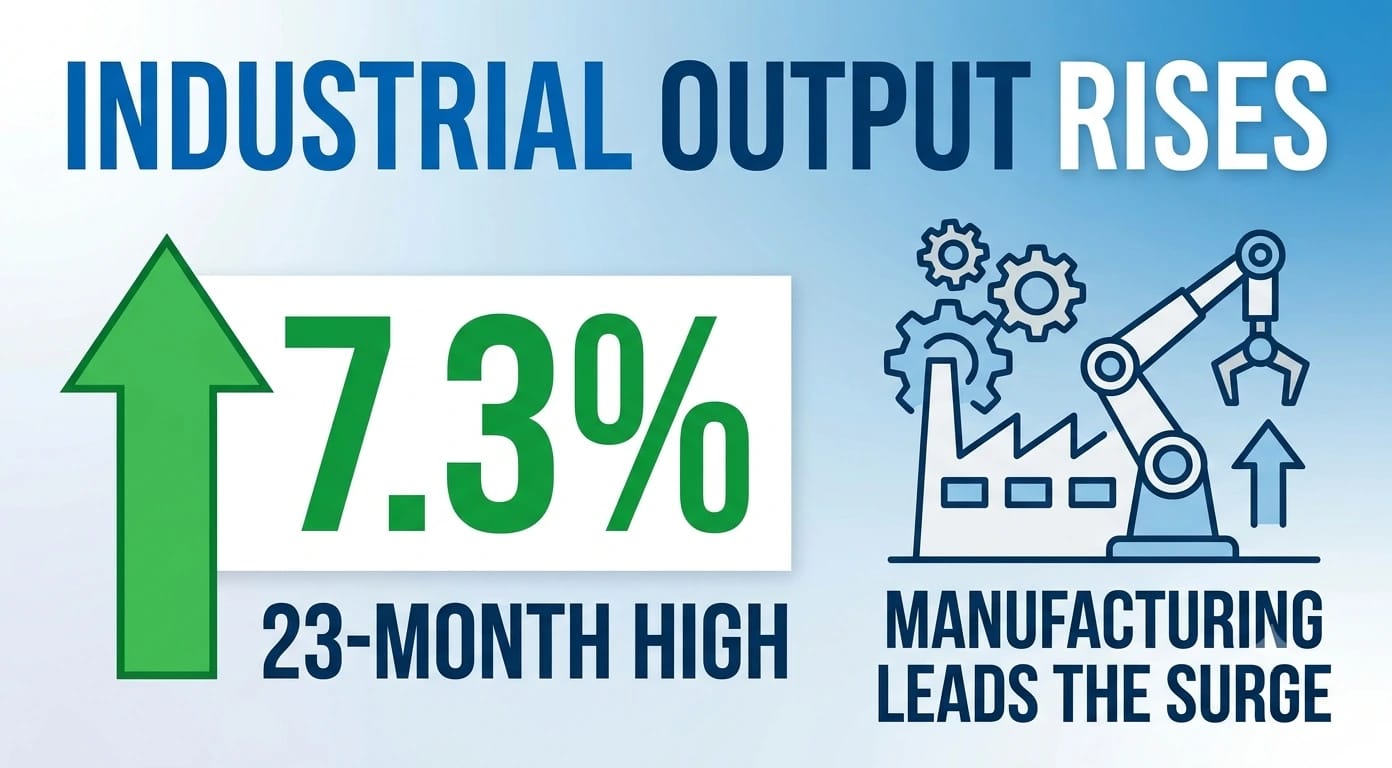
Industrial activity has moved up to a new high, with June recording a 7.3 percent rise in output, the strongest pace in nearly two years. The latest reading was above May’s 5.1 percent growth, showing that production improved in a steady and broad-based way rather than through one isolated boost. This matters because industrial output reflects how busy factories, mines, and power systems are, and a stronger reading usually means the economy is working at a faster pace.
The biggest support came from manufacturing, which grew 7.8 percent in June after 5.5 percent in May. Since manufacturing has the largest share in industrial output, even a small change in this sector can shape the overall number. Better factory production usually means more orders, better movement of goods, and a healthier business environment, especially when demand is rising across several categories at the same time.
Electricity was another strong driver, with growth of 10.6 percent in June compared with 9.9 percent in May. This is important because higher power generation often signals that homes, offices, shops, and factories are all using more energy. In simple terms, when electricity output rises, it usually means that everyday activity and industrial work are both picking up.
Mining also turned positive, with output rising 1 percent in June after falling 1.4 percent in May. That change is useful because mining supplies raw material to many other industries, including construction, manufacturing, and energy. When mining improves along with factory output and electricity, it shows that the recovery is not limited to a single sector but is spreading across the industrial chain.
The growth in capital goods gives the clearest sign of future expansion. Capital goods output rose 14.2 percent in June, compared with 15.5 percent in May, remaining at a strong level. Capital goods include machines and equipment used to produce other products, so higher growth in this category usually suggests businesses are preparing for more production ahead. This often points to investment activity, which is one of the most important signals for longer-term industrial strength.
Consumer-linked sectors also showed improvement. Output of consumer durables, such as cars and phones, rose 7.7 percent in June. This matters because these products are bought by households and are closely linked to spending power and demand in daily life. When consumer goods move up together with capital goods and manufacturing, it suggests both business activity and household demand are supporting the industrial cycle.
The broader picture is also encouraging because the rise was not driven by just one sharp increase. The data shows gains across manufacturing, electricity, mining, and investment-linked sectors at the same time. That kind of spread usually makes growth more stable and more meaningful, since it reduces the chance that the improvement is only temporary. It also suggests that the industrial recovery is becoming more balanced and better anchored in real production.
Even so, the numbers should be read with care. A strong month does not guarantee the same pace in the next one, because industrial activity can change with demand, supply conditions, weather, and business confidence. But a 23-month high is still a strong signal that production conditions have improved and that businesses are seeing better momentum than before.
The latest industrial data gives a simple but powerful message: more goods were made, more electricity was used, and more sectors moved forward together. With manufacturing, power, mining, and capital goods all showing firm growth, the overall industrial picture has become visibly stronger. This is a positive sign for jobs, investment, and future business activity, and it shows that the production side of the economy is gaining strength in a broad and practical way.

