
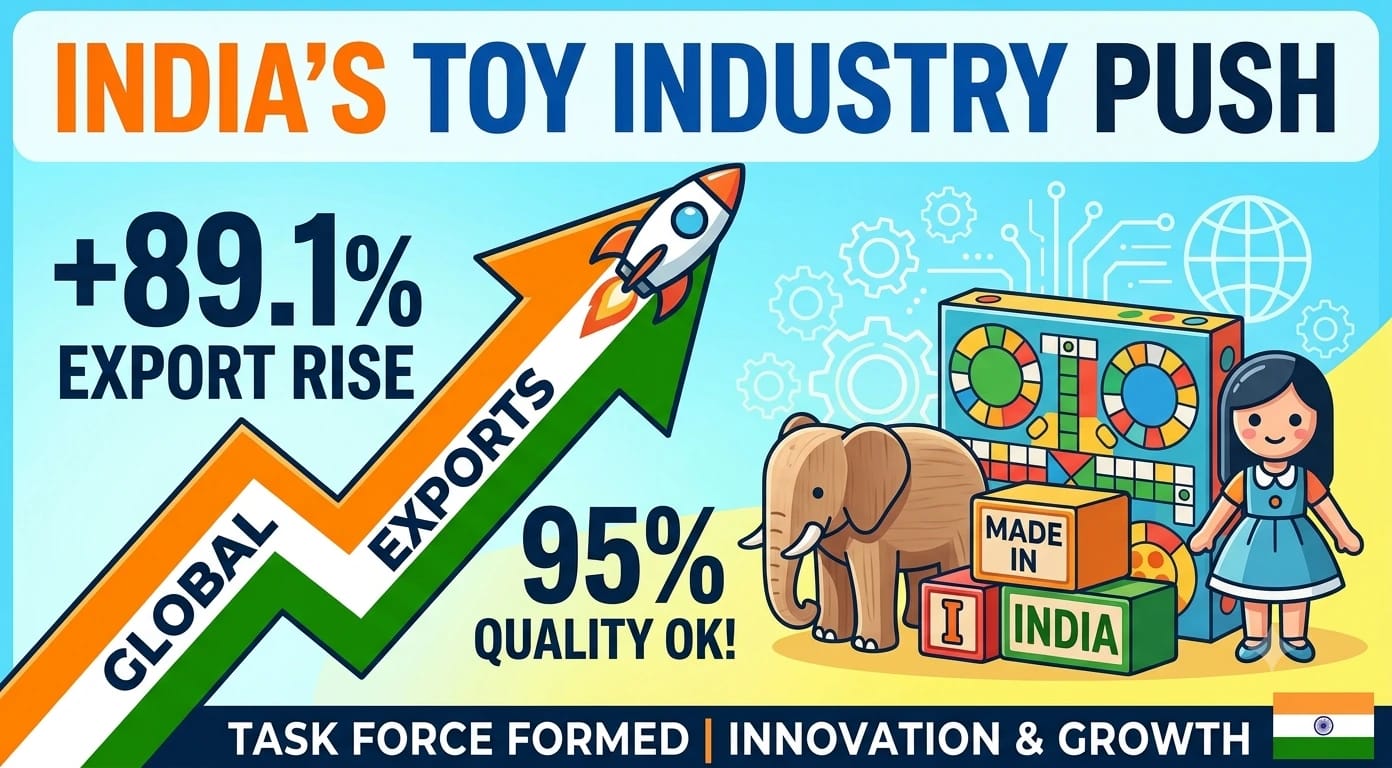
A new task force has been set up to strengthen toy manufacturing and lift the sector’s position in the world market, with a clear aim of reaching a 5 percent share by 2032. The plan is not just about making more toys, but about building a stronger system around them, from design and quality to exports, skills, and business ease.
The latest official update shows that the toy sector has already moved forward sharply in recent years. Toy exports have risen by 89.1 per cent, imports have fallen by 37.5 per cent, and the industry has become a net exporter, which means it now sells more toys abroad than it buys from outside. These numbers suggest that the sector is no longer only serving local demand; it is steadily becoming more competitive in overseas markets.
The task force has been created to identify practical steps that can help the sector grow faster and more smoothly. Its work will cover six main areas: linking domestic firms with global value chains, improving manufacturing strength, fixing supply chain bottlenecks, building a skilled workforce, supporting design and innovation, and making it easier to do business. In simple terms, this means the focus is on helping toy makers produce better products, in larger numbers, and with fewer obstacles.
The government has also highlighted that the sector is already supported by a wide base of businesses and institutions. The toy ecosystem includes more than 21,000 micro, small and medium enterprises, over 770 DPIIT-recognised toy startups, nearly 50 toy clusters, and more than 1,800 BIS licencees. This matters because a sector with many small firms needs coordinated support if it wants to grow into a strong national industry.
Quality has been a major concern, and that is where the policy effort appears to have made a visible difference. In 2019, only 33 per cent of toys in the domestic market were found to be acceptable under BIS standards, but a 2025 survey found that 95 per cent of toy samples met the prescribed quality standards. This sharp improvement shows that stronger rules, better monitoring, and more attention to standards are changing the market in a meaningful way.
The official note also explains that the sector had earlier faced a problem of unsafe, substandard, counterfeit, and cheap imports. To address that, several steps were taken, including the National Action Plan for Toys, higher customs duty on toys, a quality control order, cluster-based support, startup recognition, export support, and market access through trade agreements. Together, these measures were designed to encourage local production, improve safety, and give Indian toy makers a better chance to compete.
A major part of the story is the rising confidence in Indian toys abroad. The sector now exports to countries such as the United States, the United Kingdom, the Netherlands, and Germany, which shows that the market is widening beyond domestic buyers. The new task force appears to be meant as the next stage in this journey, shifting the focus from recovery and quality improvement to stronger scale, branding, and global reach.
The message from the latest developments is clear. The toy sector is being treated not as a small consumer segment, but as a serious manufacturing opportunity with jobs, innovation, and export potential. If the planned support works as intended, the sector could become a stronger example of how quality improvement, policy support, and industry coordination can turn a local market into a globally visible one.

