
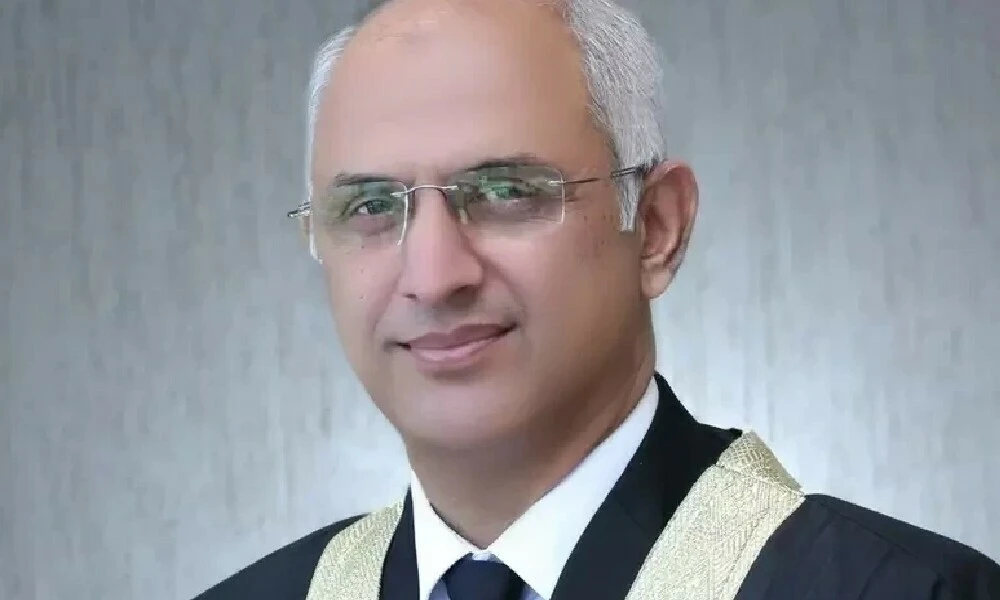
Lahore High Court Judge Justice Mohsin Akhtar Kayani has resigned from his post.
In his resignation sent to the President of Pakistan, he has cited personal reasons and health issues after recent surgery as well as ‘his conscience (voice)’, as the basis for this decision. In his resignation sent to the President on October 28, 2026, Justice Kayani said that serving in the Islamabad High Court and Lahore High Court has been an honor for him.
According to him, during his judicial tenure, he disposed of more than 23 thousand cases of various natures and ‘always tried to uphold the supremacy of the Constitution, protection of fundamental rights and provision of justice without fear or discrimination.
In his resignation, he took the position that ‘In my opinion, the changes introduced through the 26th and 27th constitutional amendments have affected the autonomy and institutional integrity of the High Courts. I have observed the growing influence of the executive (administration) on judicial institutions, the scope of which has extended to the appointment and transfer of judges.’
He further wrote that ‘In my view, this kind of interference has severely damaged public confidence in the independence of the judiciary and the impartiality of the judicial process, as a result of which public trust in the justice delivery system has been shaken. In his resignation, Justice Kayani also expressed concern over the situation of ordinary litigants.
He said that the real stakeholders of the justice system are ordinary litigants and ‘their difficulties are continuously increasing’ while the benefits of the system established for the delivery of justice are being reaped by other circles.
He wrote that in the current circumstances, ‘my conscience does not allow me to remain in judicial office.
According to Justice Mohsin Akhtar, ‘this is a painful decision,’ however, he believes that ‘judicial office cannot be separated from independence, loyalty to the constitution and protection of human dignity.
In his resignation, Justice Kayani also said that he now wants to return to the field of law practice, where he will continue his services for the protection of public rights and the promotion of legal awareness.
It should be noted that Justice Mohsin Akhtar Kayani was to retire from his post in 2032. According to the roster of judges issued by the Chief Justice of the Lahore High Court, Justice Mohsin Akhtar Kayani was to hear cases in the Rawalpindi Bench of the Lahore High Court from November 2.
The name of Justice Mohsin Akhtar Kayani has been in the news during the last few years in cases related to the independence of the judiciary, transfer of judges and alleged interference in judicial affairs.
In March 2024, six judges of the Islamabad High Court had written a letter to the Supreme Judicial Council, in which they talked about attempts to put pressure through kidnapping and torture of relatives of judges as well as secret surveillance in their homes. Justice Mohsin Akhtar Kayani was also among the judges who signed this letter. Later, the Supreme Court had taken suo motu notice of the matter.
After that, in February 2025, Justice Mohsin Akhtar Kayani was among the five judges of the Islamabad High Court who had challenged in the Supreme Court the transfer of judges from other High Courts to the Islamabad High Court and the resulting seniority dispute.
The stance of the petitioner judges was that the transfers of judges had affected the judicial structure and the seniority system. However, in June 2025, in a majority decision, the constitutional bench of the Supreme Court ruled that under Article 200 of the Constitution, the transfer of judges is constitutional and legal and cannot be considered a new appointment.
As a result of this decision, the order of seniority in the Islamabad High Court also changed and the position of Justice Mohsin Akhtar Kayani was affected.
Justice Mohsin Akhtar Kayani started his career as a judge from the Islamabad High Court and he was the most senior judge of the Islamabad High Court after Justice Aamer Farooq.
After Justice Aamer Farooq moved to the Supreme Court, the prospects of Justice Mohsin Akhtar Kayani becoming the Chief Justice of the Islamabad High Court had become bright, however, during the same period, after the constitutional amendment, during the transfer of High Court judges to other High Courts of the country, Justice Sarfraz Dogar, a judge of the Lahore High Court, was made the Chief Justice of the Islamabad High Court.
Justice Mohsin Akhtar Kayani is among the three judges whose transfer was made from Islamabad High Court to other provincial courts.
In April 2026, the Judicial Commission, using the powers obtained after the 27th constitutional amendment, approved the transfers of Islamabad High Court’s Justice Mohsin Akhtar Kayani, Justice Babar Sattar and Justice Saman Rifat Imtiaz to other High Courts.
Some legal circles criticized this decision and called it an action against these judges, while the government had rejected this impression.
In his resignation, Justice Mohsin Akhtar Kayani has specifically referred to the 26th and 27th constitutional amendments, saying that as a result of these amendments, the autonomy of the High Courts and judicial independence have been affected.
During his posting in the Islamabad High Court, Justice Mohsin Akhtar Kayani headed the larger bench that heard cases of forcibly disappeared persons.
During the hearing of these petitions, the bench headed by Justice Mohsin Akhtar Kayani had also issued orders to summon several officers of the army’s secret agencies.

