
George Orwell feared a day when the State would manufacture truth. What he perhaps never imagined was a world where entire civilizations could be judged, shamed, and politically diagnosed by a few opaque global scorecards.
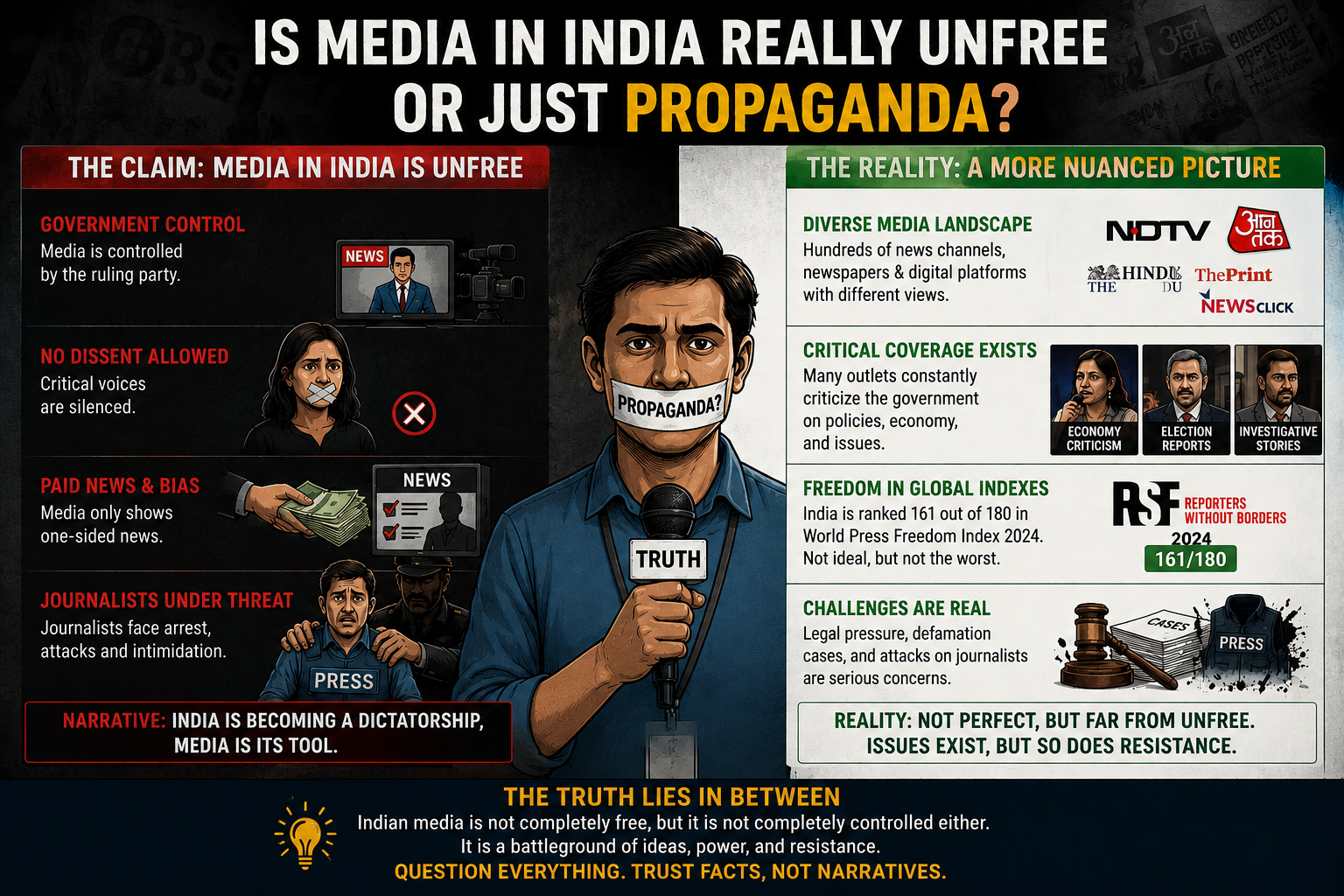
Every year, the World Press Freedom Index releases a new ranking and within hours, headlines begin mourning the ‘death of Indian democracy.’ In 2026, India was ranked 157th, and almost instantly the familiar narrative echoed across media studios and social media timelines: ‘India is becoming authoritarian’
Almost instantly, the conversation shifts from discussing the ranking to declaring India a democracy sliding toward authoritarianism, where dissent is supposedly shrinking with each passing year. But there is a question very few people pause to ask: Does India’s noisy, chaotic, deeply polarized media landscape actually resemble a silenced society or have global perceptions begun overtaking ground reality itself? And if today’s India resembles Orwell’s 1984, then what exactly were the decades when newspapers were censored during the Emergency, journalists jailed, printing presses shut down, films banned, and speech directly curbed by the State?
The deeper one examines the World Press Freedom Index, the stranger the story becomes with its opaque methodology, anonymous surveys, bizarre rankings, selective historical memory, and a framework that often struggles to understand the scale and chaos of Indian democracy itself.
This article is not about claiming India has perfect press freedom, that is for you to decide. It is about asking whether a perception-driven global index should be treated as the unquestionable truth about a civilization of 1.4 billion people.
So what exactly is the World Press Freedom Index? The WPFI, published annually since 2002 by Reporters Without Borders, ranks 180 countries on ‘press freedom’ using political, legal, economic, sociocultural, and safety indicators. Though who exactly granted a private Paris-based organization the moral authority to politically diagnose entire civilizations remains an interesting question in itself. Even more interesting is the fact that many of these indicators are deeply subjective, inconsistently applied, and often detached from historical or cultural context.
And how is this supposedly global benchmark compiled? Largely through perception surveys, questionnaires, and selected data on journalist abuses, which, in polite language, means subjective opinion dressed up as scientific assessment.
Most scores are derived from responses by journalists, academics, activists, and media ‘experts,’ many of whom carry obvious ideological and political leanings of their own. Since 2020, the methodology has been shaped by experts linked to institutions such as the Reuters Institute for the Study of Journalism, Deutsche Welle Akademie, University of Miami, and Ludwig Maximilian University of Munich.
On paper, these institutions represent expertise in journalism and media studies. In reality, they belong to a tightly networked transnational ecosystem where political assumptions are often strikingly uniform i.e. aggressively liberal-progressive on Western issues and instinctively suspicious of nationalism, civilizational identity, or strong-state politics in non-Western societies.
The contradictions become sharper when compared with reality. India, with over 1.5 lakh publications, 900+ private TV channels, thousands of digital platforms, and one of the world’s loudest anti-government media ecosystems is repeatedly portrayed as one of the least free media environments globally.
Meanwhile, the Index has ranked the United States below Suriname and Namibia despite America’s First Amendment protections, while Norway consistently tops rankings despite concentrated media ownership. If modern India is “Orwellian,” then what were colonial sedition laws, Nehru’s speech restrictions, Indira Gandhi’s Emergency censorship, or Rajiv Gandhi’s Defamation Bill? Compared to those eras, today’s India arguably has the most decentralized, noisy, and difficult-to-control media ecosystem in its history. The problem is not criticism of India, the problem is treating a perception-heavy global narrative as unquestionable scientific truth.
Why does such a scorecard seem so believable to some people? As Walter Lippmann argued, public opinion is often shaped by the “pictures in our heads.” A country ranked “157th” sounds objective, measurable, and almost scientific. Most people will never read the methodology, examine the surveys, study the respondents, or compare historical context. In an age of collapsing attention spans and algorithm-driven outrage, a single ranking travels infinitely faster than a nuanced reality ever can.
Then there is also a deeper post-colonial instinct at work: The continued obsession of sections of the Indian elite with Western validation. As Frantz Fanon observed, post-colonial societies often continue seeking intellectual and moral approval from the very institutions that once defined them from outside. If a European institution praises India, it becomes “global recognition.” If it condemns India, it becomes unquestionable moral authority.
And then comes the media logic itself. As Neil Postman warned, modern discourse increasingly rewards simplification over substance. Complex civilizations with thousands of media platforms, languages, ideological ecosystems, and digital voices are compressed into neat reports because scorecards are easier to consume than contradictions. Or, put more simply:
A ranking is easier to tweet than a nuanced reality.
Zooming out, the next section is an attempt to remind people that India, as a civilization, understood the necessity of a free press long before global indices began ranking it , because it had already lived through eras when censorship was brutally real, dissent openly punished, and newspapers treated as threats to power itself.
This is the story of a nation that witnessed newspapers seized by colonial rulers, editors dragged into sedition trials, presses silenced by governments, and journalists genuinely threatened for challenging power. And it is also the story of how that same nation evolved into a chaotic digital democracy where dissenting hashtags trend nationally within minutes, governments are abused nightly on live television, and influencers, YouTubers, comedians, journalists, meme pages and anonymous social accounts openly push political narratives often viciously anti-establishment, before audiences of millions with far less fear than any previous generation of Indian media could have imagined.
So let us now walk through the journey of the Indian press, a journey that, despite all its imperfections and contradictions, may ultimately reveal that Indian media today is freer, louder, and more decentralized than at any other point in its modern history.
Before Independence, the Indian press was not merely reporting history, it was helping create it. At a time when colonial power (mind you one of those westerners who today preach freedom of press) ruled India, newspapers became the voice through which a colonized civilization began rediscovering itself. Nationalist journalism carried ideas of resistance across provinces, languages, castes, and communities, transforming scattered anger into a shared national consciousness. That is precisely why the British Empire feared the Indian press so deeply.
The Vernacular Press Act was introduced specifically to crush Indian-language newspapers spreading nationalist sentiment. Sedition laws became weapons against editors and writers who dared challenge colonial authority. Bal Gangadhar Tilak faced repeated sedition trials for writings that inspired political awakening, while journalists like Ganesh Shankar Vidyarthi turned newspapers into instruments of resistance despite constant surveillance, censorship, and threats. Publications were seized, presses raided, and dissent criminalized openly under colonial law. In many ways, India’s freedom struggle was also fought through ink, pamphlets, underground publications, and fearless journalism.
Long before ‘press freedom’ became an international index or academic slogan, India had already understood something fundamental: A civilization that cannot speak freely eventually forgets how to remain free at all.
And then, Independence had barely arrived when the newly formed Indian State began discovering something every government in history eventually discovers: A free press is only truly free until it starts criticizing those in power. Even regimes that rose through democratic or revolutionary legitimacy often grew uneasy once criticism began targeting the ruling establishment itself. From the Soviet Union under Joseph Stalin controlling the media in the name of protecting the revolution, to several post-colonial states that preserved elections and institutions while gradually tightening influence over public discourse, history repeatedly shows how easily governments begin treating criticism of the ruling party as criticism of the nation itself.
The irony is difficult to miss. A civilization that had fought colonial censorship through underground newspapers, nationalist journalism, and public dissent now found itself under a government increasingly uncomfortable with hostile media scrutiny. In 1950, the Supreme Court, through the Romesh Thapar v. State of Madras and Brij Bhushan v. State of Delhi cases (linked to the RSS publication Organiser), strongly defended freedom of speech and struck down attempts at pre-censorship. But the response of the government was revealing.
Within just a year of Independence-era constitutional functioning, the First Amendment to the Constitution of India introduced the phrase “reasonable restrictions” into free speech protections, dramatically expanding the State’s power to curb expression in the name of public order, security, and other broad grounds. Around the same time, the Press (Objectionable Matters) Act granted sweeping powers against publications considered objectionable.
Jawaharlal Nehru, despite his carefully cultivated democratic image abroad, often reacted sharply to hostile press criticism at home. One striking example came in his hostility toward cartoonist Shankar Pillai and sections of the independent press that mocked government inefficiency and Nehruvian idealism during the 1950s and after the disastrous Sino-Indian War. While Nehru publicly appeared more tolerant of criticism than many leaders of his era, growing government discomfort increasingly revealed a ruling establishment that became uneasy whenever the press exposed its failures or challenged its ideological authority.
None of this makes Nehru anti-democratic. But it does expose an uncomfortable historical reality often forgotten in modern discourse: The same political ecosystem that today speaks most passionately about ‘press freedom’ also amended constitutional free speech protections within years of Independence when confronted with an unfriendly press.
Now, at a time when the Hindenburg–Adani controversy dominated Indian media for weeks, when the Farmers’ Protest received nonstop anti-government coverage across digital platforms, and when YouTubers like Dhruv Rathee regularly upload videos calling the government authoritarian, modern India has become so accustomed to unrestricted political outrage that it has almost forgotten what lack of freedom actually looks like.
Because the ability to openly condemn the government, mock those in power daily, and still continue broadcasting the next morning was not normal in large parts of India’s political history, it was a luxury.
The Emergency in India under Indira Gandhi remains perhaps the darkest chapter in the history of Indian media. This was direct State censorship in its rawest form. In Delhi, electricity to newspaper presses was reportedly cut overnight to prevent editions from printing. Even culture was not spared, singer Kishore Kumar was unofficially banned from All India Radio after refusing to participate in a government event.
And yet, parts of the Indian press resisted. It was during this period that the famous line emerged: “When asked to bend, they crawled.” A remark aimed at sections of the media that surrendered before power voluntarily while today those very media houses talk about ‘free press’, “Arey, Hypocrisy ki bhi seema hoti hai.”
As Orwell once warned, the further a society drifts from truth, the more it hates those who speak it. That warning echoed loudly in the late 1980s, when N. Ram of The Hindu began publishing explosive documents exposing the Bofors scandal, while The Indian Express relentlessly cornered the government with corruption-related reporting. The response was swift. In 1988, the government of Rajiv Gandhi introduced the Defamation Bill, a law journalists feared would turn investigative reporting itself into a legal risk.
Then with economic liberalization, the Indian media reshaped itself into its current state. Satellite television exploded into living rooms, private news channels replaced the old one-channel era of Doordarshan, and for the first time governments faced something unfamiliar: Uncontrolled scrutiny in real time. By the 2000s, 24×7 news had transformed politics into permanent public theatre. Aggressive anchors shouted down ministers nightly, regional media empires emerged across states, sting operations became primetime events, and no government regardless of ideology could fully dominate the narrative anymore.
After the 2000s, the relationship between governments and the media in India became far more confrontational, chaotic, and decentralized than ever before.As John Stuart Mill argued, free speech is tested when society tolerates opinions that deeply disturb rather than permitting agreeable opinions. By that measure, modern India presents a striking contradiction to the image painted by many global rankings as no single political establishment could fully dominate the narrative anymore.
After the 2002 Gujarat riots, large sections of national media openly targeted Narendra Modi for years, spreading fake news, shaping one of the most aggressive media campaigns in modern Indian politics. During the 2G spectrum case and Commonwealth Games scandal, television media relentlessly attacked the UPA government nightly, turning corruption into primetime spectacle. The Anna Hazare anti-corruption movement was amplified massively by 24×7 news channels, creating direct public pressure on the government.
Later, under the Modi government, the same decentralized media ecosystem enabled nonstop criticism during the Citizenship Amendment Act protests, where anti-government narratives dominated television debates, YouTube, podcasts, international media, and social platforms simultaneously.
That is the transformation global rankings often fail to understand:Modern Indian media may be chaotic, polarized, sensational, and exhausting but it is also more decentralized, more participatory, and arguably more difficult to silence than at any other point in India’s modern history. Yet, as Michel Foucault argued, power shapes knowledge itself. In the age of global indices, rankings increasingly shape political “truth” for the world. Complex societies are compressed into a single number, nuanced realities disappear behind headlines, and eventually perception begins overpowering lived reality itself. These rankings hold influence we have collectively chosen to treat them as unquestionable.
Perhaps the most explosive proof of how free Indian media has become lies not in what it says but in what it casually chooses to mock. In recent years, high-level diplomatic meetings involving PM Narendra Modi helped secure semiconductor partnerships with the United States, defence and aerospace cooperation with France, and the launch of the India–Middle East–Europe Economic Corridor during the G20 Summit, projects with long-term strategic and economic consequences for India’s global position. Yet huge sections of Indian digital media responded with memes about hugs, edited reels, jokes about foreign visits, sarcastic commentary, and endless political mockery rather than with censorship-approved patriotism.
And strangely enough, that itself is evidence of freedom.
Because in genuinely controlled media systems, public discourse does not possess the luxury of mocking power casually as the narratives are curated carefully, optics are protected aggressively, and ridicule carries consequences. But in modern India, creators, meme pages, stand-up comics, YouTubers, opposition ecosystems, and anonymous accounts routinely reduce even geopolitics and statecraft into viral entertainment, often chasing engagement more than understanding.
Nothing captures this better than the overnight virality of the so-called “Cockroach Janta Party (CJP)” meme ecosystem, where political mockery spread across platforms at lightning speed with zero fear of underground censorship, secret police, or midnight raids on printing presses. Now, one may laugh at the quality of today’s discourse. One may question its maturity, seriousness, or obsession with virality. But questioning the freedom behind it becomes far more difficult.
So we saw that from colonial censorship and sedition trials to constitutional restrictions, from the darkness of the Emergency to the explosion of satellite television, YouTube outrage, meme politics, viral hashtags, and global rankings, The story of Indian media has never been the story of silence. It has been the story of an increasingly loud civilization arguing with power in newer forms every generation.
Aditi Nanda is a political consultant with a background in public policy, engineering, and communications. She holds a Master’s in Public Policy, Design, and Management from Indian School of Public Policy and a degree in Mechatronics Engineering from Gujarat Technological University.

