
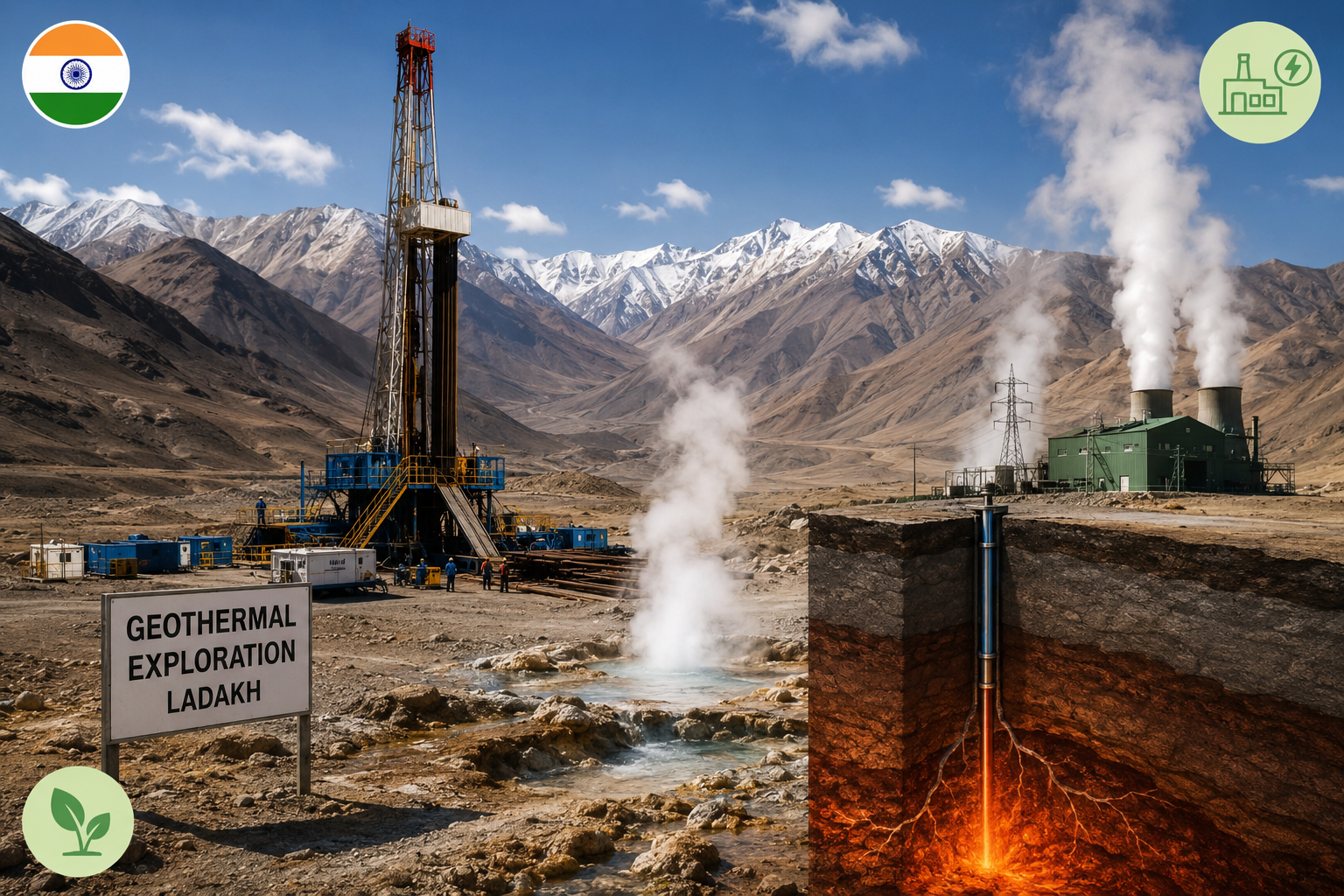
India has taken another significant step towards harnessing geothermal energy, with the Public Sector Undertaking Oil and Natural Gas Corporation (ONGC) successfully drilling a second geothermal exploration well in Ladakh. The development marks an important milestone in the country’s efforts to diversify its renewable energy mix and could pave the way for India’s first geothermal power plant in one of the world’s most geologically active regions.
Notably, this will be a major boost for India’s push towards renewable energy and reducing its dependence on fossil fuels.
For decades, for renewable energy, India has relied primarily on solar, wind, hydroelectric power to meet its growing energy demand. However, geothermal energy—power generated from the Earth’s internal heat—has remained largely unexplored despite the country possessing several promising geothermal regions. The Puga Valley in Ladakh, where ONGC is carrying out its drilling operations, is considered India’s most promising geothermal site due to its abundant hot springs, high underground temperatures and favourable geological conditions.
The drilling of the second well is aimed at gathering crucial data about the temperature, pressure and permeability of underground geothermal reservoirs. These factors determine whether the site can produce enough steam or hot water to generate electricity on a commercial scale. If the exploration confirms the expected resource potential, India could soon witness the commissioning of its first geothermal power plant, opening an entirely new chapter in the country’s clean energy journey.
Unlike solar and wind power, geothermal energy offers a major advantage as it provides continuous, round-the-clock electricity generation. Solar power depends on sunlight, while wind farms require favourable wind conditions. Geothermal plants, on the other hand, can operate 24 hours a day throughout the year, making them an ideal source of renewable power. This reliability can help stabilize India’s increasingly renewable-heavy electricity grid.
The project is especially significant for Ladakh. Due to its remote location and harsh Himalayan climate, the Union Territory faces challenges in maintaining a stable electricity supply, particularly during long winters when solar generation declines sharply. A local geothermal power plant could provide uninterrupted clean electricity, reduce dependence on costly diesel generators, and improve energy security for local communities, military installations and tourism infrastructure.
Beyond electricity generation, the heat extracted from underground reservoirs can be used for greenhouse farming, food processing, aquaculture and tourism-related activities, tourism is a major part of local economy. Such applications could support economic development in Ladakh while creating employment opportunities for local residents.
From an environmental perspective, geothermal power has one of the smallest carbon footprints among all energy sources. It emits significantly lower greenhouse gases than coal or natural gas plants and occupies relatively little land compared to large solar parks or wind farms. As India pursues its ambitious goal of achieving net-zero emissions by 2070 while expanding non-fossil fuel capacity, geothermal energy can serve as an important complement to existing renewable technologies.
The project also reflects ONGC’s broader transformation. Traditionally known for oil and gas exploration, the state-owned energy major has been expanding into cleaner energy technologies, including green hydrogen, offshore wind and geothermal exploration. This diversification aligns with India’s long-term strategy of gradually transitioning from fossil fuels to a more sustainable and resilient energy system.
While challenges remain, including high initial exploration costs, drilling risks and the need for supportive regulatory frameworks, the successful drilling of successive geothermal wells represents encouraging progress. If the Puga project proves commercially viable, it could encourage further exploration in other geothermal regions such as Himachal Pradesh, Uttarakhand, Chhattisgarh and Gujarat.
India’s move towards geothermal energy is therefore more than just another renewable energy project. It represents the opening of an entirely new source of clean, reliable and indigenous power that can strengthen energy security, reduce carbon emissions and support sustainable development in some of the country’s most remote regions. The success of the Ladakh project could ultimately position geothermal energy as the next step in India’s renewable energy revolution.

