
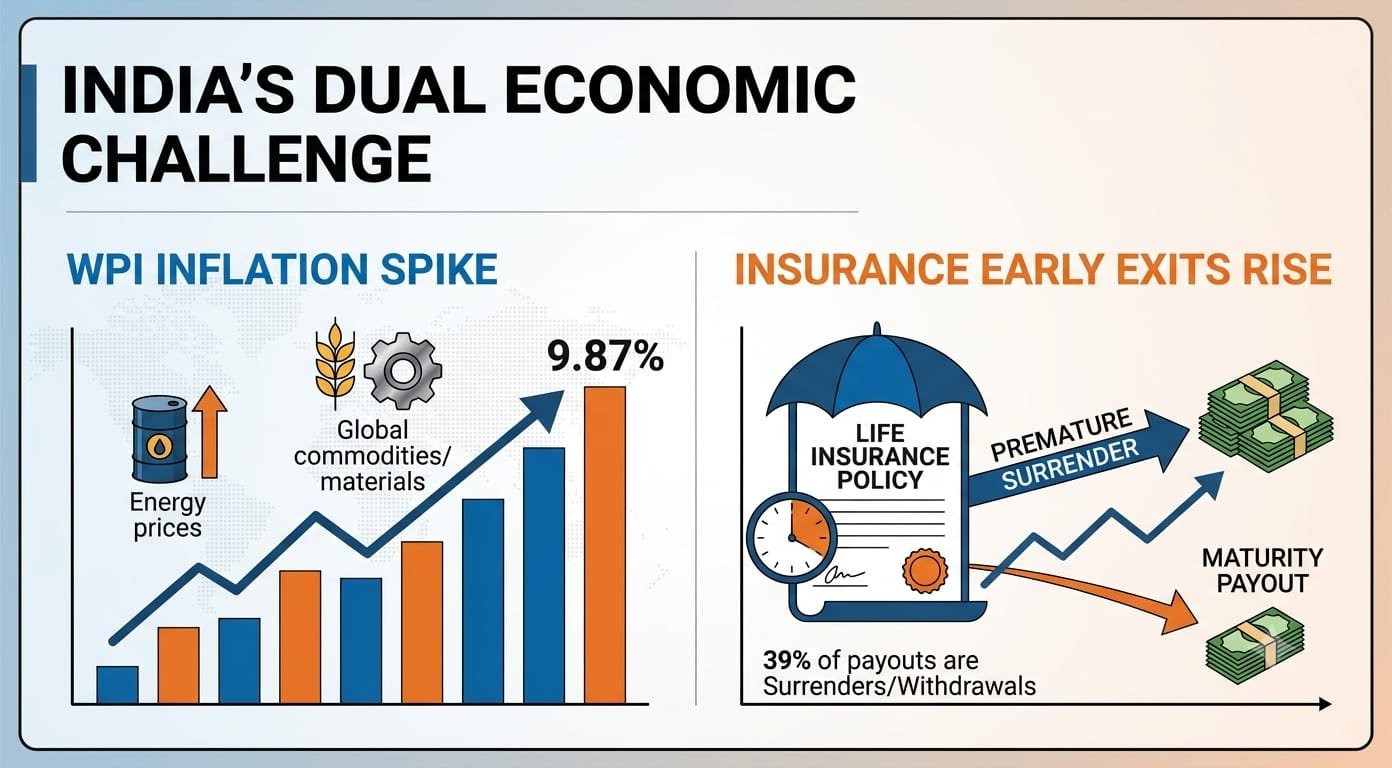
The recent spike in wholesale price inflation is being driven largely by global factors, the government has clarified. Further, a separate set of data reveals a worrying trend in the insurance sector, as policyholders are exiting life insurance plans prematurely rather than staying invested till maturity.
In a written reply in the Lok Sabha, Minister of State for Finance Pankaj Chaudhary stated that wholesale price inflation, which rose to 9.87 percent in June from 9.68 percent in May, has been significantly influenced by rising global commodity and energy prices.
The surge, he explained, is closely linked to international movements in oil prices, alongside increases in food articles, basic metals, and chemical products. This underscores the growing vulnerability of India’s domestic pricing environment to external shocks in global markets.
Despite these pressures, the government has emphasised that coordinated efforts with the Reserve Bank of India have helped contain broader inflationary risks. Measures such as maintaining buffer stocks of essential commodities, calibrated release of food grains into the open market, and timely trade policy interventions have been deployed to stabilise prices.
As a result, retail inflation, measured by the Consumer Price Index, has remained relatively contained. It averaged 3.1 percent in the January–March quarter and 3.9 percent in the following quarter, staying within the central bank’s comfort zone.
The government has also reaffirmed its inflation management framework by notifying a CPI target of 4 per cent, with a tolerance band of 2 to 6 per cent, for the five-year period ending March 2031. However, recent data shows a slight uptick, with retail inflation rising to a provisional 4.38 percent in June, compared to 3.93 percent in May, primarily due to higher food and transport costs.
Alongside inflation concerns, fresh data presented in Parliament points to a structural shift in the life insurance sector. The proportion of payouts arising from premature policy surrenders and withdrawals has increased significantly, rising from 32 percent in 2022 to 39 percent in the latest period. In contrast, the share of maturity payouts has declined from 48 percent to 37 per cent.
In absolute terms, surrender and withdrawal payouts have surged sharply to approximately ₹2.80 trillion, up from ₹1.58 trillion earlier. Meanwhile, maturity payouts have grown at a slower pace, increasing from ₹2.40 trillion to about ₹2.70 trillion. This divergence indicates that a growing number of policyholders are discontinuing their insurance plans before completion.
The Insurance Regulatory and Development Authority of India (IRDAI) attributes this trend to multiple factors. These include mis-selling of policies, products not aligning with customer needs, affordability issues related to premium payments, and limited awareness among policyholders about policy features and long-term benefits. Changing financial circumstances of households have also played a role in driving early exits.
The trend is visible across the industry. State-run Life Insurance Corporation of India reported the highest surrender value at ₹1.57 trillion in the latest financial year. Private insurers such as SBI Life, ICICI Prudential Life Insurance, and HDFC Life have also recorded substantial surrender figures, indicating that the issue is systemic rather than company-specific.
Taken together, these developments highlight two emerging challenges for India’s economic landscape. On one hand, rising wholesale inflation driven by global commodity and energy costs reinforces the need for continued vigilance against external shocks.
On the other hand, the sharp increase in premature life insurance exits raises concerns about financial literacy, product suitability, and household financial stability. Addressing these issues will require not just macroeconomic management, but also deeper structural reforms in financial awareness, consumer protection, and product design to ensure long-term economic resilience.

