
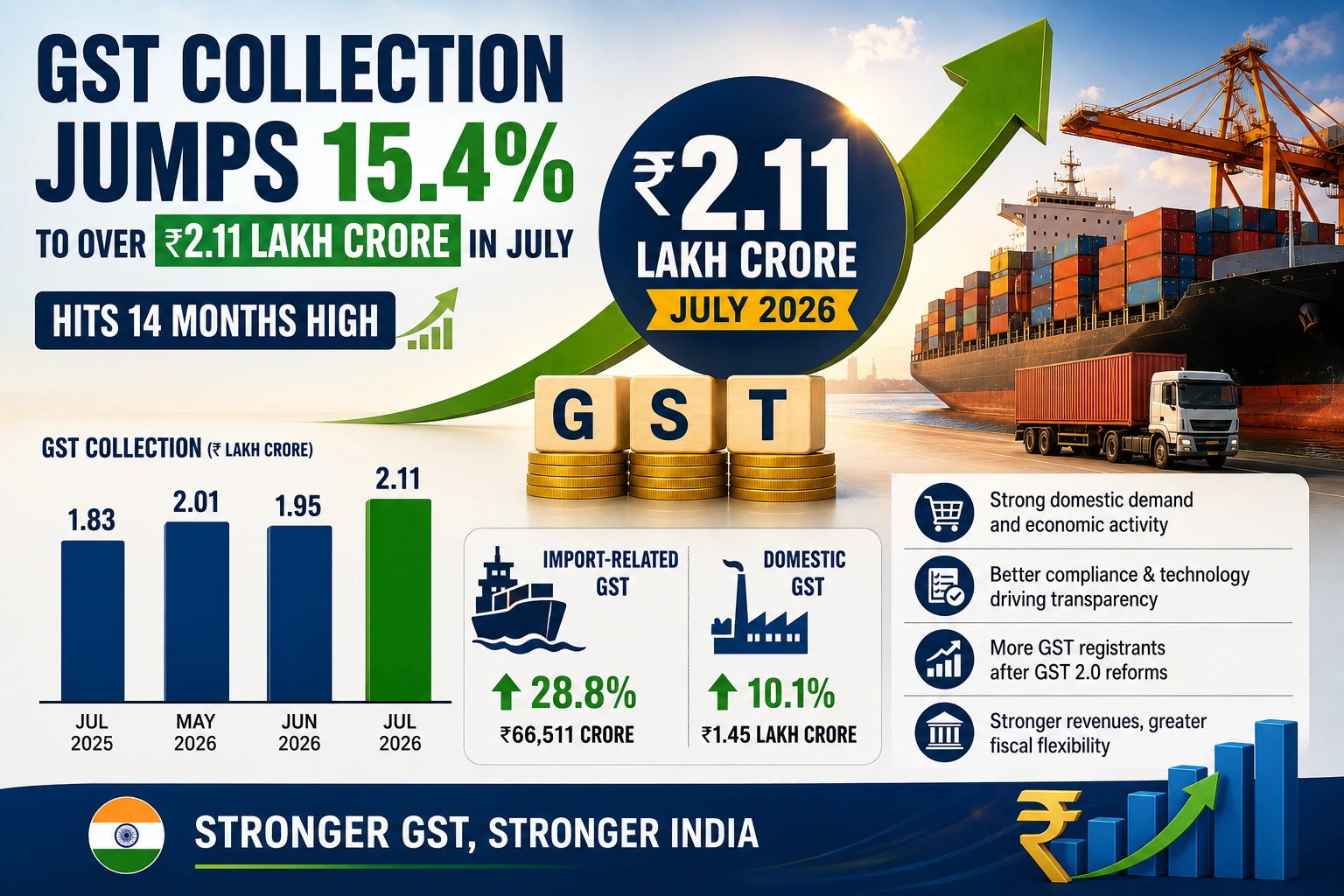
India’s Goods and Services Tax (GST) collections continued their strong growth in July 2026 with gross revenues rising 15.4% year-on-year to more than ₹2.11 lakh crore. This marks the highest monthly GST collection in the last 14 months. This is also the second time this financial year that the GST collections have crossed ₹2 lakh crore.
The strong growth of GST collections reflects strong domestic consumption, sustained economic activity even in the face of global headwinds, improved tax compliance and a sharp increase in tax collections from imports. This also highlights the underlining strength of the Indian economy.
In the previous month of June, GST revenues had risen 13.9 percent to Rs 1.95 lakh crore. At Rs 2.11 lakh crore, July 2026 collection growth was the highest since May 2025, when revenues had grown 16.4 percent year-on-year. Notably, Gross GST collections were Rs 1.83 lakh crore in July 2025.
According to official data released by the Finance Ministry, July’s GST collection marks one of the strongest revenue performances since the GST regime was introduced in 2017. The latest figures indicate that both domestic transactions and imports contributed significantly to the healthy growth in indirect tax collections.
GST collected on imported goods registered significantly higher growth than domestic GST collections, reflecting a rise in the value of imported merchandise as well as higher tax realisations. The increase suggests strong industrial demand for raw materials, pointing to rise in domestic manufacturing, while also pointing towards strong consumer demand for imported products.
Higher import-related GST collections are often viewed as an indicator of expanding economic activity. As businesses import machinery, electronic components, chemicals, crude oil and other industrial inputs, the corresponding GST collections rise, reflecting increased production and investment across sectors. In recent months, India’s import bill has also been influenced by stronger purchases of energy products, electronics and industrial goods, contributing to the higher tax revenues.
Import-related GST collections jumped as high as 28.8 percent to Rs 66,511 crore while domestic GST revenues also remained healthy, rising 10.1 percent to Rs 1.45 lakh crore.
Domestic GST collections were supported by sustained consumption, expanding formalisation of the economy and continued improvements in compliance. The government’s focus on data analytics, e-invoicing, e-way bills and tighter enforcement against tax evasion has significantly strengthened GST administration since the tax regime’s introduction. These reforms have widened the tax base and reduced leakages, resulting in consistently higher monthly collections. GST 2.0 reforms have further given a boost to the revenue collections by easing the tax regime. A clear rise in GST registrants since the reforms reflect practical changes in how registration is granted and how small businesses have entered the formal tax system.
The strong GST numbers along with several other indicators point towards the healthy state of the Indian economy. Rising manufacturing activity, steady services sector expansion, healthy automobile sales, increasing digital transactions and higher freight movement have all contributed to greater tax buoyancy. Improved compliance among businesses has further enhanced revenue generation without increasing tax rates.
Higher GST collections also provide greater fiscal flexibility to both the Centre and the states. Strong indirect tax revenues help governments finance infrastructure projects, welfare schemes, healthcare, education and capital expenditure while maintaining fiscal discipline. The continued rise in GST receipts strengthens public finances and supports India’s long-term growth ambitions.
The July collection of over ₹2.11 lakh crore underscores the growing maturity of India’s GST framework a decade after its rollout. With a strong domestic demand, increased formalisation of the economy and rising import-related revenues supporting tax collections, the latest figures reinforce confidence in India’s economic momentum.

