
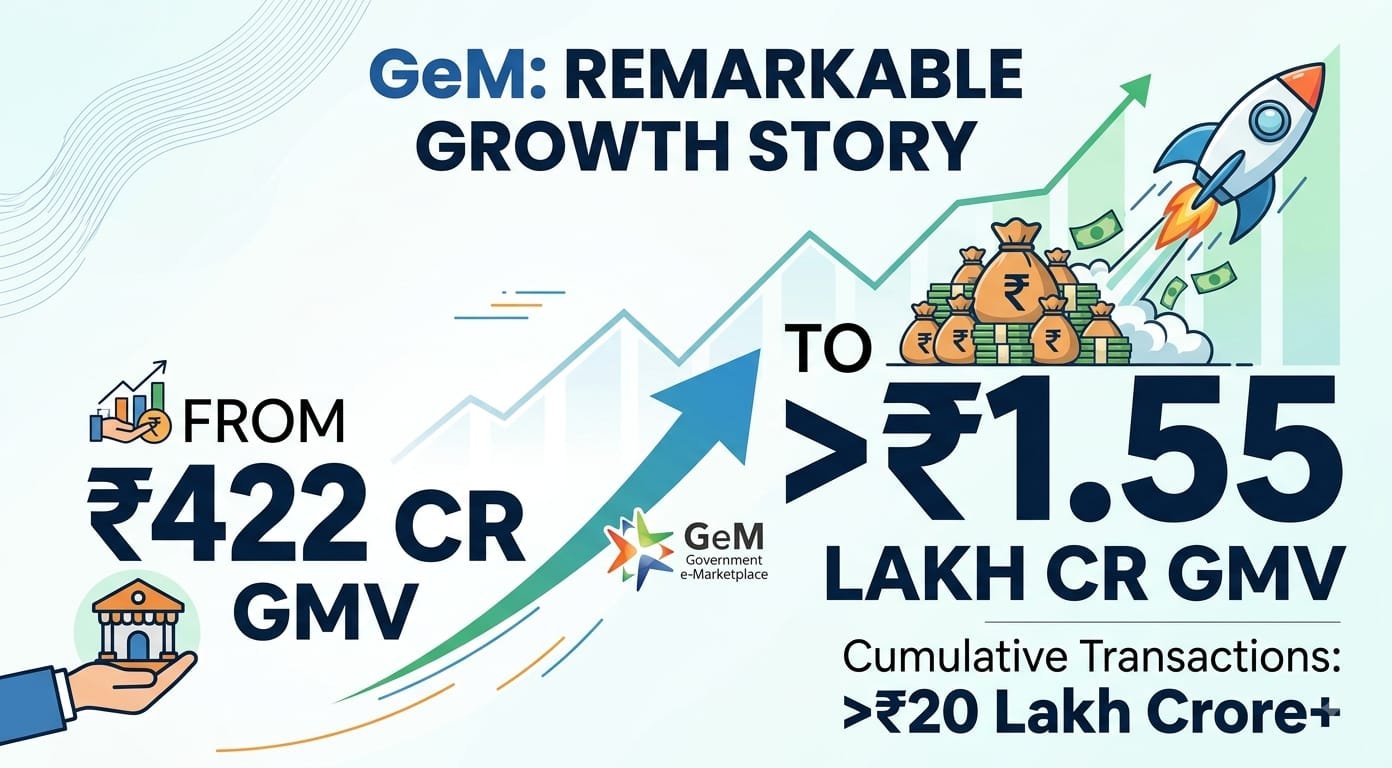
The Government e-Marketplace, commonly known as GeM, has completed a decade of major growth. Its Gross Merchandise Value, or GMV, has increased from only ₹422 crore around ten years ago to more than ₹1,55,000 crore today.
This sharp rise shows how government buying in India has moved from traditional systems to a large, end-to-end digital platform. Commerce and Industry Minister Piyush Goyal said that GeM has changed the rules of public procurement by improving competition, transparency and access for sellers across the country.
The platform has also crossed an important cumulative milestone. As of August 7, 2026, the total GMV recorded on GeM since its beginning had crossed ₹20 lakh crore. More than 3.78 crore orders had been completed through the platform.
These figures indicate that GeM is no longer limited to a small government experiment. It has become a major marketplace where government departments and public organisations can purchase goods and services from registered businesses.
The major change brought by GeM is the shift towards complete digital procurement. Government buyers can search for products, compare prices, place orders and track transactions through the same online system. This process has helped improve price discovery and competition.
It has also reduced the time needed to complete procurement and created better records of government purchases. According to Piyush Goyal, digital procurement has helped increase accountability and generate savings for the government.
Micro and Small Enterprises, or MSEs, have gained a significant place on the platform. More than 12.28 lakh MSEs are registered on GeM. These businesses have completed orders worth over ₹9 lakh crore, accounting for 45.6 per cent of the platform’s cumulative GMV.
This participation is important because smaller businesses often find it difficult to reach large government markets through traditional channels. GeM has made it easier for them to display products, compete for orders and build a record of government business.
Women-led enterprises are also becoming more visible through the platform. More than 2.25 lakh women-led MSEs are registered on GeM. Together, these businesses have completed over 50 lakh orders worth more than ₹99,800 crore.
The numbers suggest that online procurement can create more opportunities for women entrepreneurs by reducing geographical and procedural barriers.
Startups have also received support through GeM. More than 42,000 startups are registered on the portal, and they have fulfilled orders valued at over ₹65,900 crore.
The Startup Runway facility gives recognised startups an opportunity to showcase their products in 13 categories. This can help new companies reach government buyers without depending only on private markets or large distributors.
The platform has also focused on regional products and local producers. More than 600 product categories have been created under the One District One Product GeM Bazar.
This initiative connects local goods with a wider government market and supports the ideas of Vocal for Local and Make in India. Artisans, weavers, Self Help Groups and other small sellers can receive greater visibility through this system.
Financial support has been another part of GeM’s expansion. The GeM Sahay initiative offers collateral-free working capital finance against active purchase orders. More than 25,000 users have registered for the facility. Such support can help small businesses manage production and delivery costs while waiting for government payments.
The growth of GeM therefore represents more than a rise in transaction value. It reflects a wider change in how public money is spent and how Indian businesses access government demand. With MSEs, women entrepreneurs, startups and local sellers taking part, the platform is being positioned as an important tool for self-reliance and the broader vision of a Viksit Bharat.

