
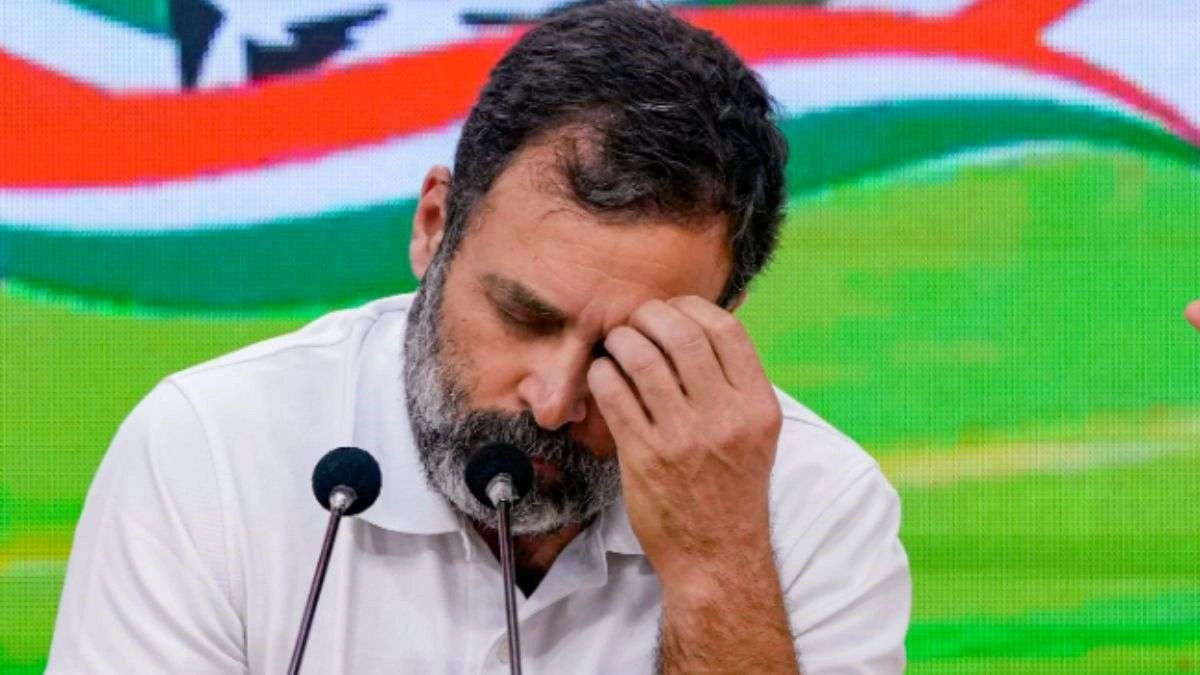
The Congress party had promised a political spectacle at Delhi’s Ramlila Maidan on November 1. The INDIA bloc was supposedly preparing to bring 10 lakh protesters to the national capital, to demonstrate its enormous political strength and send a loud message to the government over alleged electoral irregularities. Unfortunately for Congress, the spectacle turned out to be much bigger in publicity than in attendance.
After days of grand announcements, mobilisation claims and political chest-thumping, the much-hyped gathering fell considerably short of the expectations created by its organisers. Instead of the promised sea of humanity, the rally presented a far less impressive picture, with large vacant spaces and empty chairs visible in footage from the venue.
BJP leader Sambit Patra questioned the Congress’s 10-lakh claim, and pointed to visuals that showed around 40 per cent of the venue vacant. He also said that between 5,000 and 7,000 chairs were empty when the footage was recorded. While the exact attendance remains disputed and no independent final headcount is available, one thing is difficult to dispute, the Congress party did not deliver the spectacular turnout it had advertised.
For a party that regularly accuses its political opponents of manipulating numbers, the arithmetic of its own rally has become an uncomfortable subject. Ten lakh promised, but where were the ten lakh? Did the buses get lost on their way to Ramlila Maidan? Did the enthusiasm remain confined to Congress press releases? Or was the much-advertised nationwide mobilisation simply another exercise in political exaggeration?
While Congress’s attendance figures became a subject of political embarrassment, there was another group that had a much more tangible reason to be unhappy – Delhi’s traders.
For days, the Chamber of Trade and Industry and several market associations had pleaded with Congress leaders to postpone the rally until after Diwali. Their concern was straightforward. November 1 fell during an important festive shopping period when businesses depend heavily on customers, transport, wholesale supplies and uninterrupted access to markets.
Traders warned that the anticipated gathering of 10 lakh people and an estimated 15,000–20,000 vehicles could paralyse traffic across more than 20 major markets. They had even warned of business worth thousands of crores being put at risk. They suggested postponing the rally or shifting it to a venue such as Burari Ground. Their appeals, however, went unheeded. Little did they know that nobody was turning up for this joke of a protest anyway.
Rahul Gandhi and the Congress leadership decided that their political programme could not wait. The traders’ concerns apparently did not merit the same urgency as the party’s protest calendar.
And what was the outcome? The political mobilisation fell short of its grand promise, but the inconvenience imposed on ordinary businesses was real. Shopkeepers, wholesalers, customers and transport operators had to contend with the uncertainty and disruption surrounding the event.
This is perhaps the biggest irony of the entire exercise. Congress wanted to demonstrate its political strength but ended up inviting questions about its organisational capacity. The party wanted to send a message to the government but seemingly failed to listen to the people who were asking it to reconsider the timing of its own programme.
A rally that promised a million voices delivered a political embarrassment instead. Ten lakh promised, empty chairs delivered, and traders left counting the cost.

