
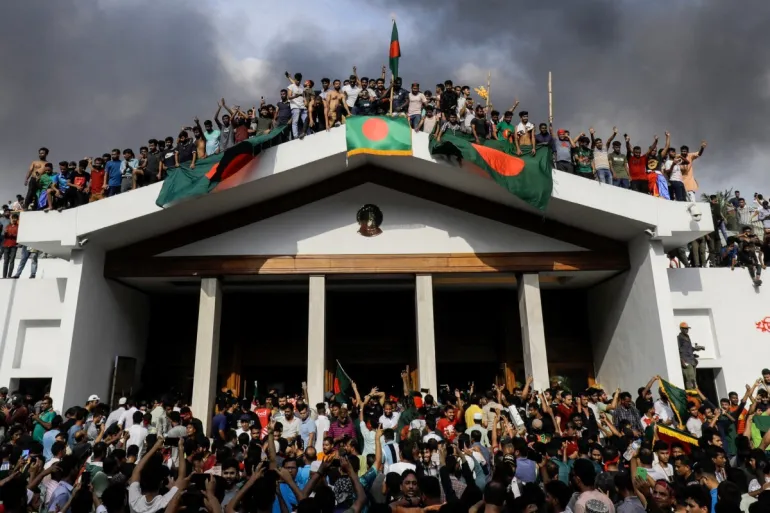
Revolutions promise to liberate a country from its problems, but invariably create an entirely new set of problems for its people. Bangladesh is discovering this the hard way. The student-led uprising of August 2024, which brought down Sheikh Hasina’s government, was celebrated in certain quarters as a historic victory of people power. Images of protesters taking over the streets, the departure of Hasina and the formation of an interim government led by Muhammad Yunus were presented as the beginning of a new democratic era. The usual cheerleaders of revolutionary politics were ecstatic. Apparently, Bangladesh had shown the world how to overthrow an established political order.
Two years later, however, the economic picture is considerably less glamorous. The revolution may have produced dramatic television footage, but it has hardly delivered the economic transformation its supporters promised.
According to the International Monetary Fund (IMF), Bangladesh’s GDP growth declined from 5.8 per cent in FY23 to 4.2 per cent in FY24 and further to just 3.7 per cent in FY25. Inflation remained elevated, reaching 8.2 per cent in October 2025. The IMF also highlighted sluggish private investment, weaknesses in the banking sector, poor revenue mobilisation and continuing financial vulnerabilities. Its January 2026 assessment projected growth of just 4.7 per cent for FY26.
This is hardly the economic miracle that revolution enthusiasts had advertised.
Of course, Bangladesh’s economic difficulties did not begin with the uprising. Sheikh Hasina’s government had its own serious problems, including allegations of corruption, cronyism, institutional weaknesses and an increasingly authoritarian political environment. Economic inequality and dissatisfaction with governance contributed to the protests. Pretending that everything was perfect before August 2024 would be dishonest.
But acknowledging the problems of the previous government does not mean pretending that overthrowing it automatically solves them. In fact, the revolution has made economic problems worse.
The disruption caused by the uprising, uncertainty surrounding political arrangements, sluggish investment and instability have all added to the economic challenges. As we all know, businesses need predictable policies, functioning institutions, security and confidence in the future. Investors do not commit billions of dollars simply because a country has experienced an exciting political upheaval. They want to know whether their factories, investments and employees will be safe tomorrow.
Bangladesh’s garment industry, one of the country’s biggest economic engines, is particularly important in this context. Millions of livelihoods depend on an industry that requires international buyers to have confidence in production schedules, labour stability and the country’s ability to deliver. Political uncertainty and industrial disruption are hardly attractive selling points.
And this brings us to an interesting development much closer home.
For sections of India’s political Left, Bangladesh’s uprising became more than an event in a neighbouring country. It became an ideological inspiration. The familiar vocabulary of revolution, people power and overthrowing the establishment suddenly acquired a new urgency. There are sections of the Indian Left that appear particularly enthusiastic about the prospect of a similar political upheaval in India. Since Bangladesh’s revolution, many people have expressed their wish to see a similar revolution in India because, electorally, the Indian opposition has no chance of defeating the PM Modi-led NDA alliance.
One wonders whether they have examined the economic consequences of the experiment they are celebrating.
India is not Bangladesh. It is a continental-sized economy with a complex manufacturing ecosystem, a massive services sector, an expanding digital economy, a sophisticated financial system and deep integration with international markets. Millions of jobs depend on businesses operating in an environment where political and economic stability matter enormously.
According to the World Bank’s April 2026 India Development Update, India remained the fastest-growing major economy in FY26, recording GDP growth of 7.6 per cent, compared with 7.1 per cent in FY25. The Reserve Bank of India has also highlighted the country’s strong domestic consumption, investment, manufacturing activity and resilient financial sector. India is also certain to be the fastest-growing major economy during the current financial year.
These achievements are not reasons for complacency. India has enormous challenges. The government must be questioned, criticised and held accountable. Democratic opposition, peaceful protests and demands for institutional reforms are essential to a healthy democracy.
But there is a fundamental difference between demanding accountability through democratic institutions and romanticising the destruction of those institutions.
India’s economic ambitions require sustained investment in infrastructure, manufacturing, semiconductors, electronics, defence production, renewable energy and technology. Businesses need policy continuity. International investors need confidence. Young Indians need employment opportunities, not prolonged political instability.
Imagine the consequences of a Bangladesh-style upheaval in India. What happens to investor confidence when political uncertainty becomes the norm? What happens to manufacturing investments when businesses cannot predict the next six months? What happens to millions of workers when factories, supply chains and commercial activity are disrupted? And what happens to India’s ambition of becoming a developed nation by 2047 if economic growth is sacrificed at the altar of a romanticised revolution?
Revolutions make for exciting slogans, dramatic photographs and romantic political speeches. Rebuilding an economy, however, requires considerably more patience, competence and institutional discipline.
Bangladesh’s experience should be a warning against confusing the excitement of overthrowing an establishment with the difficult business of governing a country.
The people of Bangladesh deserve political freedom, accountable institutions and economic prosperity. But they also deserve something more practical than revolutionary nostalgia- Jobs, stable prices, investment and a government capable of delivering economic growth.
As for India’s revolutionary romantics, perhaps they should spend less time fantasising about importing Bangladesh’s political upheaval and more time studying what economic uncertainty can cost an ordinary citizen.
A revolution can bring down a government in a matter of days. Building an economy that creates prosperity for millions takes decades. And destroying that progress can be considerably easier than rebuilding it.

