
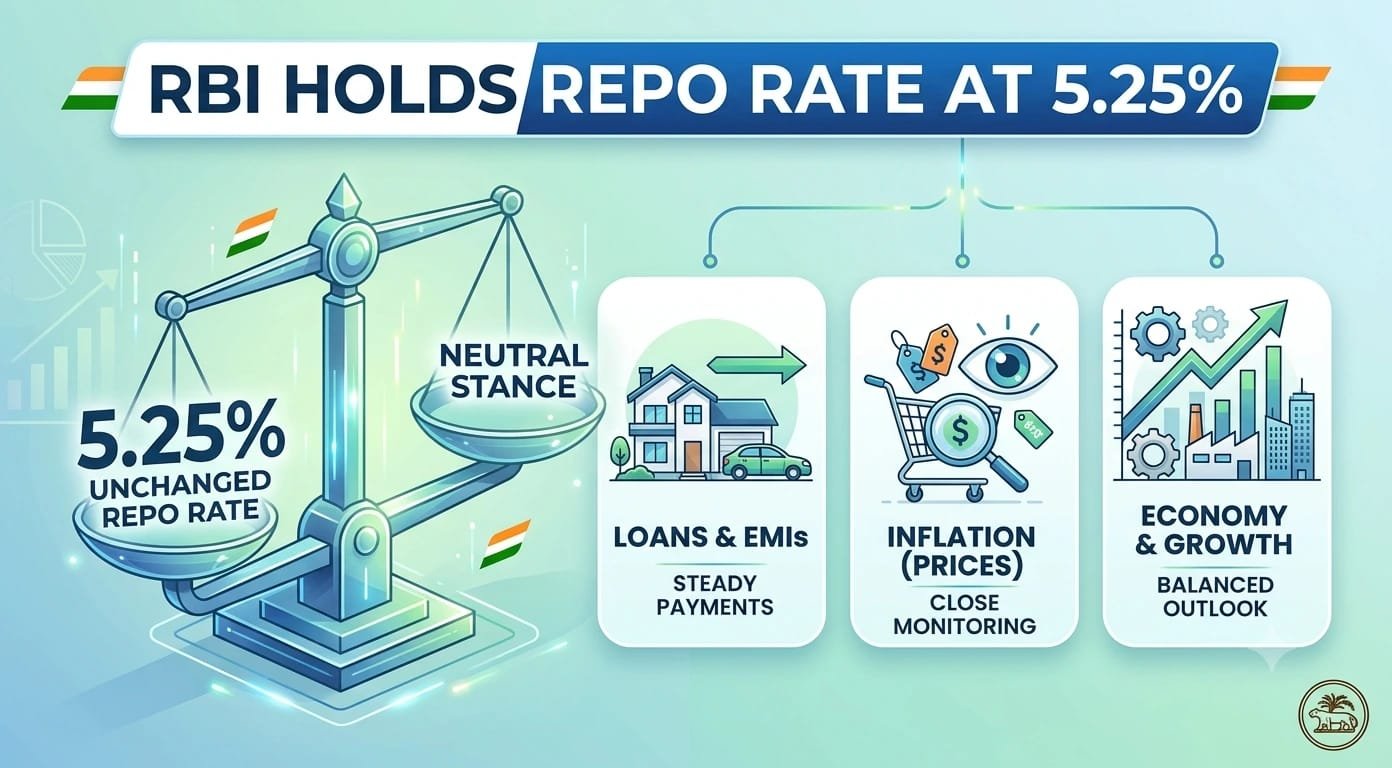
The Reserve Bank of India has kept the repo rate unchanged at 5.25% and continued with a neutral stance after its latest monetary policy review. This decision means the central bank is choosing to wait and watch, instead of changing borrowing costs right away, while it studies how inflation, growth, and global risks are moving.
For ordinary households, this is important because the repo rate often shapes how costly or affordable loans become in the banking system.
In simple words, the repo rate is the rate at which the RBI lends short-term money to banks. When this rate stays unchanged, banks usually do not get a strong push to raise or cut lending rates quickly, so home loans, vehicle loans, business loans, and personal loans may remain broadly steady for now.
That also means EMIs are likely to stay stable in the near term, which can give some relief to borrowers who were hoping for predictability in monthly payments.
The RBI’s neutral stance is also a signal that the central bank is not leaning fully toward easing or tightening at the moment. This kind of stance is often used when the economy is facing mixed signals, because growth may need support, but inflation still needs careful monitoring.
In this case, the RBI appears to be balancing two concerns at once: keeping growth on track while avoiding fresh pressure on prices.
This decision comes at a time when the RBI is paying close attention to inflation risks and global uncertainty. Recent reports say the central bank has raised concern about factors such as higher energy prices, supply disruptions, and tension in global markets, all of which can affect India’s price stability.
At the same time, India is still being described as one of the fastest-growing large economies, which gives the RBI a reason to avoid sudden policy moves.
For savers, the immediate effect may be limited as well. Fixed deposit rates and other savings returns may stay near current levels unless banks change them for their own business reasons. That means both borrowers and savers may see a period of relative calm, rather than sharp changes in interest rates.
The latest policy choice also shows that the RBI prefers caution over urgency. Instead of reacting too quickly, it is allowing more time for incoming data to show whether prices cool further or whether growth needs more support. In everyday terms, this is like pausing before making a big family budget decision, so the next step is based on clearer facts rather than pressure.
Overall, the message from the RBI is simple: Stability first, action later if needed. Loans are likely to remain steady for now, inflation will stay under close watch, and future rate moves will depend on how the economy behaves in the coming months.

