
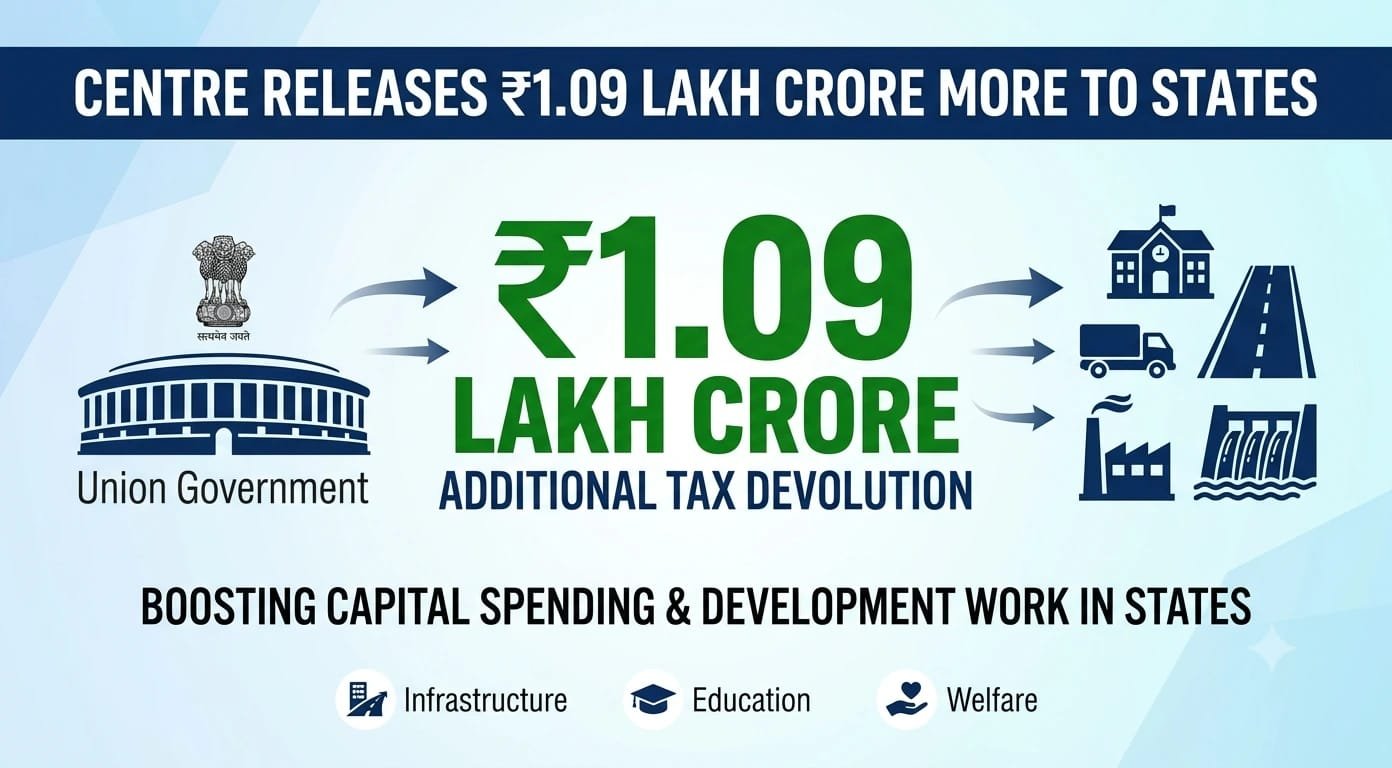
The Union government has released an additional Rs 1,09,000 crore to state governments as tax devolution in August 2026, and this move is meant to strengthen state finances at a time when many states are preparing for higher capital expenditure and ongoing development work.
The transfer comes ahead of the regular monthly devolution cycle, which means states will receive money sooner than expected and can use it for public projects, welfare spending, and infrastructure support. In simple terms, tax devolution is the sharing of the Centre’s tax collection with the states, and it is one of the most important ways through which money moves from the national government to the state governments.
This release is significant because it gives states more flexibility to manage expenses without waiting for the usual scheduled installment, and that can help speed up work on roads, schools, hospitals, irrigation projects, and local development schemes.
According to the Finance Ministry, this allocation is in addition to the normal monthly devolution for August, which shows that the Centre wanted to provide immediate fiscal support rather than delaying the transfer until the standard date. Such steps are often important in a federal system like India, where states depend on timely fund flows to maintain momentum in spending and avoid disruption in projects already underway.
The amount is also useful because many state governments face uneven revenue collection through the year, while their expenditure commitments remain regular and predictable. When more funds arrive in advance, states are better positioned to clear pending bills, continue construction activity, and support administrative needs in districts and towns.
The largest beneficiaries of the transfer include Uttar Pradesh, Bihar, Madhya Pradesh, Maharashtra, Rajasthan, West Bengal, Odisha, Karnataka, and Tamil Nadu, reflecting the formula-based nature of tax sharing in which larger and more populous states generally receive larger amounts.
For example, states like Uttar Pradesh and Bihar tend to receive a high share because the devolution system is designed not only on population and income factors but also on equity considerations, so that poorer states can receive stronger support.
This money is especially valuable in the months when states plan major public works, because capital expenditure has a direct impact on employment, local demand, and long-term growth. A state that receives funds early can begin tendering, ordering materials, and executing projects faster, which is often more effective than releasing funds at the last minute.
The Finance Ministry’s decision also reflects the Centre’s wider effort to maintain smooth fiscal coordination with states, especially at a time when public investment remains an important driver of economic activity. Tax devolution is not a grant in the narrow sense; it is the constitutional share of taxes that belongs to the states, based on recommendations of the Finance Commission and the structure of Indian fiscal federalism.
That is why this release is viewed as a routine but very important support mechanism rather than an exceptional handout. Even though the amount is large, it fits into the broader system of monthly transfers that the Centre makes to keep state budgets functioning efficiently. The main takeaway is simple: more money has reached the states early, and that should help them spend faster on development and public services.

