
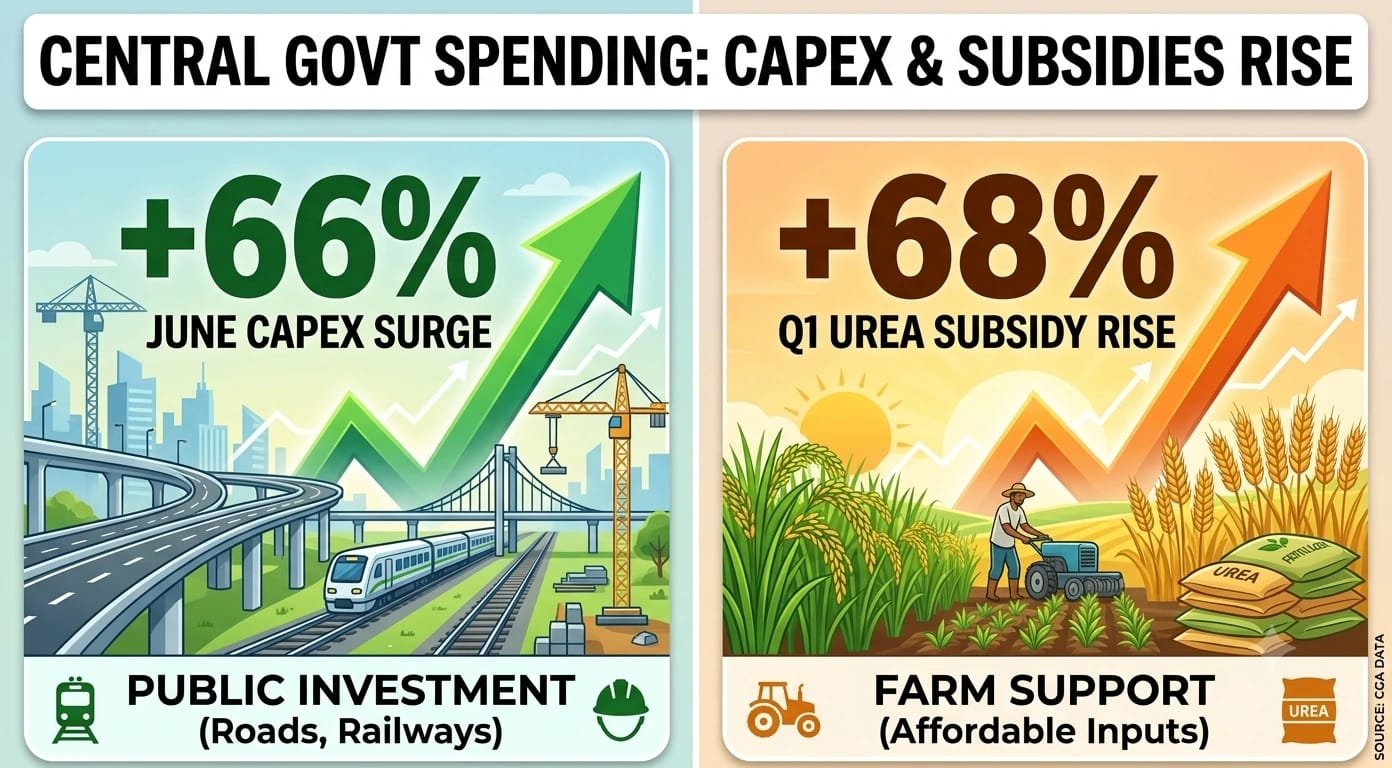
The central government’s capital expenditure rose sharply in June, climbing 66% year-on-year to Rs 89,255 crore, according to data released by the Controller General of Accounts, showing that the government continued to push public investment even in a month when total spending did not increase.
This rise matters because capital expenditure is the part of government spending that usually goes into roads, railways, infrastructure, and other long-term assets that can support growth over time.
At the same time, the government’s total spending in June stayed unchanged from a year earlier, mainly because revenue expenditure fell 8% as interest payments dropped 31%, which helped offset other costs.
The June data also suggests that the Centre is moving at a healthy pace to meet its full-year capital spending plan. The government has set a capital expenditure target of Rs 12.22 lakh crore for 2026-27, and by the end of the first three months, it had already achieved 28% of that target.
In simple terms, this means a large part of the yearly infrastructure push is already underway, and the June numbers show that the spending momentum has not slowed.
For a country like India, where public investment is often used to support growth when private investment is cautious, this kind of spending can have a noticeable impact on construction activity, logistics, and industrial demand.
However, the story is not only about capital spending. Subsidy expenditure also rose sharply in the April-June period, with urea subsidy spending increasing 68% to Rs 53,034 crore.
That is a large jump and shows that the government is still spending heavily to keep essential farm inputs affordable, especially fertiliser. This kind of support is important for farmers because it helps control input costs, but it also adds pressure to the fiscal side of the budget.
The combination of stronger capex and higher subsidy spending gives a clearer picture of how the government is managing its finances. On one hand, it wants to keep building long-term assets and maintain the investment cycle.
On the other hand, it has to absorb rising subsidy bills, which can grow quickly when global commodity prices, import costs, or supply disruptions push up the cost of fertilisers and other essential items. The June data shows that the government has managed to protect capital spending even while meeting these other obligations.
The key point is that public spending in India is now split between two important needs: immediate support through subsidies and long-term growth through capex. The June numbers show a 66% surge in capital expenditure and a 68% rise in urea subsidy spending in the first quarter, which means both the investment side and the welfare-support side of the budget are active at the same time.
That balance will matter in the months ahead because it can shape both economic growth and the fiscal deficit path. In short, the government is spending aggressively, but the quality and composition of that spending will determine how much of it turns into durable growth.

