
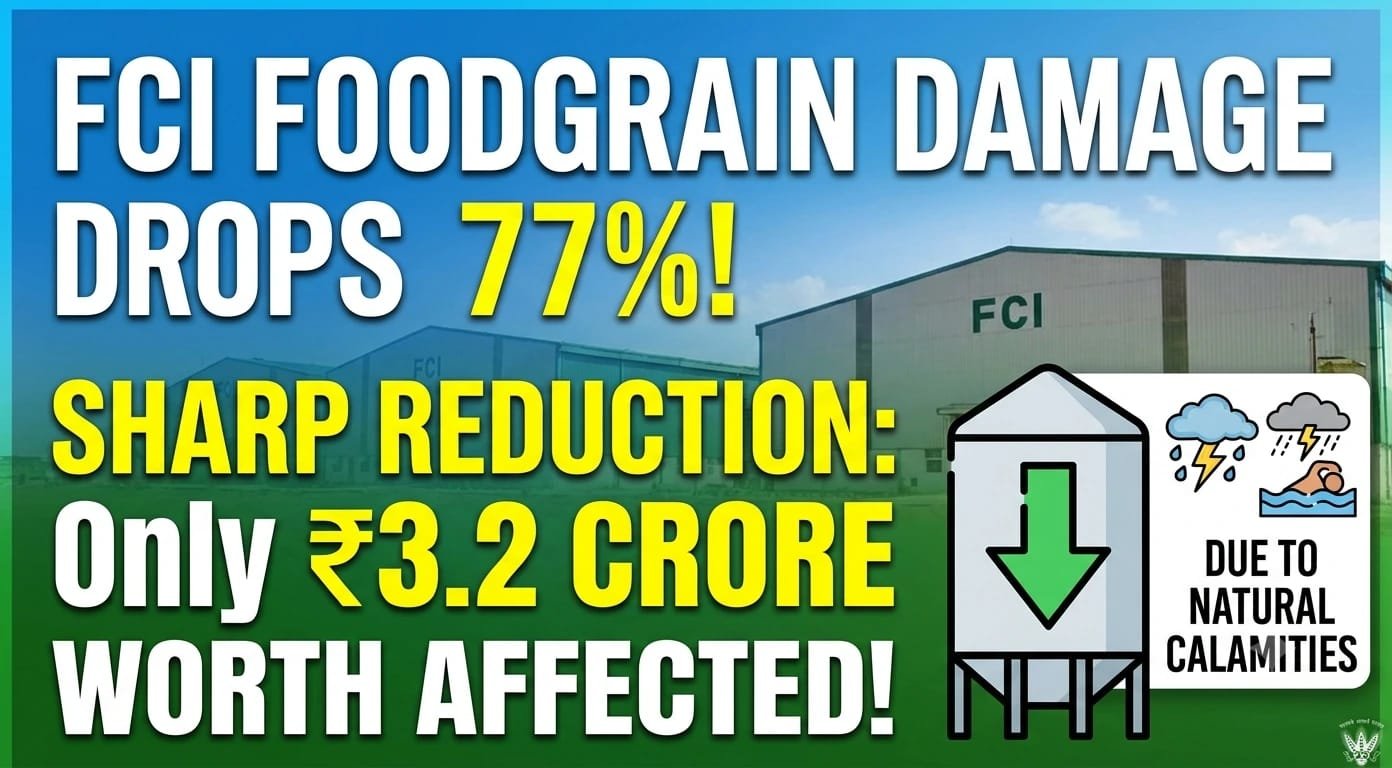
The Government of India has reported a steep reduction in the monetary value and quantity of central-pool foodgrains classified as non-issuable or damaged in Food Corporation of India (FCI) godowns in fiscal year 2025–26, stating that foodgrains worth about ₹3.2 crore were damaged mainly due to natural calamities such as cyclones, floods and heavy rain, a fall of roughly 77% from the previous year’s figure, and an absolute damaged quantity of 0.022 lakh tonnes which is 0.005% of the total foodgrains handled, underscoring that the losses were both monetarily and proportionally negligible relative to the scale of FCI operations which annually handle more than 80 million tonnes of procurement.
This official data, tabled in Parliament by the Ministry of Consumer Affairs, Food and Public Distribution, attributes the damage primarily to unforeseen hydro-meteorological events rather than to dilapidated or inadequate storage infrastructure, and the ministry explicitly stated there were no losses that could be directly ascribed to poor storage arrangements in FCI godowns.
The ministry’s reply, provided in response to parliamentary questions, gave a breakdown showing that of the tiny quantum that became non-issuable, the causes were natural disasters rain, cyclone and flood and that overall the percentage of damaged stocks relative to off-take remains extremely low (around 0.005% in FY26), a figure that experts term negligible when set against procurement volumes and the monetary value of stocks managed by the government each year.
Historical patterns of damage in the central pool show small absolute quantities frequently arise from unavoidable transit or weather-related incidents even as the FCI continues to store foodgrains using scientific methods (covered godowns and cover-and-plinth where needed), and official releases and parliamentary answers going back several years indicate damage in the order of thousandths of a percent of off-take, for example damage figures of 0.02–0.05 lakh tonnes in earlier recent years, reinforcing that the FY26 outcome is both an improvement in monetary terms and consistent with long-term trends of low storage losses under current systems.
The State and regional variation exists in the data: while the national number for damaged central-pool stocks was very small, some States and Union Territories recorded higher localised accruals for instance Jammu & Kashmir reported increases in earlier years measured in metric tonnes which points to the fact that extreme weather events often have a geographically concentrated impact even when national aggregates remain muted, and this heterogeneity suggests that targeted strengthening of local disaster-resilient storage and quicker response mechanisms could further limit such accruals at the state level.
The ministry also described administrative practices for damage monitoring and mitigation, including Damage Monitoring Cells and routine scrutiny of every case of damaged foodgrains, which helps ensure accountability and permits remedial measures such as improving drainage, elevating storage platforms, and where necessary shifting stocks to alternative secure facilities; these institutional safeguards, together with regular audits and procedural checks, are cited by officials as the reasons why no central-pool losses were linked to storage neglect in FY26 and why overall damage remains a minute fraction of government-held stocks.
Economically, the headline ₹3.2 crore loss in FY26 is tiny compared with the government’s annual procurement outlay (procurement volumes exceed 80 million tonnes and involve expenditure running into several lakh crore rupees), so the fiscal impact is minimal, yet policymakers and officials note that any avoidable loss should be prevented given the sensitivity of public distribution and buffer stocks, and so continued investments in modernised infrastructure such as silos, better covered storage, and strengthened supply-chain monitoring are recommended to immunise the central pool further against increasingly erratic extreme weather patterns linked to climate variability.
In short, the FY26 parliamentary data indicate a marked fall in the value and quantity of foodgrains damaged in FCI godowns about ₹3.2 crore and 0.022 lakh tonnes, roughly 77% lower than the prior year with natural calamities identified as the principal cause and no evidence in the official reply of damage resulting from inadequate storage, while state-level variations and the persistent risk of weather shocks make continued investments in resilient storage and disaster-response measures a prudent policy priority to keep such losses negligible going forward.

