
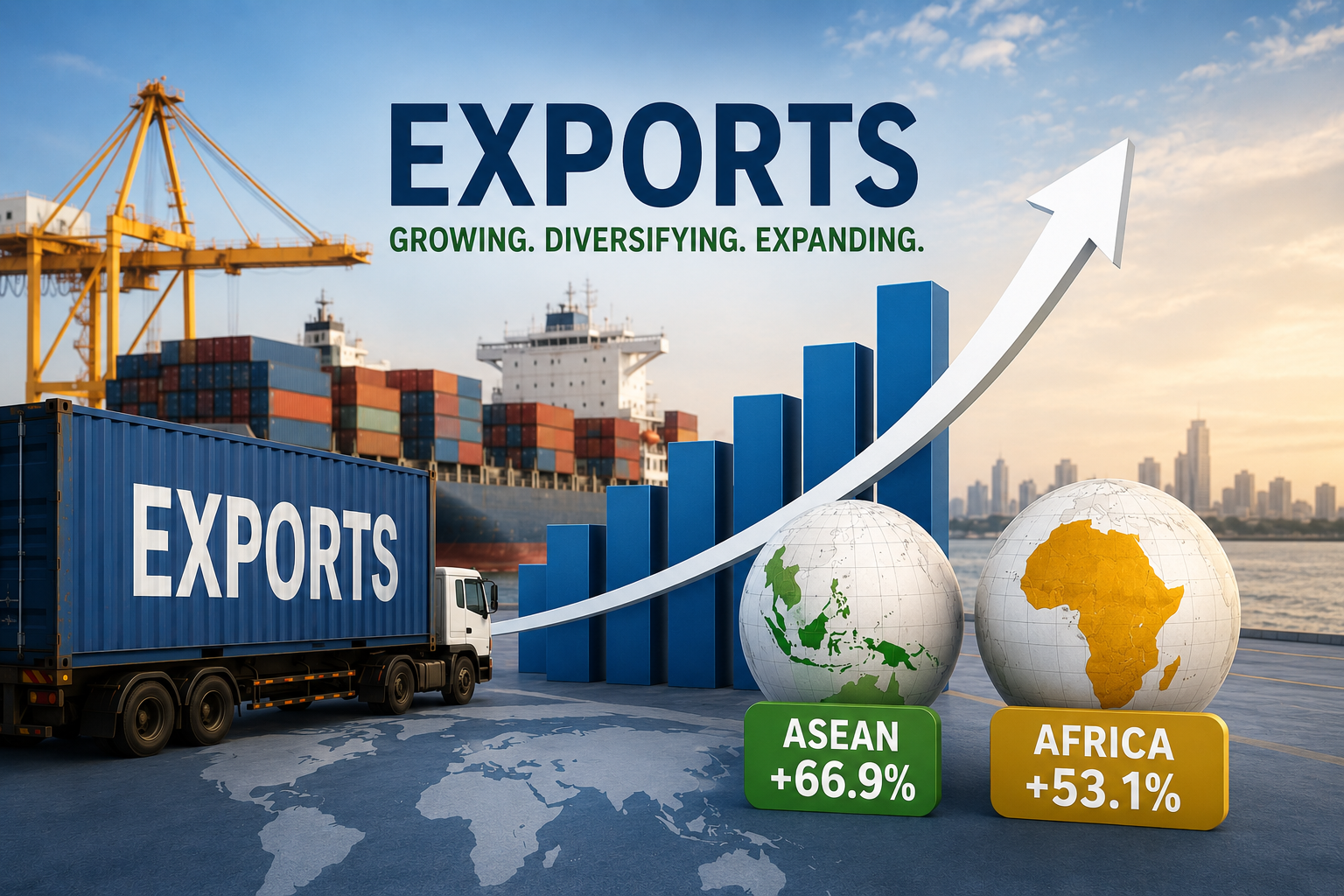
The latest trade data from the commerce ministry shows a clear shift in export momentum during the first two months of FY27, with ASEAN and Africa emerging as the biggest growth drivers. In simple terms, the external demand picture has become more balanced, and the strongest gains are now coming from markets that had earlier played a smaller role in export growth.
According to the ministry data reported by Economic Times and other outlets, total exports in April-May 2026-27 rose 16.09% year-on-year to $88.91 billion, showing a solid start to the financial year.
The most striking part of the data is the rise in shipments to ASEAN countries. Exports to the region jumped 66.9% to $10.5 billion from $6.3 billion a year earlier, which is a very sharp rise for just two months. Africa also posted strong growth, with exports increasing 53.1% to $9.6 billion from $6.3 billion in the same period last year.
Together, these two regions added more than $7.6 billion to export growth, which makes them the main reason behind the overall rise in shipments during April and May.
This trend matters because it shows how trade is slowly spreading across more markets instead of depending only on a few large destinations. When export growth comes from ASEAN and Africa, it usually suggests stronger demand in developing economies, more room for Indian goods in these markets, and better diversification for exporters.
That kind of spread can help reduce risk when demand in some advanced economies becomes slow or uncertain. In this case, the numbers suggest that the export basket is finding support in regions that are expanding faster and buying more from global suppliers.
At the same time, traditional markets still remain relevant. North American markets, especially NAFTA countries, continued to be a major destination, with exports rising 2.6% to $19.3 billion from $18.8 billion a year earlier.
This means the older export links have not weakened completely; instead, they are being joined by faster growth in newer regions. That combination is important for stability, because a broad market base usually gives exporters more strength during uncertain global conditions.
The data also fits with the broader export trend seen in the early part of FY27. Earlier reporting showed that exports had already started the year on a strong note, supported by double-digit growth in April and continued momentum in May.
Commerce and Industry Minister Piyush Goyal had also said that exports were growing at nearly 15% in the first two and a half months of the fiscal year, based on data available up to mid-June. That makes the April-May trade numbers look less like a one-time spike and more like part of a wider improvement in outbound trade.
The story is not only about higher export values but also about changing direction. The strongest gains are now coming from ASEAN and Africa, while established markets are still contributing but at a slower pace.
This points to a more diversified trade pattern, which is usually a healthy sign for any economy that wants steady export growth. For firms, policymakers, and market watchers, the message is clear: the export map is widening, and newer destinations are becoming more important than before.

