
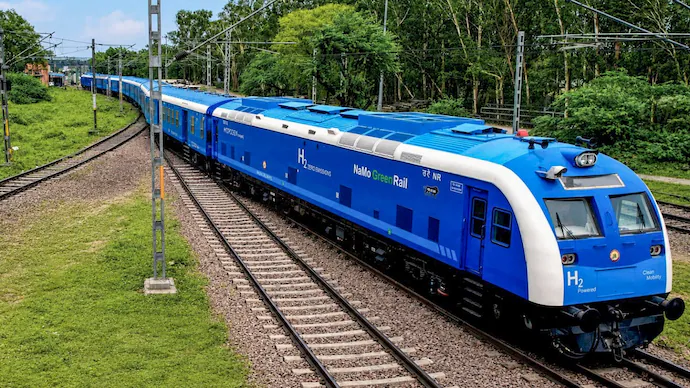
Ever since Modi government came to power in 2014, India has been transforned. The country has seen massive infrastructure projects in every field. The modernisation of the Indian Railways has been a major success story, and the latest one is the arrival of Hydrogen train.
PM Modi inaugurated the train which will run from Jind to Sonipat in Haryana. The pilot project for the Hydrogen train is this 79-KM long stretch.
India, which was once known for slow trains, ageing infrastructure and dependence on diesel locomotives, is now witnessing rapid electrification, indigenous technology development, modern stations, improved safety and the introduction of futuristic projects such as hydrogen-powered trains. The government’s focus has been on making the railways faster, cleaner, safer and more efficient while reducing its carbon footprint.
One of the biggest achievements has been the rapid electrification of railway tracks. Before 2014, electrification progressed at a relatively slow pace. Over the past decade, however, the pace has accelerated dramatically, with thousands of route kilometres being electrified every year. Today, nearly the entire Broad Gauge railway network has been electrified, making India one of the world’s largest fully electrified rail systems. Electrification has significantly reduced dependence on imported diesel, lowered operating costs and improved energy efficiency. Electric locomotives are not only faster but also more environmentally friendly, helping Indian Railways move closer to its target of becoming a net-zero carbon emitter by 2030.
The next milestone is the introduction of hydrogen-powered trains. India’s first hydrogen train is set to be flagged off from Jind in Haryana, becoming the country’s first step towards adopting green hydrogen for rail transport. Unlike diesel locomotives, hydrogen trains generate electricity through fuel cells, with water vapour and heat being the only by-products. This eliminates harmful emissions while reducing noise pollution. These trains are particularly suitable for routes where electrification is difficult or expensive, offering a clean alternative without compromising operational efficiency.
Modernisation has also been visible in passenger services. The launch of Vande Bharat Express trains has transformed intercity travel with higher speeds, improved comfort, automatic doors, advanced safety features and world-class interiors. Designed and manufactured in India, these semi-high-speed trains showcase the country’s growing capabilities in railway engineering. Their success has paved the way for sleeper variants and future high-speed rail projects.
Safety has been another major area of focus. The installation of the indigenous Kavach automatic train protection system aims to prevent collisions by automatically applying brakes when necessary. The elimination of thousands of unmanned level crossings, replacement of old tracks, stronger bridges and deployment of modern signalling systems have also contributed to improved railway safety.
Infrastructure development has expanded beyond trains. Dedicated Freight Corridors are improving the movement of goods by separating freight traffic from passenger trains, reducing congestion and increasing average speeds. Redevelopment of major railway stations under the Amrit Bharat Station Scheme is providing passengers with airport-like facilities, better accessibility and modern amenities.
Digital transformation has further improved passenger convenience through online ticketing, real-time train tracking, digital payments and better customer services. Freight operations have also become more efficient with technology-driven logistics management.
Together, rapid electrification, hydrogen-powered trains, indigenous manufacturing, better safety systems and large-scale infrastructure investments reflect a comprehensive effort to modernise Indian Railways. More than just upgrading trains, these initiatives are reshaping one of the world’s largest railway networks into a cleaner, faster and technologically advanced transport system that supports India’s economic growth while promoting sustainable mobility for the future.

